

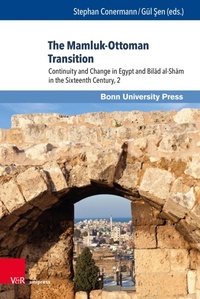
The Mamluk-Ottoman Transition
Continuity and Change in Egypt and Bilad al-Sham in the Sixteenth Century, 2
1st Edition
Published on 11. July 2022
502 pages
978-3-8470-1152-1 (ISBN)
Description

While the Ottoman conquest of the Mamluk realm in 1516-17 doubtlessly changed the balance of political power in Egypt and Greater Syria, the changes must be seen as a wide-ranging transition process. The present collection of essays provides several case studies on the changing situation during the fifteenth and sixteenth centuries and explains how the reconfiguration of political power affected both Egypt and Greater Syria. With reference to the first volume (2017), this second volume continues the debate on key issues of the transition period with contributions by scholars from both Mamluk and Ottoman studies. By combining these perspectives, the authors provide a more comprehensive and nuanced picture of the process of transformation from Mamluk to Ottoman rule.
Prof. Dr. Stephan Conermann lehrt Islamwissenschaft an der Universität Bonn und ist seit 2010 Sprecher der Kollegforschergruppe 1262 »Geschichte und Gesellschaft der Mamlukenzeit«.
Prof. Dr. Stephan Conermann lehrt Islamwissenschaft an der Universität Bonn und ist seit 2010 Sprecher der Kollegforschergruppe 1262 »Geschichte und Gesellschaft der Mamlukenzeit«.
More details
Other editions
Additional editions
Stephan Conermann | Gül Sen
The Mamluk-Ottoman Transition
Continuity and Change in Egypt and Bilad al-Sham in the Sixteenth Century, 2
Book
07/2022
1st Edition
Brill Deutschland
€69.00
Shipment within 7-9 days
Persons
Prof. Dr. Stephan Conermann lehrt Islamwissenschaft an der Universität Bonn und ist seit 2010 Sprecher der Kollegforschergruppe 1262 »Geschichte und Gesellschaft der Mamlukenzeit«.
Content
- Intro
- Title Page
- Copyright
- Table of Contents
- Body
- List of Illustrations
- Linda T. Darling
- Albrecht Fuess
- Toru Miura
- Bethany J. Walker
- Wakako Kumakura
- Gül Sen
- Abbreviations
- Stephan Conermann / Gül Sen: Preface
- Miri Shefer-Mossensohn: Obituary for Michael Winter (1934-2020)
- Introduction
- Linda T. Darling: From Border Province to Imperial Hub: The Geopolitical Transition of Syria from Mamluk to Ottoman Rule
- Re-Orienting the Eastern Mediterranean
- North-South Reorientation and the Opening of Borders
- Commercial Expansion and the Caravan Trade
- Syria and the Empire
- Conclusion
- Bibliography
- Sources
- Studies
- Political Culture
- Nasser Rabbat: The Paradox of Being Mamluk
- The Mamluk System that the Mamluks Established
- Mamluk Historiography and the Notion of Mamluk
- Ibn Khaldun on the Mamluks
- Al-Maqrizi on the Mamluks
- Conclusion
- Bibliography
- Sources
- Studies
- Jane Hathaway: The Kul Problem in Early Ottoman Egypt: Ottoman Reorganization Gone Awry
- Selim I and the Mamluks of Egypt
- Early Rebellions
- The 1525 Kanunname-i Mısır and the Replacement of Mamluks with Kuls
- The 1609 Rebellion and the "Breaking" of Egypt's Kullar
- Anti-kul Sentiment in the Ottoman Palace
- Caucasian Mamluks in Egypt
- Conclusion
- Bibliography
- Sources
- Studies
- Military
- Albrecht Fuess: Why Domenico Had to Die and Black Slaves Wore Red Uniforms: Military Technology and Its Decisive Role in the 1517 Ottoman Conquest of Egypt
- Firearms in the Ottoman Army Prior to the 1480s
- The Firearms of the Mamluk Army Prior to the 1480s
- The Ottoman-Mamluk War (1485-91)
- Military Reforms under Sultan al-Na?ir Mu?ammad II (r. 1496-98) and Internal Mamluk Turmoils until 1501
- The Ottoman Military Situation, 1491-1510
- The Mamluk Military under Sultan Qan?uh al-Ghawri (r. 1501-16)
- The Decisive Ottoman Advance in 1514-17
- Conclusion
- Bibliography
- Sources
- Studies
- Charles Wilkins: Ottoman Elite Recruitment and the Case of Janbulad Bek b. Qasim (d. ca. 1575)
- The Kurds of Northern Syria and Ottoman Post-Conquest Governance
- The Redemption of Janbulad b. Qasim
- The Statecraft of Janbulad Bek: Substance and Style
- Household Formation, Resource Management, and Military Command
- Conclusion
- Bibliography
- Sources
- Studies
- Violence
- Carl F. Petry: Violence as Tactic: Rioting by Mamluk Soldiers in the Late Circassian Period
- Rioting and Pillage
- Strong-Arm Tactics
- The Context of Urban Riots
- Riots by Chattel Slaves
- Sanctions for Rioting: between Punishment and Expediency
- Punishing Homicide
- Conclusion
- Bibliography
- Sources
- Studies
- Timothy J. Fitzgerald: Shedding Blood Justly: Perceptions of Violence in Early Ottoman Syria
- Aleppo's "Men of the Sword"
- "Abominations" in Hamah
- Conclusion
- Bibliography
- Sources
- Studies
- Finances
- Yehoshua Frenkel: The Waqf System During the Last Decades of Mamluk Rule
- Sources and Documentation
- Beduinization and the Declien of Agricultural Revenues
- Modification of Land Tenure (Iq?a?)
- Gift Economy: The Role of Pious Charities
- Mamluk Endowments: The Proliferation of Awqaf
- Conclusion
- Bibliography
- Sources
- Studies
- Wakako Kumakura: The Tax Survey Record of the First Year of Ottoman Rule in Egypt
- Ta'rikh al-Fayyum and Variants of Its Manuscript
- The Date and Purpose of the Compilation of MS. Ayasofya 2960
- Origin of the Ottoman Tax Survey Record
- Actors in the Survey
- Recorded Villages
- Contents of the Records of Each Village
- Basic Format and Items
- Notes on Cultivation and Irrigation
- Conclusion
- Bibliography
- Sources
- Studies
- Provincial Administration
- Reuven Amitai: Late Mamluk Gaza: Aspects of Economy, Security and Administration on the Eve of Ottoman Rule
- Economy
- Security and Stability: Changing relations with the Bedouins?
- Administration of Gaza and Its Region
- Conclusion
- Bibliography
- Sources
- Studies
- Bethany J. Walker: The Changing Face of Agricultural 'Estates' in Fifteenth and Sixteenth-Century Palestine: the Commercialization of Khirbet Beit Mazmil
- What was the Built Environment of the Mamluk Iq?a??
- The Mamluk Estate
- The "Outbuildings" of the Southern Site
- The Residential Complex of the Northern Site-the North Building
- The Residential Complex of the Northern Site-the South Building
- The Residential Complex of the Northern Site-the Water Systems
- The Early Ottoman Farmstead and Commercialization of Agriculture
- Beit Mazmil's Farmland
- The Late Life of the Farmstead: the Making of the E?zbeh
- Conclusion
- Bibliography
- Sources
- Studies
- Gül Sen: The Political Administration of the Districts of Greater Syria in the Sixteenth Century
- The Administrative Geography of Mamluk Syria
- The Reorganization of Former Mamluk Territory
- The ?anunnames and the Mü?imme Registers
- The Administration of Districts
- How Did the Communication System Work?
- Offices, Positions, and Mobility in the Administration
- Law, Order, and Rogue Officials
- Conclusion
- Bibliography
- Sources
- Studies
- Intellectual Changes
- Anna Kollatz: Intellectual Changes Triggered by Transition? The Case of Ibn Iyas and Ibn ?ulun
- The Social Contexts
- The Historiographical Narratives Compared
- Facing the Ottoman Conquest: The Perspective of Ibn Iyas
- Conclusion
- Bibliography
- Sources
- Studies
- Christian Mauder: Ottomanization before the Conquest? Mamluk-Ottoman Religious and Cultural Entanglements in the Courtly Salons of Qani?awh al-Ghawri and Post-conquest Gatherings
- Historical Background and Sources
- Mamluk-Ottoman Religious and Cultural Entanglements before the Conquest
- Islamic Law and Theology
- Religious and Epic Literature
- Sufism
- Islamic Political Thought
- Post-Conquest majalis and the Memory of al-Ghawri's Salons
- A Mamluk Prince in Ottoman Courtly mecalis
- Remembering Mamluk majalis in Ottoman Literature
- Post-Conquest Encounters in Non-Courtly majalis in the Former Mamluk Lands
- Conclusion
- Bibliography
- Sources
- Studies
- Toru Miura: Socio-Political Changes among the ?Ulama? in Syria and Egypt in the Sixteenth Century
- Professionalization and Institutionalization
- The Life of the ?Ulama?
- A Comparative Perspective
- The Dilemma between Knowledge and Social Practices
- Socio-Political Changes from the End of the Mamluk Period to Ottoman Rule
- The Career and Activities of the Sixteenth-Century ?Ulama?
- An Ottoman Hierarchy?
- Conclusion
- Bibliography
- Sources
- Studies
- Adam Sabra: Sufism and the Practice of Politics in Early Ottoman Egypt
- Sufis as Power Brokers in an Era of Transition
- Waqf and Patronage
- ?Abd al-Wahhab al-Sha?rani: A Politically Active Sufi in the Age of Sulayman
- Conclusion
- Bibliography
- Sources
- Studies
- Notes on Editors and Contributers
- Editors
- Contributers
- Index
- Leere Seite
