

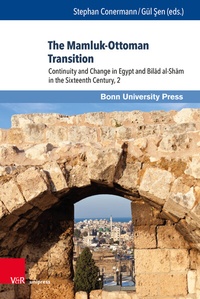
The Mamluk-Ottoman Transition
Continuity and Change in Egypt and Bilad al-Sham in the Sixteenth Century, 2
1st Edition
Published on 11. July 2022
Book
Hardback
502 pages
978-3-8471-1152-8 (ISBN)
Description
While the Ottoman conquest of the Mamluk realm in 1516-17 doubtlessly changed the balance of political power in Egypt and Greater Syria, the changes must be seen as a wide-ranging transition process. The present collection of essays provides several case studies on the changing situation during the fifteenth and sixteenth centuries and explains how the reconfiguration of political power affected both Egypt and Greater Syria. With reference to the first volume (2017), this second volume continues the debate on key issues of the transition period with contributions by scholars from both Mamluk and Ottoman studies. By combining these perspectives, the authors provide a more comprehensive and nuanced picture of the process of transformation from Mamluk to Ottoman rule.
More details
Other editions
Additional editions
Stephan Conermann | Gül Sen
The Mamluk-Ottoman Transition
Continuity and Change in Egypt and Bilad al-Sham in the Sixteenth Century, 2
E-Book
07/2022
1st Edition
V&R unipress
€69.00
Available for download
Persons
Editor
Stephan Conermann, PhD, is the Speaker of the Bonn Center for Dependency and Slavery Studies, and the Dean of the Faculty of Arts at the University of Bonn. His research interests include slaveries, narrative strategies in historiographic texts, transition periods, reconciliation processes, global history, and rule and power. His work is focused on the Mamluk and Delhi Sultanates, the Mughal and Ottoman Empires, and the Crossroads Area "Transottomanica."
ISNI:
ISNI:
PD Dr. Gül Sen habilitierte sich an der Universität Bonn und erhielt Venia Legendi für das Fach Islamwissenschaft. Derzeit ist sie als Vertretungsprofessorin für Islamwissenschaft an der Universität Heidelberg tätig.
Contributions
PD Dr. Gül Sen habilitierte sich an der Universität Bonn und erhielt Venia Legendi für das Fach Islamwissenschaft. Derzeit ist sie als Vertretungsprofessorin für Islamwissenschaft an der Universität Heidelberg tätig.
Dr Anna Kollatz is professor for Islamic Studies (Arabic), University of Heidelberg, who focuses on Islam in the Mediterranean and in South Asia.
Stephan Conermann, PhD, is the Speaker of the Bonn Center for Dependency and Slavery Studies, and the Dean of the Faculty of Arts at the University of Bonn. His research interests include slaveries, narrative strategies in historiographic texts, transition periods, reconciliation processes, global history, and rule and power. His work is focused on the Mamluk and Delhi Sultanates, the Mughal and Ottoman Empires, and the Crossroads Area "Transottomanica."
ISNI:
ISNI:
Yehoshua Frenkel is Professor of Middle Eastern History at the University of Haifa. His research interests embrace popular culture, Islamic etiquette, communal practices, social history, and legal discourse in Middle and Late Caliphate Egypt and Syria (1055-1517).
Prof Dr Bethany J. Walker is Research Professor of Mamluk Studies at the University of Bonn and Director of the Research Unit of Islamic Archaeology. As a historically-trained archaeologist, she directs several field projects in Jordan and Israel.
Prof. Dr. Albrecht Fuess lehrt seit 2010 Islamwissenschaft am Centrum für Nah- und Mittelost-Studien der Universität Marburg.
Prof Dr Reuven Amitai teaches Medieval Middle Eastern History at the Hebrew University of Jerusalem, Israel.