

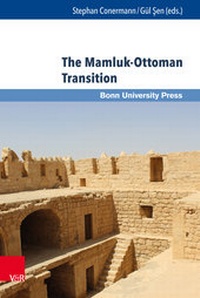
The Mamluk-Ottoman Transition
Continuity and Change in Egypt and Bilad al-Sham in the Sixteenth Century
1st Edition
Published on 7. November 2016
378 pages
978-3-8470-0637-4 (ISBN)
Description

The essays discuss continuity and change in Bilad al Sham (Greater Syria) during the sixteenth century, examining to what extent Egypt and Greater Syria were affected by the transition from Mamluk to Ottoman rule. This is explored in a variety of areas: diplomatic relations, histories and historiography, fiscal and agricultural administration, symbolic orders, urban developments, local perspectives and material culture. In order to rethink the sixteenth century from a transitional perspective and thus overcome the conventional dynasty-centered fields of research Mamlukists and Ottomanists have been brought together, shedding light on the remarkable sixteenth century, so decisive for the formation of early modern Muslim empires.
More details
Other editions
Additional editions
Stephan Conermann | Gül Sen
The Mamluk-Ottoman Transition
Continuity and Change in Egypt and Bilad al-Sham in the Sixteenth Century
Book
11/2016
1st Edition
Brill Deutschland
€75.00
Shipment within 7-9 days
Persons
Editor
Prof Dr Stephan Conermann teaches the History of the Islamicate World at the Institute of Oriental and Asian Studies, University of Bonn.
Dr. Gül Sen ist wissenschaftliche Mitarbeiterin am Institut für Orient- und Asienwissenschaften der Universität Bonn.
Contributions
Dr. Torsten Wollina arbeitet seit 2014 am Orient Institut Beirut, wo er sich mit der mamlukischen und osmanischen Historiographie beschäftigt und die Herausgabe der Schriftenreihe Beiruter Texte und Studien" (BTS) organisiert. "
Prof Dr Stephan Conermann teaches the History of the Islamicate World at the Institute of Oriental and Asian Studies, University of Bonn.
Dr. Gül Sen ist wissenschaftliche Mitarbeiterin am Institut für Orient- und Asienwissenschaften der Universität Bonn.
Consultant editor
Prof. Dr. Uwe Baumann lehrt Anglistik/Amerikanistik: Literatur- und Kulturwissenschaft an der Universität Bonn.
Dr. Thomas Becker ist Leiter des Archivs der Universität Bonn und Lehrbeauftragter am Institut für Geschichtswissenschaft, Abteilung für rheinische Landesgeschichte.
Content
- Intro
- Title Page
- Copyright
- Table of Contents
- Body
- Notes from the Editors
- List of Illustrations
- Abbreviations
- Stephan Conermann and Gül Sen: Introduction: A Transitional Point of View
- Michael Winter: Egypt and Syria in the Sixteenth Century
- The Ottoman Occupation
- Ottoman Measures in Cairo
- The Principles of Ottoman Rule in Egypt and the Army
- Mamluks and Beys in the Sixteenth Century
- Religious and Urban Aspects of Ottoman Rule in Egypt and Syria
- Ibrahim Pasha and the Qanun-name-i Mı?ır
- Religion and Ethnicity in Early Ottoman Egypt
- Conclusion
- Bibliography
- Egypt
- Paulina B. Lewicka: Challenges of Daily Life in Early-Ottoman Cairo: a Learned Sufi's Perspective. Preliminary Remarks on al-Munawi's Memorandum on Decent Behavior
- Al-Munawi and his Mamluk-Ottoman environment
- Al-Munawi's Memorandum, or Tadhkarat Uli al-Albab bi-Ma'rifat al-Adab
- Memorandum in its socio-cultural context
- Conclusions
- Bibliography
- Wakako Kumakura: The Early Ottoman Rural Government System and Its Development in Terms of Water Administration
- Sources
- Topography and Position of Fayyum Province
- The System for Maintaining Irrigation Facilities
- The Change in Record Management
- Conclusion
- Bibliography
- Claudia Römer: An Attempt at Reconstructing the Ottoman Correspondence during Grand Vizier Ibrahim Pasa's 1525 Mission to Egypt
- The sources
- Decision making far away from the Porte
- Quotations from firmans?
- Bostan as a major source
- Conclusion
- Bibliography
- Michael Winter: The Conquest of Syria and Egypt by Sultan Selim I, According to Evliyâ Çelebi
- Selim's Early Career
- "Selim the First Turns his Brothers and their Children into Shahids (Martyrs)"
- Selim Starts his Rule as the Sultan
- Selim's War against Shah Isma?il
- The Road to Marj Dabiq
- The First Defeat of al-Ghawri by Selim
- The Grave of Ibn al-?Arabi in Damascus
- The Ottoman Conquest of the Cairo Citadel
- Qan?awh al-Ghawri's Death
- ?umanbay's Death: Evliyâ Çelebi's Version
- Sultan Selim's Voyage to Dimya?, Rashid and Alexandria
- Selim Introduces his Laws for Egypt
- Conclusion
- Bibliography
- Syria
- Linda T. Darling: Investigating the Fiscal Administration of the Arab Provinces after the Ottoman Conquest of 1516
- Financial Malfeasance and Its Documentary Traces
- Revenue Collection in Syria: Issues and Records
- Human Resources: Tracing the Military
- Provincial Administration and Its Traces
- Conclusion
- Bibliography
- Alev Masarwa: Performing the Occasion: The Chronograms of Mamayya ar-Rumi (930-985 or 987/1534-1577 or 1579)
- Chronograms and the Value of Letters
- Language of Poetics and the Language of Numerals
- Mamayya ar-Rumi
- Mamayya's Poetical Works
- The Compositional Specifics of Mamayya's Diwan
- Chronograms for the Sultans
- Chronograms for Pious Buildings
- Capture of Cyprus
- Conclusion
- Appendix
- Conquest of Cyprus
- 1. Ode (meter: ragaz): ????? ?? ????? ??? ?????
- 2. Ode (meter: ramal): ???? ????????? ??????
- Bibliography
- Sources
- Studies
- Toru Miura: Transition of the ?Ulama? Families in Sixteenth Century Damascus
- Changes in Urban Society at the End of the Mamluk Period
- The Emergence of Jama?as and the Change of Administration
- The Furfur Family: Wali al-Din Mu?ammad
- Waqf Properties of the Furfur Family
- Wali al-Din Mu?ammad's descendants
- The Mufli? Family, a ?anbali Family
- The Branches of the Qudama Family
- Conclusion: Continuity and Fluctuation
- Bibliography
- Torsten Wollina: Sultan Selim in Damascus: The Ottoman Appropriation of a Mamluk Metropolis (922-924/1516-1518)
- The Sources
- The Ottomans Arrive
- Ottoman Dress
- Appropriating a Muslim City
- Architectural Policies
- Selims Mosque
- Sites of Sultanic Charity
- Conclusion
- Bibliography
- Sources
- Studies
- Mamluks-Ottomans
- Timothy J. Fitzgerald: Rituals of Possession, Methods of Control, and the Monopoly of Violence: The Ottoman Conquest of Aleppo in Comparative Perspective
- Early Ottoman Aleppo: Subdued?
- Violence and Unrest, and Their Persistence
- A Balanced and Comparative Perspective
- Bibliography
- Sources
- Studies
- Yehoshua Frenkel: The Ottomans and the Mamluks through the Eyes of Arab Travelers (in 16th-17th Centuries)
- Continuous History
- Common Interests and Court Societies
- Changes
- Conclusion
- Bibliography
- Sources
- Studies
- Cihan Yüksel Muslu: "Nomadic" Borders of Ottoman Provinces during the Mamluk-Ottoman Imperial Transition
- Geographical Background
- First Experiments of the Transition: Rise of Sehsüvaroglu ?Ali Bey
- Sah Veli's Uprising and Demise of Sehsüvaroglu ?Ali Bey
- "Nomadic" Borders of the New Ottoman Province?(s): Surveys from 1522-1524 and 1527-1530
- Historiography, Surveys, and Conclusions
- Bibliography
- Sources
- Studies
- Gül Sen: Ottoman Servant, Mamluk Rebel? Narrative Strategies in Sixteenth-Century Ottoman Historiography - the Example of Janbirdi al-Ghazali's Downfall
- Janbirdi al-Ghazali and his Rebellion
- Sixteenth-Century Ottoman Historiographic Sources on Janbirdi's Rebellion
- Celalzade and his Taba?at ül-Memalik
- Narrative Strategies in the Depiction of Janbirdi
- a) Janbirdi as the victim of his own limitations
- b) Janbirdi's act as an exemplum
- c) A matter not of person but of principle
- Conclusion
- Bibliography
- Sources
- Studies
- Bethany J. Walker: Early Ottoman/Late Islamic I/post-Mamluk: What are the Archaeological Traces of the 16th Century in Syria?"
- How to Define the 16th Century
- Archaeological Evidence of the 16th Century
- Material Culture
- Ceramics
- Vernacular architecture
- Settlement and land use
- Conclusion
- Bibliography
- Sources
- Studies
- Notes on Contributors
- Index
