

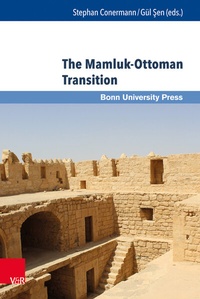
The Mamluk-Ottoman Transition
Continuity and Change in Egypt and Bilad al-Sham in the Sixteenth Century
1st Edition
Published on 7. November 2016
Book
Hardback
378 pages
978-3-8471-0637-1 (ISBN)
Description
The essays discuss continuity and change in Bilad al Sham (Greater Syria) during the sixteenth century, examining to what extent Egypt and Greater Syria were affected by the transition from Mamluk to Ottoman rule. This is explored in a variety of areas: diplomatic relations, histories and historiography, fiscal and agricultural administration, symbolic orders, urban developments, local perspectives and material culture. In order to rethink the sixteenth century from a transitional perspective and thus overcome the conventional dynasty-centered fields of research Mamlukists and Ottomanists have been brought together, shedding light on the remarkable sixteenth century, so decisive for the formation of early modern Muslim empires.
More details
Other editions
Additional editions
Stephan Conermann | Gül Sen
The Mamluk-Ottoman Transition
Continuity and Change in Egypt and Bilad al-Sham in the Sixteenth Century
E-Book
11/2016
1st Edition
V&R unipress
€75.00
Available for download
Persons
Editor
Stephan Conermann, PhD, is the Speaker of the Bonn Center for Dependency and Slavery Studies, and the Dean of the Faculty of Arts at the University of Bonn. His research interests include slaveries, narrative strategies in historiographic texts, transition periods, reconciliation processes, global history, and rule and power. His work is focused on the Mamluk and Delhi Sultanates, the Mughal and Ottoman Empires, and the Crossroads Area "Transottomanica."
ISNI:
ISNI:
PD Dr. Gül Sen habilitierte sich an der Universität Bonn und erhielt Venia Legendi für das Fach Islamwissenschaft. Derzeit ist sie als Vertretungsprofessorin für Islamwissenschaft an der Universität Heidelberg tätig.
Contributions
Prof Dr Bethany J. Walker is Research Professor of Mamluk Studies at the University of Bonn and Director of the Research Unit of Islamic Archaeology. As a historically-trained archaeologist, she directs several field projects in Jordan and Israel.
Dr. Torsten Wollina arbeitet seit 2014 am Orient Institut Beirut, wo er sich mit der mamlukischen und osmanischen Historiographie beschäftigt und die Herausgabe der Schriftenreihe Beiruter Texte und Studien" (BTS) organisiert. "
Toru Miura is Vice-President and Professor at the Ochanomizu University, and Research Fellow at the Toyo Bunko, Japan.
Yehoshua Frenkel is Professor of Middle Eastern History at the University of Haifa. His research interests embrace popular culture, Islamic etiquette, communal practices, social history, and legal discourse in Middle and Late Caliphate Egypt and Syria (1055-1517).
Stephan Conermann, PhD, is the Speaker of the Bonn Center for Dependency and Slavery Studies, and the Dean of the Faculty of Arts at the University of Bonn. His research interests include slaveries, narrative strategies in historiographic texts, transition periods, reconciliation processes, global history, and rule and power. His work is focused on the Mamluk and Delhi Sultanates, the Mughal and Ottoman Empires, and the Crossroads Area "Transottomanica."
ISNI:
ISNI:
PD Dr. Gül Sen habilitierte sich an der Universität Bonn und erhielt Venia Legendi für das Fach Islamwissenschaft. Derzeit ist sie als Vertretungsprofessorin für Islamwissenschaft an der Universität Heidelberg tätig.
Consultant editor
Prof. Dr. Uwe Baumann lehrt Anglistik: Literatur- und Kulturwissenschaft an der Universität Bonn.
ISNI:
ISNI:
Dr. Thomas Becker ist Leiter des Archivs der Universität Bonn und Lehrbeauftragter am Institut für Geschichtswissenschaft, Abteilung für rheinische Landesgeschichte.