

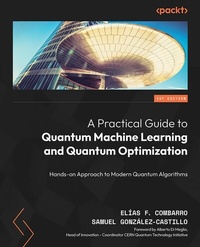
A Practical Guide to Quantum Machine Learning and Quantum Optimization
Hands-on Approach to Modern Quantum Algorithms
1st Edition
Published on 21. May 2024
680 pages
978-1-80461-830-1 (ISBN)
Description

No detailed description available for "A Practical Guide to Quantum Machine Learning and Quantum Optimization".
All prices
More details
Other editions
Additional editions
Elias F. Combarro | Samuel Gonzalez-Castillo
A Practical Guide to Quantum Machine Learning and Quantum Optimization
Hands-on Approach to Modern Quantum Algorithms
Book
03/2023
Packt Publishing
€117.90
Shipment within 3-4 weeks
Persons
Combarro Elías F. :
Elías F. Combarro holds degrees from the University of Oviedo (Spain) in both Mathematics (1997, award for second highest grades in the country) and Computer Science (2002, award for highest grades in the country). After some research stays at the Novosibirsk State University (Russia), he obtained a Ph.D. in Mathematics (Oviedo, 2001) with a dissertation on the properties of some computable predicates under the supervision of Prof. Andrey Morozov and Prof. Consuelo Martínez. Since 2009, Elías F. Combarro has been an associate professor at the Computer Science Department of the University of Oviedo. He has published more than 50 research papers in international journals on topics such as Computability Theory, Machine Learning, Fuzzy Measures and Computational Algebra. His current research focuses on the application Quantum Computing to algebraic, optimisation and machine learning problems. From July 2020 to January 2021, he was a Cooperation Associate at CERN openlab. Currently, he is the Spain representative in the Advisory Board of CERN Quantum Technology Initiative, a member of the Advisory Board of SheQuantum and one of the founders of the QSpain, a quantum computing think tank based in Spain.González-Castillo Samuel :
Samuel González-Castillo holds degrees from the University of Oviedo (Spain) in both Mathematics and Physics (2021). He is currently a mathematics research student at the National University of Ireland, Maynooth, where he works as a graduate teaching assistant. He completed his physics bachelor thesis under the supervision of Prof. Elías F. Combarro and Prof. Ignacio F. Rúa (University of Oviedo), and Dr. Sofia Vallecorsa (CERN). In it, he worked alongside other researchers from ETH Zürich on the application of Quantum Machine Learning to classification problems in High Energy Physis. In 2021, he was a summer student at CERN developing a benchmarking framework for quantum simulators. He has contributed to several conferences on quantum computing.
Elías F. Combarro holds degrees from the University of Oviedo (Spain) in both Mathematics (1997, award for second highest grades in the country) and Computer Science (2002, award for highest grades in the country). After some research stays at the Novosibirsk State University (Russia), he obtained a Ph.D. in Mathematics (Oviedo, 2001) with a dissertation on the properties of some computable predicates under the supervision of Prof. Andrey Morozov and Prof. Consuelo Martínez. Since 2009, Elías F. Combarro has been an associate professor at the Computer Science Department of the University of Oviedo. He has published more than 50 research papers in international journals on topics such as Computability Theory, Machine Learning, Fuzzy Measures and Computational Algebra. His current research focuses on the application Quantum Computing to algebraic, optimisation and machine learning problems. From July 2020 to January 2021, he was a Cooperation Associate at CERN openlab. Currently, he is the Spain representative in the Advisory Board of CERN Quantum Technology Initiative, a member of the Advisory Board of SheQuantum and one of the founders of the QSpain, a quantum computing think tank based in Spain.González-Castillo Samuel :
Samuel González-Castillo holds degrees from the University of Oviedo (Spain) in both Mathematics and Physics (2021). He is currently a mathematics research student at the National University of Ireland, Maynooth, where he works as a graduate teaching assistant. He completed his physics bachelor thesis under the supervision of Prof. Elías F. Combarro and Prof. Ignacio F. Rúa (University of Oviedo), and Dr. Sofia Vallecorsa (CERN). In it, he worked alongside other researchers from ETH Zürich on the application of Quantum Machine Learning to classification problems in High Energy Physis. In 2021, he was a summer student at CERN developing a benchmarking framework for quantum simulators. He has contributed to several conferences on quantum computing.
Content
Table of Contents - Foundations of Quantum Computing
- The Tools of the Trade in Quantum Computing
- Working with Quadratic Unconstrained Binary Optimization Problems
- Adiabatic Quantum Computing and Quantum Annealing
- QAOA: Quantum Approximate Optimization Algorithm
- GAS: Grover Adaptative Search
- VQE: Variational Quantum Solver
- What is Quantum Machine Learning?
- Quantum Support Vector Machines
- Quantum Neural Networks
- The Best of Both Worlds: Hybrid Architectures
- Quantum Generative Adversarial Networks
- Afterword: The Future of Quantum Computing
- Complex Numbers
- Basic Linear Algebra
- Computational Complexity
- Installing the Tools
- Production Notes
- The Tools of the Trade in Quantum Computing
- Working with Quadratic Unconstrained Binary Optimization Problems
- Adiabatic Quantum Computing and Quantum Annealing
- QAOA: Quantum Approximate Optimization Algorithm
- GAS: Grover Adaptative Search
- VQE: Variational Quantum Solver
- What is Quantum Machine Learning?
- Quantum Support Vector Machines
- Quantum Neural Networks
- The Best of Both Worlds: Hybrid Architectures
- Quantum Generative Adversarial Networks
- Afterword: The Future of Quantum Computing
- Complex Numbers
- Basic Linear Algebra
- Computational Complexity
- Installing the Tools
- Production Notes
