

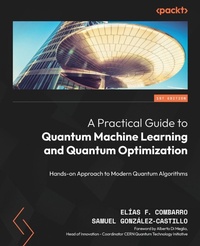
A Practical Guide to Quantum Machine Learning and Quantum Optimization
Hands-on Approach to Modern Quantum Algorithms
Published on 31. March 2023
Book
Paperback/Softback
680 pages
978-1-80461-383-2 (ISBN)
Description
Work with fully explained algorithms and ready-to-use examples that can be run on quantum simulators and actual quantum computers with this comprehensive guideKey Features
Get a solid grasp of the principles behind quantum algorithms and optimization with minimal mathematical prerequisites
Learn the process of implementing the algorithms on simulators and actual quantum computers
Solve real-world problems using practical examples of methods
Book DescriptionThis book provides deep coverage of modern quantum algorithms that can be used to solve real-world problems. You'll be introduced to quantum computing using a hands-on approach with minimal prerequisites.
You'll discover many algorithms, tools, and methods to model optimization problems with the QUBO and Ising formalisms, and you will find out how to solve optimization problems with quantum annealing, QAOA, Grover Adaptive Search (GAS), and VQE. This book also shows you how to train quantum machine learning models, such as quantum support vector machines, quantum neural networks, and quantum generative adversarial networks. The book takes a straightforward path to help you learn about quantum algorithms, illustrating them with code that's ready to be run on quantum simulators and actual quantum computers. You'll also learn how to utilize programming frameworks such as IBM's Qiskit, Xanadu's PennyLane, and D-Wave's Leap.
Through reading this book, you will not only build a solid foundation of the fundamentals of quantum computing, but you will also become familiar with a wide variety of modern quantum algorithms. Moreover, this book will give you the programming skills that will enable you to start applying quantum methods to solve practical problems right away.What you will learn
Review the basics of quantum computing
Gain a solid understanding of modern quantum algorithms
Understand how to formulate optimization problems with QUBO
Solve optimization problems with quantum annealing, QAOA, GAS, and VQE
Find out how to create quantum machine learning models
Explore how quantum support vector machines and quantum neural networks work using Qiskit and PennyLane
Discover how to implement hybrid architectures using Qiskit and PennyLane and its PyTorch interface
Who this book is forThis book is for professionals from a wide variety of backgrounds, including computer scientists and programmers, engineers, physicists, chemists, and mathematicians. Basic knowledge of linear algebra and some programming skills (for instance, in Python) are assumed, although all mathematical prerequisites will be covered in the appendices.
Get a solid grasp of the principles behind quantum algorithms and optimization with minimal mathematical prerequisites
Learn the process of implementing the algorithms on simulators and actual quantum computers
Solve real-world problems using practical examples of methods
Book DescriptionThis book provides deep coverage of modern quantum algorithms that can be used to solve real-world problems. You'll be introduced to quantum computing using a hands-on approach with minimal prerequisites.
You'll discover many algorithms, tools, and methods to model optimization problems with the QUBO and Ising formalisms, and you will find out how to solve optimization problems with quantum annealing, QAOA, Grover Adaptive Search (GAS), and VQE. This book also shows you how to train quantum machine learning models, such as quantum support vector machines, quantum neural networks, and quantum generative adversarial networks. The book takes a straightforward path to help you learn about quantum algorithms, illustrating them with code that's ready to be run on quantum simulators and actual quantum computers. You'll also learn how to utilize programming frameworks such as IBM's Qiskit, Xanadu's PennyLane, and D-Wave's Leap.
Through reading this book, you will not only build a solid foundation of the fundamentals of quantum computing, but you will also become familiar with a wide variety of modern quantum algorithms. Moreover, this book will give you the programming skills that will enable you to start applying quantum methods to solve practical problems right away.What you will learn
Review the basics of quantum computing
Gain a solid understanding of modern quantum algorithms
Understand how to formulate optimization problems with QUBO
Solve optimization problems with quantum annealing, QAOA, GAS, and VQE
Find out how to create quantum machine learning models
Explore how quantum support vector machines and quantum neural networks work using Qiskit and PennyLane
Discover how to implement hybrid architectures using Qiskit and PennyLane and its PyTorch interface
Who this book is forThis book is for professionals from a wide variety of backgrounds, including computer scientists and programmers, engineers, physicists, chemists, and mathematicians. Basic knowledge of linear algebra and some programming skills (for instance, in Python) are assumed, although all mathematical prerequisites will be covered in the appendices.
More details
Language
English
Place of publication
Birmingham
United Kingdom
Target group
Professional and scholarly
Dimensions
Height: 235 mm
Width: 191 mm
Thickness: 37 mm
Weight
1248 gr
ISBN-13
978-1-80461-383-2 (9781804613832)
Copyright in bibliographic data and cover images is held by Nielsen Book Services Limited or by the publishers or by their respective licensors: all rights reserved.
Schweitzer Classification
Other editions
Additional editions
Elías F. Combarro | Samuel González-Castillo
A Practical Guide to Quantum Machine Learning and Quantum Optimization
Hands-on Approach to Modern Quantum Algorithms
E-Book
05/2024
1st Edition
Packt Publishing Limited
from
€38.39
Available for download
Persons
Elias F. Combarro holds degrees from the University of Oviedo (Spain) in both Mathematics (1997, award for second highest grades in the country) and Computer Science (2002, award for highest grades in the country). After some research stays at the Novosibirsk State University (Russia), he obtained a Ph.D. in Mathematics (Oviedo, 2001) with a dissertation on the properties of some computable predicates under the supervision of Prof. Andrey Morozov and Prof. Consuelo Martinez.
Since 2009, Elias F. Combarro has been an associate professor at the Computer Science Department of the University of Oviedo. He has published more than 50 research papers in international journals on topics such as Computability Theory, Machine Learning, Fuzzy Measures and Computational Algebra. His current research focuses on the application Quantum Computing to algebraic, optimisation and machine learning problems.
From July 2020 to January 2021, he was a Cooperation Associate at CERN openlab. Currently, he is the Spain representative in the Advisory Board of CERN Quantum Technology Initiative, a member of the Advisory Board of SheQuantum and one of the founders of the QSpain, a quantum computing think tank based in Spain. Samuel Gonzalez-Castillo holds degrees from the University of Oviedo (Spain) in both Mathematics and Physics (2021). He is currently a mathematics research student at the National University of Ireland, Maynooth, where he works as a graduate teaching assistant.
He completed his physics bachelor thesis under the supervision of Prof. Elias F. Combarro and Prof. Ignacio F. Rua (University of Oviedo), and Dr. Sofia Vallecorsa (CERN). In it, he worked alongside other researchers from ETH Zuerich on the application of Quantum Machine Learning to classification problems in High Energy Physis. In 2021, he was a summer student at CERN developing a benchmarking framework for quantum simulators. He has contributed to several conferences on quantum computing.
Since 2009, Elias F. Combarro has been an associate professor at the Computer Science Department of the University of Oviedo. He has published more than 50 research papers in international journals on topics such as Computability Theory, Machine Learning, Fuzzy Measures and Computational Algebra. His current research focuses on the application Quantum Computing to algebraic, optimisation and machine learning problems.
From July 2020 to January 2021, he was a Cooperation Associate at CERN openlab. Currently, he is the Spain representative in the Advisory Board of CERN Quantum Technology Initiative, a member of the Advisory Board of SheQuantum and one of the founders of the QSpain, a quantum computing think tank based in Spain. Samuel Gonzalez-Castillo holds degrees from the University of Oviedo (Spain) in both Mathematics and Physics (2021). He is currently a mathematics research student at the National University of Ireland, Maynooth, where he works as a graduate teaching assistant.
He completed his physics bachelor thesis under the supervision of Prof. Elias F. Combarro and Prof. Ignacio F. Rua (University of Oviedo), and Dr. Sofia Vallecorsa (CERN). In it, he worked alongside other researchers from ETH Zuerich on the application of Quantum Machine Learning to classification problems in High Energy Physis. In 2021, he was a summer student at CERN developing a benchmarking framework for quantum simulators. He has contributed to several conferences on quantum computing.
Content
Table of Contents
Foundations of Quantum Computing
The Tools of the Trade in Quantum Computing
Working with Quadratic Unconstrained Binary Optimization Problems
Adiabatic Quantum Computing and Quantum Annealing
QAOA: Quantum Approximate Optimization Algorithm
GAS: Grover Adaptative Search
VQE: Variational Quantum Solver
What is Quantum Machine Learning?
Quantum Support Vector Machines
Quantum Neural Networks
The Best of Both Worlds: Hybrid Architectures
Quantum Generative Adversarial Networks
Afterword: The Future of Quantum Computing
Complex Numbers
Basic Linear Algebra
Computational Complexity
Installing the Tools
Production Notes
Foundations of Quantum Computing
The Tools of the Trade in Quantum Computing
Working with Quadratic Unconstrained Binary Optimization Problems
Adiabatic Quantum Computing and Quantum Annealing
QAOA: Quantum Approximate Optimization Algorithm
GAS: Grover Adaptative Search
VQE: Variational Quantum Solver
What is Quantum Machine Learning?
Quantum Support Vector Machines
Quantum Neural Networks
The Best of Both Worlds: Hybrid Architectures
Quantum Generative Adversarial Networks
Afterword: The Future of Quantum Computing
Complex Numbers
Basic Linear Algebra
Computational Complexity
Installing the Tools
Production Notes