

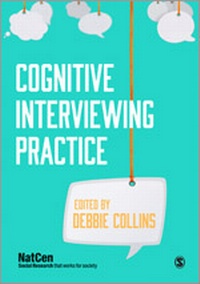
Cognitive Interviewing Practice
1st Edition
Published on 10. November 2014
288 pages
978-1-4739-0918-2 (ISBN)
Description

The use of the cognitive interviewing method for survey question testing has proliferated and evolved over the past 30 years. In more recent years the method has been applied to the evaluation of information letters and leaflets and to research consent forms. This book provides a practical handbook for implementing cognitive interviewing methods in the context of applied social policy research, based on the approach used by the authors at the NatCen Social Research (NatCen) where cognitive interviewing methods have been used for well over a decade.
The book provides a justification for the importance of question testing and evaluation and discusses the position of cognitive interviewing in relation to other questionnaire development and evaluation techniques. Throughout the book, the focus is on providing practical and hands-on guidance around elements such as sampling and recruitment, designing probes, interviewing skills, data management and analysis and how to interpret the findings and use them to improve survey questions and other documents. The book also covers cognitive interviewing in different survey modes, in cross national, cross cultural and multilingual settings and discusses some other potential uses of the method.
The book provides a justification for the importance of question testing and evaluation and discusses the position of cognitive interviewing in relation to other questionnaire development and evaluation techniques. Throughout the book, the focus is on providing practical and hands-on guidance around elements such as sampling and recruitment, designing probes, interviewing skills, data management and analysis and how to interpret the findings and use them to improve survey questions and other documents. The book also covers cognitive interviewing in different survey modes, in cross national, cross cultural and multilingual settings and discusses some other potential uses of the method.
Reviews / Votes
A goldmine of good advice for any researcher planning to use cognitive interviewing to test survey questions or other materials. The authors' vast experience shines through, as do common sense and clarity of thought. Highly recommended. -- Peter Lynn Full of practical real life examples and 'top tip' bullet points, the book reveals the wide remit in which cognitive interviewing can be used. -- Pamela Campanelli ...This is a highly valuable book for practitioners - whether new to the method or old hands. It equally serves those who need to have their questionnaires tested to understand the method and assess to what extent, how and when its application can be useful. -- Dorothee Behr, cross-cultural survey methodologist at GESIS - Leibniz Institute for the Social Sciences, Germany This book is necessary for all scientists who develop or translate questionnaires and use the methods of survey and interview. The book presents thoroughly the problems related to item generation, formulation of questions and decision-making regarding the final form of the questionnaire before the main study. It gives detailed guidelines how to conduct the pilot study and to use in the best way its findings for the goals of the main study. These topics are often underestimated in the process of practical work in the area of psychological measurements. Psychologists, as well as sociologists and all scientists who develop and use questionnaires in their work could profit from the recommendations given in this book. -- Stanislava Yordanova StoyanovaMore details
Language
English
Place of publication
London
United Kingdom
Target group
College/higher education
Professional and scholarly
ISBN-13
978-1-4739-0918-2 (9781473909182)
Copyright in bibliographic data and cover images is held by Nielsen Book Services Limited or by the publishers or by their respective licensors: all rights reserved.
Schweitzer Classification
Other editions
Additional editions
Debbie Collins
Cognitive Interviewing Practice
Book
11/2014
1st Edition
SAGE Publications Ltd
€224.33
Article exhausted; check different version
Person
Debbie Collins is Head of Questionnaire Development and Testing at NatCen Social Research. An experienced survey researcher, Debbie has specialised over the past decade in survey methodology, questionnaire development and testing. Debbie founded NatCen's Questionnaire Development and Testing Hub, with Michelle Gray in 2006 and has developed and tested survey questions and data collection tools for a wide range of clients. Debbie's research interests include novel uses of cognitive interviewing, effective combinations of pretesting methods, and the design of web and mixed mode questionnaires.
Content
Background and Context
Cognitive Interviewing: Origin, Purpose and Limitations
Other Pretesting Methods
How to Conduct a Cognitive Interiewing Project
Planning a Cognitive Interviewing Project
Sampling and Recruitment
Developing Interview Protocols
Conducting Cognitive Interviews
Data Management
Analysis and Interpretation
Application of Findings
Cognitive Interviewing in Practice
Survey Mode and its Implications for Cognitive Interviewing
Cross-national, Cross-cultural and Multilingual Cognitive Interviewing
Wider Applications of Cognitive Interviewing
Cognitive Interviewing: Origin, Purpose and Limitations
Other Pretesting Methods
How to Conduct a Cognitive Interiewing Project
Planning a Cognitive Interviewing Project
Sampling and Recruitment
Developing Interview Protocols
Conducting Cognitive Interviews
Data Management
Analysis and Interpretation
Application of Findings
Cognitive Interviewing in Practice
Survey Mode and its Implications for Cognitive Interviewing
Cross-national, Cross-cultural and Multilingual Cognitive Interviewing
Wider Applications of Cognitive Interviewing
