

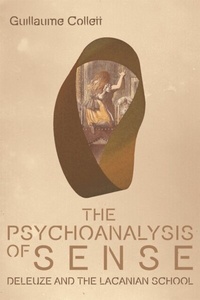
Psychoanalysis of Sense
Description

Guillaume Collett questions to what extent we can locate Deleuze within the Lacanian School during the late-1960s, prior to Guattari. In so doing, he offers a new, integrated reading of Deleuze's The Logic of Sense (1969) by understanding it as a 'psychoanalysis of sense', and gives a new interpretation of Deleuze's conception of philosophy itself.
The Psychoanalysis of Sense shows that Deleuze was not merely aware of the debates animating the Lacanian School during the 1960s: he sought to contribute to them. Emphasising his appropriation of the work of post-Lacanian Serge Leclaire, Collett explains how Deleuze constructed a more singular and immanent theory of the linguistic structure of the unconscious - granting the erogenous body a larger structuring role.
- The first book devoted to situating Deleuze's 1960s work on psychoanalysis within the context of the Lacanian School
- Shows how Deleuze drew on Lewis Carroll and Sacher-Masoch to immanentise the work of the Lacanian School
- Develops a new reading of The Logic of Sense by viewing it as a meta-philosophical precursor to What is Philosophy?
More details
Other editions
Additional editions
Content
- Intro
- THE PSYCHOANALYSIS OF SENSE
- Copyright
- Contents
- Acknowledgements
- Introduction
- 1 The Body of the Letter: From Name-of-the-Father to Re-père
- 2 Theatres of Terror and Cruelty: From Noise to the Voice
- 3 The Three Syntheses of the Body: From the Voice to Speech
- 4 Logic of the Phantasm: From Speech to the Verb
- 5 The Speculative Univocity of Being and Language: From the Verb to Univocity
- Bibliography
- Index
