

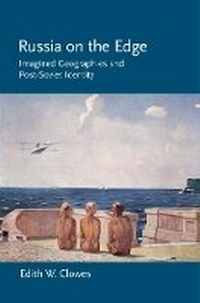
Russia on the Edge
Imagined Geographies and Post-Soviet Identity
Published on 15. April 2011
200 pages
978-0-8014-6114-9 (ISBN)
Description

Since the dissolution of the Soviet Union in 1991, Russians have confronted a major crisis of identity. Soviet ideology rested on a belief in historical progress, but the post-Soviet imagination has obsessed over territory. Indeed, geographical metaphors-whether axes of north vs. south or geopolitical images of center, periphery, and border-have become the signs of a different sense of self and the signposts of a new debate about Russian identity. In Russia on the Edge Edith W. Clowes argues that refurbished geographical metaphors and imagined geographies provide a useful perspective for examining post-Soviet debates about what it means to be Russian today.
Clowes lays out several sides of the debate. She takes as a backdrop the strong criticism of Soviet Moscow and its self-image as uncontested global hub by major contemporary writers, among them Tatyana Tolstaya and Viktor Pelevin. The most vocal, visible, and colorful rightist ideologue, Aleksandr Dugin, the founder of neo-Eurasianism, has articulated positions contested by such writers and thinkers as Mikhail Ryklin, Liudmila Ulitskaia, and Anna Politkovskaia, whose works call for a new civility in a genuinely pluralistic Russia. Dugin's extreme views and their many responses-in fiction, film, philosophy, and documentary journalism-form the body of this book.
In Russia on the Edge literary and cultural critics will find the keys to a vital post-Soviet writing culture. For intellectual historians, cultural geographers, and political scientists the book is a guide to the variety of post-Soviet efforts to envision new forms of social life, even as a reconstructed authoritarianism has taken hold. The book introduces nonspecialist readers to some of the most creative and provocative of present-day Russia's writers and public intellectuals.
Clowes lays out several sides of the debate. She takes as a backdrop the strong criticism of Soviet Moscow and its self-image as uncontested global hub by major contemporary writers, among them Tatyana Tolstaya and Viktor Pelevin. The most vocal, visible, and colorful rightist ideologue, Aleksandr Dugin, the founder of neo-Eurasianism, has articulated positions contested by such writers and thinkers as Mikhail Ryklin, Liudmila Ulitskaia, and Anna Politkovskaia, whose works call for a new civility in a genuinely pluralistic Russia. Dugin's extreme views and their many responses-in fiction, film, philosophy, and documentary journalism-form the body of this book.
In Russia on the Edge literary and cultural critics will find the keys to a vital post-Soviet writing culture. For intellectual historians, cultural geographers, and political scientists the book is a guide to the variety of post-Soviet efforts to envision new forms of social life, even as a reconstructed authoritarianism has taken hold. The book introduces nonspecialist readers to some of the most creative and provocative of present-day Russia's writers and public intellectuals.
More details
Language
English
Place of publication
Ithaca
United States
Product notice
Reflowable
ISBN-13
978-0-8014-6114-9 (9780801461149)
Copyright in bibliographic data and cover images is held by Nielsen Book Services Limited or by the publishers or by their respective licensors: all rights reserved.
Schweitzer Classification
Other editions
Additional editions
Book
04/2011
Cornell University Press
€38.44
Shipment within 10-20 days
Book
04/2011
Cornell University Press
€143.84
Shipment within 10-20 days
Person
Edith W. Clowes is the Brown-Forman Professor of Arts and Sciences in the Department of Slavic Languages & Literatures at the University of Virginia. Her previous books include Fiction's Overcoat: Russian Literary Culture and the Question of Philosophy, also from Cornell, Doctor Zhivago: A Critical Companion, The Revolution of Moral Consciousness: Nietzsche and Russian Literature, and Russian Experimental Fiction: Resisting Ideology after Utopia.
Content
Introduction: Is Russia a Center or a Periphery?
1. Deconstructing Imperial Moscow
2. Postmodernist Empire Meets Holy Rus': How Aleksandr Dugin Tried to Change the Eurasian Periphery into the Sacred Center of the World
3. Illusory Empire: Viktor Pelevin's Parody of Neo-Eurasianism
4. Russia's Deconstructionist Westernizer: Mikhail Ryklin's "Larger Space of Europe" Confronts Holy Rus'
5. The Periphery and Its Narratives: Liudmila Ulitskaia's Imagined South
6. Demonizing the Post-Soviet Other: The Chechens and the Muslim South
ConclusionIndex
1. Deconstructing Imperial Moscow
2. Postmodernist Empire Meets Holy Rus': How Aleksandr Dugin Tried to Change the Eurasian Periphery into the Sacred Center of the World
3. Illusory Empire: Viktor Pelevin's Parody of Neo-Eurasianism
4. Russia's Deconstructionist Westernizer: Mikhail Ryklin's "Larger Space of Europe" Confronts Holy Rus'
5. The Periphery and Its Narratives: Liudmila Ulitskaia's Imagined South
6. Demonizing the Post-Soviet Other: The Chechens and the Muslim South
ConclusionIndex
