

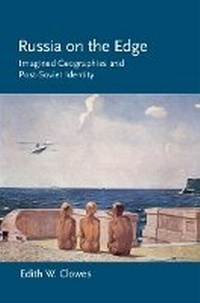
Russia on the Edge
Imagined Geographies and Post-Soviet Identity
Published on 15. April 2011
Book
Hardback
200 pages
978-0-8014-4856-0 (ISBN)
Description
Since the dissolution of the Soviet Union in 1991, Russians have confronted a major crisis of identity. Soviet ideology rested on a belief in historical progress, but the post-Soviet imagination has obsessed over territory. Indeed, geographical metaphors-whether axes of north vs. south or geopolitical images of center, periphery, and border-have become the signs of a different sense of self and the signposts of a new debate about Russian identity. In Russia on the Edge Edith W. Clowes argues that refurbished geographical metaphors and imagined geographies provide a useful perspective for examining post-Soviet debates about what it means to be Russian today.
Clowes lays out several sides of the debate. She takes as a backdrop the strong criticism of Soviet Moscow and its self-image as uncontested global hub by major contemporary writers, among them Tatyana Tolstaya and Viktor Pelevin. The most vocal, visible, and colorful rightist ideologue, Aleksandr Dugin, the founder of neo-Eurasianism, has articulated positions contested by such writers and thinkers as Mikhail Ryklin, Liudmila Ulitskaia, and Anna Politkovskaia, whose works call for a new civility in a genuinely pluralistic Russia. Dugin's extreme views and their many responses-in fiction, film, philosophy, and documentary journalism-form the body of this book.
In Russia on the Edge literary and cultural critics will find the keys to a vital post-Soviet writing culture. For intellectual historians, cultural geographers, and political scientists the book is a guide to the variety of post-Soviet efforts to envision new forms of social life, even as a reconstructed authoritarianism has taken hold. The book introduces nonspecialist readers to some of the most creative and provocative of present-day Russia's writers and public intellectuals.
Clowes lays out several sides of the debate. She takes as a backdrop the strong criticism of Soviet Moscow and its self-image as uncontested global hub by major contemporary writers, among them Tatyana Tolstaya and Viktor Pelevin. The most vocal, visible, and colorful rightist ideologue, Aleksandr Dugin, the founder of neo-Eurasianism, has articulated positions contested by such writers and thinkers as Mikhail Ryklin, Liudmila Ulitskaia, and Anna Politkovskaia, whose works call for a new civility in a genuinely pluralistic Russia. Dugin's extreme views and their many responses-in fiction, film, philosophy, and documentary journalism-form the body of this book.
In Russia on the Edge literary and cultural critics will find the keys to a vital post-Soviet writing culture. For intellectual historians, cultural geographers, and political scientists the book is a guide to the variety of post-Soviet efforts to envision new forms of social life, even as a reconstructed authoritarianism has taken hold. The book introduces nonspecialist readers to some of the most creative and provocative of present-day Russia's writers and public intellectuals.
Reviews / Votes
"Russia on the Edge is an exceptionally innovative and insightful contribution to the literature on nationalism, national self-images, and identity in Russia today. Arguing that conceptions of 'what Russia is' depend critically on notions about where the country is located, Edith W. Clowes makes a compelling case for the new importance of 'imagined geographies' as perceptual arenas for the construction and contestation of identity in Post-Soviet Russia." -- Mark Bassin, Soedertoern University "Clowes provides a provocative reassessment of the new Russia, positing a shift from a traditional temporal historical paradigm to a spatial one. With the fall of the multinational Soviet empire where power resided in Moscow, a more diffuse situation has developed with the rise of ethnic and national identities on the geographical perimeters. Geography has partially displaced history, to the great discomfort of the central ethnic Russian populace.... In this stimulating study, Clowes discusses liberal commentators Mikhail Ryklin and Anna Politkovskaia versus Aleksandr Dugin, an ultra-nationalist... and the more diverse attitudes of 'peripheralist' writers such as Victor Pelevin and Ludmilla Ulitskaia." "In Russia on the Edge, Edith Clowes investigates how and why borders are so central in today's Russia. She brilliantly demonstrates that much of Russian identity is defined not by what Russia is but rather where Russia is. Indeed peripheries function imaginatively as the sites of vital debates about how Russians see themselves. Clowes therefore offers a must-read analysis of how geographical and geopolitical metaphors construct post-Soviet Russian identity." -- Marlene Laruelle, The Johns Hopkins UniversityMore details
Language
English
Place of publication
Ithaca
United States
Target group
College/higher education
Product notice
Paper over boards
Dimensions
Height: 235 mm
Width: 155 mm
Thickness: 19 mm
Weight
454 gr
ISBN-13
978-0-8014-4856-0 (9780801448560)
Copyright in bibliographic data and cover images is held by Nielsen Book Services Limited or by the publishers or by their respective licensors: all rights reserved.
Schweitzer Classification
Other editions
Additional editions
E-Book
04/2011
Cornell University Press
€27.49
Available for download
Person
Edith W. Clowes is the Brown-Forman Professor of Arts and Sciences in the Department of Slavic Languages & Literatures at the University of Virginia. Her previous books include Fiction's Overcoat: Russian Literary Culture and the Question of Philosophy, also from Cornell, Doctor Zhivago: A Critical Companion, The Revolution of Moral Consciousness: Nietzsche and Russian Literature, and Russian Experimental Fiction: Resisting Ideology after Utopia.
Content
Introduction: Is Russia a Center or a Periphery?
1. Deconstructing Imperial Moscow
2. Postmodernist Empire Meets Holy Rus': How Aleksandr Dugin Tried to Change the Eurasian Periphery into the Sacred Center of the World
3. Illusory Empire: Viktor Pelevin's Parody of Neo-Eurasianism
4. Russia's Deconstructionist Westernizer: Mikhail Ryklin's "Larger Space of Europe" Confronts Holy Rus'
5. The Periphery and Its Narratives: Liudmila Ulitskaia's Imagined South
6. Demonizing the Post-Soviet Other: The Chechens and the Muslim South
ConclusionIndex
1. Deconstructing Imperial Moscow
2. Postmodernist Empire Meets Holy Rus': How Aleksandr Dugin Tried to Change the Eurasian Periphery into the Sacred Center of the World
3. Illusory Empire: Viktor Pelevin's Parody of Neo-Eurasianism
4. Russia's Deconstructionist Westernizer: Mikhail Ryklin's "Larger Space of Europe" Confronts Holy Rus'
5. The Periphery and Its Narratives: Liudmila Ulitskaia's Imagined South
6. Demonizing the Post-Soviet Other: The Chechens and the Muslim South
ConclusionIndex