

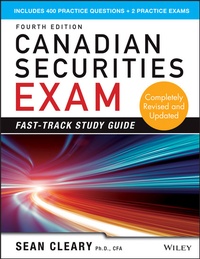
Canadian Securities Exam Fast-Track Study Guide
Description

For anyone dreaming of a career in the Canadian finance industry, whether in banking, brokerage, financial planning, or mutual funds, passing the Canadian Securities Exam is the first step on the path to success. But there's a lot of material to know and almost everyone needs a helping hand. Thankfully, the Canadian Securities Exam Fast-Track Study Guide is the perfect quick-review tool covering all the basics you need to know. It includes 'quick hits' of the key points in language that's straightforward and easy to understand. Fully updated to cover the latest topics added to the CSC curriculum, this is the perfect study guide for staying cool under pressure and getting the best score you can. An ideal way to prepare for the Canadian Securities Exam, this handy guide will have you fully prepped and ready to go in no time flat.
- An affordable, compact study guide that simply summarizes must-know information
- Features 400 sample questions, including multiple choice chapter review questions and two full practice exams, as well as cross-referencing to the CSC textbook
- Written by a professor of finance and the Director of the Master of Management in Finance program at Queen's School of Business, Queen's University
- Ideal for finance students who need a quick review of the vital information they need to pass the Canadian Securities Exam
Dr. Sean Cleary, Ph.D., CFA, is BMO Professor of Finance and Director of the Master of Finance program at Queen's School of Business, Queen's University. Dr. Cleary holds a Ph.D. in finance from the University of Toronto, and an MBA. He is a Chartered Financial Analyst (CFA) charter holder and a former Board member of both the Toronto CFA Society and the Atlantic Canada CFA Society. He has completed the Professional Financial Planning Course (PFPC), the Canadian Securities Course (CSC), as well as the Investment Funds Institute of Canada (IFIC) Mutual Fund Course. He has been on the faculty at St. Mary's University and the Schulich School of Business, York University, and has taught preparation courses for the Canadian Securities Exam. Dr. Cleary has published numerous articles in the Journal of Finance, the Journal of Financial and Quantitative Analysis, Financial Management, the Journal of Banking and Finance, the Journal of Multinational Financial Management, the Journal of Financial Research, the International Journal of Managerial Finance, the Canadian Investment Review, and the Canadian Journal of Administrative Sciences. He is co-author of the first three editions of Introduction to Corporate Finance (Wiley, 2007, 2010, 2013), as well as numerous other finance textbooks.
More details
Other editions
Additional editions
Previous edition
Content
- Intro
- Canadian Securities: EXAM: FAST-TRACK STUDY GUIDE
- Table of Contents
- Acknowledgements
- Introduction: How to Use this Book
- Chapter 1: The Capital Market
- Introduction
- Suppliers and Users of Investment Capital
- Investment Capital
- Sources of Capital
- Users of Capital
- The Role of Financial Instruments
- Financial Instruments
- Financial Markets
- Auction Markets (Stock Exchanges)
- Dealer Markets: The Unlisted Market
- Alternative Trading Systems
- Chapter 1 Review Questions
- Chapter 2: The Canadian Securities Industry
- An Overview of the Canadian Securities Industry
- The Role of Financial Intermediaries
- The Canadian Securities Industry
- The Securities Industry Today
- Primary Markets
- Secondary Markets
- Chartered Banks
- Other Intermediaries
- Trust and Mortgage Companies
- Credit Unions and Caisses Populaires
- Life Insurance Companies
- Property and Casualty Insurance
- Investment Funds
- Savings Banks
- Pension Plans
- Sales Finance and Consumer Loans
- Chapter 2 Review Questions
- Chapter 3: The Canadian Regulatory Environment
- Regulatory Organizations
- The Office of the Superintendent of Financial Institutions (OSFI)
- The Provincial Regulators
- The Self-Regulatory Organizations (SROs)
- Canadian Investor Protection Fund (CIPF)
- Arbitration
- Regulation and Investor Protection
- The Ethics of Trading
- Takeovers and Insider Trading
- Chapter 3 Review Questions
- Chapter 4: Economic Principles
- Overview of Economics
- Measuring the Economy
- The Business Cycle
- Business Cycle Indicators
- Labour Markets
- Interest Rates
- Money and Inflation
- International Economics
- The Exchange Rate
- Chapter 4 Review Questions
- Chapter 5: Economic Policy
- Economic Theories
- Fiscal Policy
- Monetary Policy
- Implementing Monetary Policy
- Chapter 5 Review Questions
- Chapter 6: Fixed-income Securities: Features and Types
- Overview and Terminology
- Bond Features
- Protective Provisions
- Government Securities
- Corporate Bonds
- Chapter 6 Review Questions
- Chapter 7: Fixed-income Securities: Pricing and Trading
- Bond Pricing Principles
- The Term Structure of Interest Rates
- Delivery, Regulation, and Settlement
- Bond Indexes
- Chapter 7 Review Questions
- Chapter 8: Equity Securities: Common and Preferred Shares
- Introduction
- Common Shares
- Preferred Share Characteristics
- Types of Preferred Shares
- Other Preferreds
- Preferred Features
- Stock Indices and Averages
- Chapter 8 Review Questions
- Chapter 9: Equity Securities: Equity Trading
- Cash and Margin Accounts
- Short Sales
- Equity Transactions
- Chapter 9 Review Questions
- Chapter 10: Derivatives
- Introduction
- Options
- Futures and Forwards
- Rights and Warrants
- Chapter 10 Review Questions
- Chapter 11: Financing and Listing Securities
- Basic Forms of Business Organization
- 1. Proprietorship
- 2. Partnership
- 3. Corporation
- The Incorporation Process
- Shareholder Rights
- Corporation Structure
- Government and Corporate Financing
- The Financing Procedure
- The Listing Process
- Chapter 11 Review Questions
- Chapter 12: Corporations and Their Financial Statements
- Understanding Financial Statements
- Statement of Financial Position
- Assets
- Liabilities and Shareholders' Equity
- Statement of Comprehensive Income
- Other Components
- Chapter 12 Review Questions
- Chapter 13: Fundamental and Technical Analysis
- Overview
- Fundamental Macroeconomic Analysis
- Industry Analysis
- Fundamental Valuation Models
- Technical Analysis
- Chapter 13 Review Questions
- Chapter 14: Company Analysis
- Fundamental Company Analysis
- Interpreting Financial Statements
- Analyzing Liquidity
- Risk Analysis
- Operating Performance
- Analyzing Value
- Assessing Preferred Share Investment Quality
- Chapter 14 Review Questions
- Chapter 15: Introduction to the Portfolio Approach
- Introduction
- Risk and Return
- Returns
- Portfolio Risk and Return
- Combining Securities
- The Portfolio Management Process
- Determining Objectives and Constraints
- The Investment Policy Statement
- Chapter 15 Review Questions
- Chapter 16: The Portfolio Management Process
- Developing an Asset Mix and Selecting Investment Styles
- The Asset Mix
- Setting the Asset Mix
- Implementing the Asset Mix
- Monitoring the Economy, the Markets, the Portfolio, and the Client
- Evaluating Portfolio Performance
- Chapter 16 Review Questions
- Chapter 17: Evolution of Managed and Structured Products
- Managed versus Structured Products
- Chapter 17 Review Questions
- Chapter 18: Mutual Funds: Structure and Regulation
- Introduction
- The Structure of Mutual Funds
- Organizational Structure
- The Pricing of Mutual Fund Securities
- Labour-sponsored Venture Capital Corporations (LSVCCs)
- Regulation of Mutual Funds
- Registration Requirements
- Mutual Fund Restrictions
- Chapter 18 Review Questions
- Chapter 19: Mutual Funds: Types and Features
- Types of Mutual Funds
- Fund Management Styles
- Equity Management Styles
- Redeeming Mutual Fund Units or Shares
- Comparing Mutual Fund Performance
- Chapter 19 Review Questions
- Chapter 20: Segregated Funds and Other Insurance Products
- Key Features of Segregated Funds
- Maturity Guarantees and Benefits
- Fees and Expenses
- Tax Considerations
- Regulation
- Other Insurance Products
- Chapter 20 Review Questions
- Chapter 21: Hedge Funds
- Overview of Hedge Funds
- Hedge Fund Indexes
- Benefits and Risks of Hedge Funds
- Due Diligence
- Hedge Fund Strategies
- Funds of Hedge Funds
- Chapter 21 Review Questions
- Chapter 22: Exchange-listed Managed Products
- Closed-end Funds
- Income Trusts
- Exchange-traded Funds
- Private Equity
- Chapter 22 Review Questions
- Chapter 23: Fee-based Accounts
- Fee-based Accounts
- Chapter 23 Review Questions
- Chapter 24: Structured Products
- Principal Protected Notes (PPNs)
- Index-linked Guaranteed Investment Certificates (GICs)
- Split Shares
- Asset-backed Securities (ABS)
- Mortgage-backed Securities (MBS)
- Chapter 24 Review Questions
- Chapter 25: Canadian Taxation
- Taxes and Taxation Issues
- Taxation of Investment Income
- Capital Gains and Losses
- Tax Deferral Plans
- Registered Education Savings Plans (RESPs)
- Basics of Tax Planning
- Chapter 25 Review Questions
- Chapter 26: Working with the Retail Client
- The Process of Financial Planning
- 1. Establishing the Client-Advisor Relationship
- 2. Collecting Data and Information
- 3. Analyzing Data and Information
- 4. Recommending Strategies to Meet Goals
- 5. Implementing Recommendations
- 6. Conducting a Periodic Review or Follow-up
- Financial Planning Aids
- Ethics and the Financial Advisor
- Standards of Conduct
- Case Studies
- Case 1: Brigid
- Case 2: Brennan and Angela
- Chapter 26 Review Questions
- Chapter 27: Working with the Institutional Client
- Who Are Institutional Clients?
- 1. Corporate Treasuries
- 2. Insurance Companies
- 3. Pension Funds
- 4. Mutual Funds
- 5. Hedge Funds
- 6. Endowments
- 7. Trusts
- Suitability Requirements for Institutional Investors
- Roles and Responsibilities in the Institutional Market
- Chapter 27 Review Questions
- Answers to End-of-Chapter Review Questions
- Chapter 1
- Chapter 2
- Chapter 3
- Chapter 4
- Chapter 5
- Chapter 6
- Chapter 7
- Chapter 8
- Chapter 9
- Chapter 10
- Chapter 11
- Chapter 12
- Chapter 13
- Chapter 14
- Chapter 15
- Chapter 16
- Chapter 17
- Chapter 18
- Chapter 19
- Chapter 20
- Chapter 21
- Chapter 22
- Chapter 23
- Chapter 24
- Chapter 25
- Chapter 26
- Chapter 27
- CSC Practice Examination #1: Chapters 1-12
- CSC Practice Examination #2: Chapters 13 -27
- Answers to Practice Exam #1: Chapters 1-12
- Answers to Practice Exam #2: Chapters 13 -27
- EULA
