

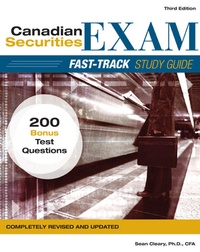
Canadian Securities Exam Fast-Track Study Guide
Description

The Wiley Canadian Securities Exam Fast-Track Study Guide is a quick-review tool that covers all the basics you need to know to pass the exam. It presents 'quick hits' of the key points you need to know, in language that's easy to understand and follow. This concise study aid:
- summarizes the essential, 'need-to-know' information
- highlights important topics
- features multiple choice review questions at the end of each chapter
- makes material easy to read, understand and remember
- includes two practice exams and double the number of review questions in the last edition
This edition has been completely updated and revised to reflect recent changes to the course and the exams. It features updates throughout, new questions and new practice exams, and it has been restructured for ease of use and comprehension.
Don't let the stress and amount of material you need to know for the exam overwhelm you. Prepare yourself with the Wiley Canadian Securities Exam Fast-Track Study Guide. It's the perfect quick-review tool to wrap up your studying and help you focus on doing your best on the exam.
Dr. Sean Cleary, CFA, is the BMO Professor of Finance and the Director of the Master's of Management in Finance, Queen's School of Business, Queen's University. Dr. Cleary has taught numerous university finance courses and has also taught preparatory courses and seminars for the Canadian Securities Exam. Textbooks he has co-authored include Introduction to Corporate Finance (1st and 2nd editions), Introduction to Corporate Finance, Finance in a Canadian Setting (6th Edition) and Investments: Analysis and Management (first three Canadian editions). Dr. Cleary is an internationally renowned researcher whose research has appeared in the world's top finance journals. He appears frequently in the media.
More details
Other editions
New editions
Additional editions
Content
- Canadian Securities Exam
- Table of Contents
- How to Use This Book
- Chapter 1: The Capital Market
- Introduction
- Suppliers and Users of Investment Capital
- The Role of Financial Instruments
- Financial Markets
- Chapter 1 Review Questions
- Chapter 2: The Canadian Securities Industry
- The Role of Financial Intermediaries
- The Canadian Securities Industry
- Chartered Banks
- Other Intermediaries
- Chapter 2 Review Questions
- Chapter 3: The Canadian Regulatory Environment
- Regulatory Organizations
- Arbitration
- Regulation and Investor Protection
- The Ethics of Trading
- Takeovers and Insider Trading
- Chapter 3 Review Questions
- Chapter 4: Economic Principles
- Overview of Economics
- Measuring the Economy
- Labour Markets
- Interest Rates
- Money and Inflation
- International Economics
- Chapter 4 Review Questions
- Chapter 5: Economic Policy
- Economic Theories
- Fiscal Policy
- Monetary Policy
- Chapter 5 Review Questions
- Chapter 6: Fixed Income Securities: Features and Types
- Overview and Terminology
- Bond Features
- Government of Canada Securities
- Corporate Bonds
- Chapter 6 Review Questions
- Chapter 7: Fixed Income Securities: Pricing and Trading
- Bond Pricing Principles
- The Term Structure of Interest Rates
- Delivery, Regulation, and Settlement
- Bond Indexes
- Chapter 7 Review Questions
- Chapter 8: Equity Securities: Common and Preferred Shares
- Introduction
- Common Shares
- Preferred Share Characteristics
- Stock Indices and Averages
- Chapter 8 Review Questions
- Chapter 9: Equity Securities: Equity Trading
- Cash and Margin Accounts
- Short Sales
- Equity Transactions
- Chapter 9 Review Questions
- Chapter 10: Derivatives
- Introduction
- Options
- Futures and Forwards
- Rights and Warrants
- Chapter 10 Review Questions
- Chapter 11: Financing and Listing Securities
- Basic Forms of Business Organization
- The Incorporation Process
- Government and Corporate Financing
- The Financing Procedure
- The Listing Process
- Chapter 11 Review Questions
- Chapter 12: Corporations and Their Financial Statements
- Understanding Financial Statements
- Balance Sheet
- Earnings Statement
- Other Components
- Chapter 12 Review Questions
- Chapter 13: Fundamental and Technical Analysis
- Overview
- Fundamental Macroeconomic Analysis
- Industry Analysis
- Fundamental Valuation Models
- Technical Analysis
- Chapter 13 Review Questions
- Chapter 14: Company Analysis
- Fundamental Company Analysis
- Interpreting Financial Statements
- Assessing Preferred Share Investment Quality
- Chapter 14 Review Questions
- Chapter 15: Introduction to the Portfolio Approach
- Introduction
- Risk and Return
- Portfolio Risk and Return
- Chapter 15 Review Questions
- Chapter 16: The Portfolio Management Process
- Developing an Asset Mix and Selecting Investment Styles
- Implementing the Asset Mix
- Monitoring the Economy, the Markets, the Portfolio, and the Client
- Evaluating Portfolio Performance
- Chapter 16 Review Questions
- Chapter 17: Mutual Funds: Structure and Regulation
- Introduction
- The Structure of Mutual Funds
- Regulation of Mutual Funds
- Chapter 17 Review Questions
- Chapter 18: Mutual Funds: Types and Features
- Types of Mutual Funds
- Fund Management Styles
- Redeeming Mutual Fund Units or Shares
- Comparing Mutual Fund Performance
- Chapter 18 Review Questions
- Chapter 19: Segregated Funds
- Key Features of Segregated Funds
- Maturity Guarantees and Benefits
- Tax Considerations
- Structure
- Disclosure
- Regulation
- Innovations in Seg Funds
- Chapter 19 Review Questions
- Chapter 20: Hedge Funds
- Overview of Hedge Funds
- Hedge Fund Indexes
- Benefits and Risks of Hedge Funds
- Due Diligence
- Hedge Fund Strategies
- Funds of Hedge Funds
- Principal-Protected Notes (PPNs)
- Chapter 20 Review Questions
- Chapter 21: Analysis of Other Managed Products
- Closed-end Funds
- Income Trusts
- Exchange-traded Funds
- Labour-Sponsored Venture Capital Corporations (LSVCCS)
- Managed Accounts
- Index-Linked Guaranteed Investment Certificates (GIC)
- Mortgage Backed Securities (MBS)
- Universal Life Insurance
- Scholarship Trusts
- Investment Contracts
- Chapter 21 Review Questions
- Chapter 22: Canadian Taxation
- Taxes and Taxation Issues
- Taxation of Investment Income
- Tax Deferral Plans
- Chapter 22 Review Questions
- Chapter 23: Working with the Client
- The Process of Financial Planning
- Financial Planning Aids
- Ethics and the Financial Advisor
- Case Studies
- Chapter 23 Review Questions
- Answers to End-of-Chapter Review Questions
- Chapter 1
- Chapter 2
- Chapter 3
- Chapter 4
- Chapter 5
- Chapter 6
- Chapter 7
- Chapter 8
- Chapter 9
- Chapter 10
- Chapter 11
- Chapter 12
- Chapter 13
- Chapter 14
- Chapter 15
- Chapter 16
- Chapter 17
- Chapter 18
- Chapter 19
- Chapter 20
- Chapter 21
- Chapter 22
- Chapter 23
- CSC Practice Examination #1: Chapters 1-12
- CSC Practice Examination #2: Chapters 13-23
- Answers to Practice Exam #1: Chapters 1-12
- Answers to Practice Exam #2: Chapters 13-23
- Acknowledgements
