

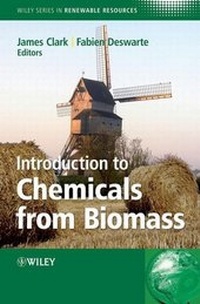
Introduction to Chemicals from Biomass
Description

More details
Other editions
Additional editions
Persons
Professor James Clark, Head of the Clean Technology Centre, University of York, UK
James Clark has an international reputation for his work in green chemistry and is a founding director of the Green Chemistry Network. He was also the founding Scientific Editor for the leading journal in the field, Green Chemistry, and is also an author of numerous books on the subject. He holds the Chair of Industrial & Applied Chemistry at the University of York and heads the Clean Technology Centre which integrates green chemistry research, industrial collaboration and educational developments and issues relevant to the public understanding of science. He is also the Director of the Greenchemistry Centre of Industrial Collaboration. His research interests include heterogeneous catalysis and supported reagents and the exploitation of renewable resources.
Fabien Deswarte, Green Chemistry Education Associate, Clean Technology Centre, University of York, UK
Fabien Deswarte's research interests lie mainly in the exploitation of renewable resources (crops, forestry residue, food waste, etc) as a source of bioproducts and bioenergy. Further to this, his interest lies in the development of teaching material for all level of education in the areas of renewable resources and sustainable development. He is also involved in developing "Green" practical experiments for undergraduate and postgraduate students with the potential to extend the scope of these experiments to students of all levels.
Content
Preface.
List of Contributors.
1. The Biorefinery Concept-An Integrated Approach (James H.Clark and Fabien E. I. Deswarte).
1.1. The Challenge of Sustainable Development.
1.2. Renewable Resources - Nature and Availability.
1.3. Impact on Ecosystem Services.
1.4. The Biorefinery Concept.
1.5. Conclusions.
2. The Chemical Value of Biomass (David B. Turley).
2.1. Introduction.
2.2. Plant Oils.
2.3. Carbohydrates.
2.4. Lignin.
2.5. Proteins.
2.6. Waxes.
2.7. Secondary Metabolites.
2.8. Prospects Arising from Developments in PlantBiotechnology and Biorefining.
2.9. Concluding Comments.
3. Green Chemical Technologies (Francesca M. Kerton).
3.1. Introduction.
3.2. What are Green Chemistry and Green Engineering?
3.3. Evaluating the Environmental Effects of Chemistry and GreenMetrics.
3.4. Alternative Solvents.
3.5. Energy Considerations: Microwaves, Ultrasound, Electricityand Light.
3.6. Catalysts.
3.7. Conclusions.
4. Production of Chemicals from Biomass (Apostolis A.Koutinas, C. Du, R.H. Wang and Colin Webb).
4.1. Introduction.
4.2. Carbohydrates.
4.3. Vegetable Oils.
4.4. Chemical Production from Proteins.
4.5. Chemical Production through Green Chemical.
5. Biomaterials (Carlos Vaca-Garcia).
5.1. Introduction.
5.2. Wood and Natural Fibres.
5.3. Isolated and modified Biopolymers ads Biomaterials.
5.4. Agromaterials, Blends and Composites.
5.5. Biodegradable Plastics.
5.6. Conclusion.
6. Production of Energy from Biomass (Mehrdad Arshadi andAnita Sellstedt).
6.1. Introduction.
6.2. Physical Upgrading Processes.
6.3. Microbiological Processes.
6.4. Thermochemical Processes.
6.5. Chemical Processes.
6.6. Power Generation from Biomass.
Index.
