

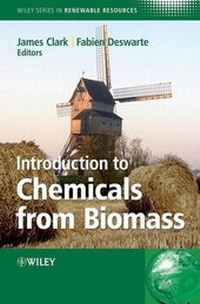
Introduction to Chemicals from Biomass
Published on 15. August 2008
Book
Hardback
200 pages
978-0-470-05805-3 (ISBN)
Description
Nature provides us with an abundance of chemical potential. Presenting an overview of the use of bioresources in the 21st century, Introduction to Chemicals from Biomass covers resources, chemical composition of biomass, key factors affecting composition, utilization of wastes, extraction technologies, controlled pyrolysis, fermentation, platform molecules, and green chemical technologies for their conversion to valuable chemicals. The text shows how smaller volume chemicals could become bulk chemicals as a result of a greater exploitation of biomass products, making it an important resource for academic and industrial scientists and researchers.
Reviews / Votes
"[The book] provides a thorough introduction to this fast moving sector. The authors include a wide variety of accesible definitions. Overall I found the book very readable and would recommend it to anyone wishing to learn about the benefits of microreactor technology." (Chemistry World, March 2009)More details
Series
Edition
1. Auflage
Language
English
Place of publication
Hoboken
United Kingdom
Publishing group
John Wiley and Sons Ltd
Target group
Professional and scholarly
Illustrations
Illustrations
Dimensions
Height: 24.4 cm
Width: 16.8 cm
Thickness: 1.6 cm
Weight
416 gr
ISBN-13
978-0-470-05805-3 (9780470058053)
Schweitzer Classification
Other editions
New editions
James H. Clark | Fabien Deswarte
Introduction to Chemicals from Biomass
Book
02/2015
2nd Edition
Wiley
€101.50
Shipment within 15-20 days
Additional editions
James H. Clark | Fabien Deswarte
Introduction to Chemicals from Biomass
E-Book
08/2011
Wiley
€77.99
Available for download
James H. Clark | Fabien Deswarte
Introduction to Chemicals from Biomass
E-Book
09/2008
Wiley
€77.99
Available for download
Persons
Content
Series Preface.
Preface.
List of Contributors.
1. The Biorefinery Concept-An Integrated Approach (James H. Clark and Fabien E. I. Deswarte).
1.1. The Challenge of Sustainable Development.
1.2. Renewable Resources - Nature and Availability.
1.3. Impact on Ecosystem Services.
1.4. The Biorefinery Concept.
1.5. Conclusions.
2. The Chemical Value of Biomass (David B. Turley).
2.1. Introduction.
2.2. Plant Oils.
2.3. Carbohydrates.
2.4. Lignin.
2.5. Proteins.
2.6. Waxes.
2.7. Secondary Metabolites.
2.8. Prospects Arising from Developments in Plant Biotechnology and Biorefining.
2.9. Concluding Comments.
3. Green Chemical Technologies (Francesca M. Kerton).
3.1. Introduction.
3.2. What are Green Chemistry and Green Engineering?
3.3. Evaluating the Environmental Effects of Chemistry and Green Metrics.
3.4. Alternative Solvents.
3.5. Energy Considerations: Microwaves, Ultrasound, Electricity and Light.
3.6. Catalysts.
3.7. Conclusions.
4. Production of Chemicals from Biomass (Apostolis A. Koutinas, C. Du, R.H. Wang and Colin Webb).
4.1. Introduction.
4.2. Carbohydrates.
4.3. Vegetable Oils.
4.4. Chemical Production from Proteins.
4.5. Chemical Production through Green Chemical.
5. Biomaterials (Carlos Vaca-Garcia).
5.1. Introduction.
5.2. Wood and Natural Fibres.
5.3. Isolated and modified Biopolymers ads Biomaterials.
5.4. Agromaterials, Blends and Composites.
5.5. Biodegradable Plastics.
5.6. Conclusion.
6. Production of Energy from Biomass (Mehrdad Arshadi and Anita Sellstedt).
6.1. Introduction.
6.2. Physical Upgrading Processes.
6.3. Microbiological Processes.
6.4. Thermochemical Processes.
6.5. Chemical Processes.
6.6. Power Generation from Biomass.
Index.