

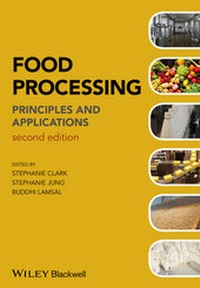
Food Processing
Description

Reviews / Votes
"As a hands-on guide to the essential processingprinciples and their applications, covering the theoretical andapplied aspects of food processing in one accessible volume, thisbook is a valuable tool for food industry professionals across allmanufacturing sectors, and serves as a relevant primary orsupplemental text for students of food science." (Biotechnology, Agronomy, Society and Environment, 1October 2014)More details
Other editions
Additional editions
Persons
Content
List of Contributors xi
1 Principles of Food Processing 1
Sung Hee Park, Buddhi P. Lamsal, and V.M. Balasubramaniam
1.1 Processing of foods: an introduction 1
1.2 Unit operations in food processing 2
1.3 Thermophysical properties, microbial aspects, and other considerations in food processing 4
1.4 Common food preservation/processing technologies 7
1.5 Other food processing/preservation technologies 12
1.6 Emerging issues and sustainability in food processing 13
1.7 Conclusion 13
2 Thermal Principles and Kinetics 17
Prabhat Kumar and K.P. Sandeep
2.1 Introduction 17
2.2 Methods of thermal processing 17
2.3 Microorganisms 20
2.4 Thermal kinetics 21
2.5 Thermal process establishment 24
2.6 Thermal process calculation 26
2.7 Thermal process validation 28
2.8 Process monitoring and control 29
2.9 Emerging processing technologies 29
2.10 Future trends 30
3 Separation and Concentration Technologies in Food Processing 33
Yves Pouliot, Valérie Conway, and Pierre-Louis Leclerc
3.1 Introduction 33
3.2 Physical separation of food components 34
3.3 Processes involving phase separation 37
3.4 Membrane separations 46
3.5 Sustainability of separation technologies in food processing 57
4 Dehydration 61
Robert H. Driscoll
4.1 Introduction 61
4.2 Drying and food quality 61
4.3 Hot air drying 62
4.4 Drying theory 67
4.5 Drying equipment 71
4.6 Analysis of dryers 75
4.7 Sustainability 77
4.8 Conclusion 77
5 Chilling and Freezing of Foods 79
Stephen J. James and Christian James
5.1 Introduction to the food cold chain 79
5.2 Effect of refrigeration on food safety and quality 79
5.3 Blanching 83
5.4 Principles of refrigeration systems 84
5.5 Heat transfer during chilling and freezing 86
5.6 Chilling and freezing systems 87
5.7 Chilled and frozen storage systems 92
5.8 Chilled and frozen transport systems 93
5.9 Refrigerated retail display systems 95
5.10 Recommended temperatures 99
5.11 Refrigeration and the environment 100
5.12 Specifying, designing, and commissioning refrigeration systems 101
5.13 Conclusion 102
6 Fermentation and Enzyme Technologies in Food Processing 107
Ali Demirci, Gulten Izmirlioglu, and Duygu Ercan
6.1 Introduction 107
6.2 Fermentation culture requirements 108
6.3 Fermentation technologies 112
6.4 Downstream processing 114
6.5 Fermented foods 117
6.6 Enzyme applications 123
6.7 Sustainability 131
6.8 Concluding remarks and future trends 131
7 Alternative Food Processing Technologies 137
Hudaa Neetoo and Haiqiang Chen
7.1 Introduction 137
7.2 Alternative thermal processing technologies 137
7.3 Alternative non-thermal processing technologies 144
7.4 Sustainability and energy efficiency of processing methods 159
7.5 Conclusion 160
8 Nanotechnology for Food: Principles and Selected Applications 171
Sundaram Gunasekaran
8.1 Introduction 171
8.2 Biosensing 172
8.3 Packaging 191
8.4 Nanotechnology and sustainability 198
8.5 Summary 199
9 Sustainability and Environmental Issues in Food Processing 207
Fionnuala Murphy, Kevin McDonnell, and Colette C. Fagan
9.1 Introduction 207
9.2 Sustainable food processing drivers 207
9.3 Environmental impact of food processing 210
9.4 Green technologies: examples in the food processing industry 213
9.5 Environmental sustainability assessment methods 214
9.6 Conclusion 227
10 Food Safety and Quality Assurance 233
Tonya C. Schoenfuss and Janet H. Lillemo
10.1 Introduction 233
10.2 Elements of total quality management 233
10.3 Hazard Analysis Critical Control Point (HACCP) system 235
10.4 Sanitary processing conditions 236
10.5 Supporting prerequisite programs 242
10.6 Product quality assurance 245
10.7 Conclusion 246
11 Food Packaging 249
Joongmin Shin and Susan E.M. Selke
11.1 Introduction 249
11.2 Functions of food packaging 249
11.3 Packaging systems 250
11.4 Materials for food packaging 251
11.5 Other packaging types 263
11.6 Sustainable food packaging 268
12 Food Laws and Regulations 275
Barbara Rasco
12.1 Introduction 275
12.2 The regulatory status of food ingredients and additives 276
12.3 Adulteration and misbranding 276
12.4 The global food trade: risk from adulterated and misbranded foods 279
12.5 US Department of Agriculture programs 280
12.6 Environmental Protection Agency programs 283
12.7 The Food Safety Modernization Act 283
12.8 Summary 291
13 Crops - Cereals, 293
Kent D. Rausch and Vijay Singh
13.1 Introduction 293
13.2 Industrial corn processing for food uses 293
13.3 Industrial wheat processing for food uses 300
13.4 Sustainability of corn and wheat processing 302
14 Crops - Legumes 305
George Amponsah Annor, Zhen Ma, and Joyce Irene Boye
14.1 Introduction 305
14.2 Technologies involved in legume processing 306
14.3 Traditional processing technologies 307
14.4 Modern processing technologies 310
14.5 Ingredients from legumes 312
14.6 Novel applications 329
14.7 Conclusion 331
15 Processing of Fruit and Vegetable Beverages 339
José I. Reyes-De-Corcuera, Renée M. Goodrich-Schneider, Sheryl Barringer, and Miguel A. Landeros-Urbina
15.1 Introduction 339
15.2 Juices 341
15.3 Nectars 356
15.4 Clean-in-place 358
15.5 Conclusion 360
16 Fruits and Vegetables - Processing Technologies and Applications 363
Nutsuda Sumonsiri and Sheryl A. Barringer
16.1 Raw materials 363
16.2 Basic processing 369
17 Milk and Ice Cream Processing 383
Maneesha S. Mohan, Jonathan Hopkinson, and Federico Harte
17.1 Introduction 383
17.2 Physical and chemical properties of milk constituents 383
17.3 Milk handling 386
17.4 Dairy product processing 391
17.5 US regulations for milk and milk products 400
17.6 Sustainability of the dairy industry 402
17.7 Conclusion 402
18 Dairy - Fermented Products 405
R.C. Chandan
18.1 Introduction 405
18.2 Consumption trends 406
18.3 Production of starters for fermented dairy foods 406
18.4 Biochemical basis of lactic fermentation for flavor and texture generation 410
18.5 Yogurt 410
18.6 Cultured (or sour) cream 422
18.7 Cheeses 424
18.8 Sustainability efforts in whey processing 431
19 Eggs and Egg Products Processing 437
Jianping Wu
19.1 Introduction 437
19.2 Shell egg formation 437
19.3 Structure of eggs 438
19.4 Chemical composition of eggs 440
19.5 Shell egg processing 441
19.6 Further processing of eggs and egg products 444
19.7 Liquid egg products 445
19.8 Pasteurization 446
19.9 Desugarization 448
19.10 Dehydration 449
19.11 Egg further processing (value-added processing) 449
19.12 Sustainability 450
19.13 Conclusion 450
20 Fats and Oils - Plant Based 457
Amy S. Rasor and Susan E. Duncan
20.1 Introduction 457
20.2 Sources, composition, and uses of plant-based fats and oils 457
20.3 Properties of plant-based fats and oils 460
20.4 Nutritional areas of interest 461
20.5 Degradation of plant-based fats and oils 462
20.6 General handling considerations 463
20.7 Recovery of oils from their source materials 463
20.8 Refining 466
20.9 Modification of plant-based fats and oils 469
20.10 Packaging and postprocessing handling 473
20.11 Margarine processing 473
20.12 Mayonnaise processing 476
20.13 Sustainability 477
21 Fats and Oils - Animal Based 481
Stephen L. Woodgate and Johan T. van der Veen
21.1 Introduction 481
21.2 Raw materials 481
21.3 Land animals 482
21.4 Processing methods 484
21.5 EU legislation 487
21.6 Safety 488
21.7 Characteristics and quality 490
21.8 Applications 493
21.9 Health aspects 496
21.10 Sustainability 497
21.11 Conclusion 497
22 Aquatic Food Products 501
Mahmoudreza Ovissipour, Barbara Rasco, and Gleyn Bledsoe
22.1 Introduction 501
22.2 Aquatic plants and animals as food 501
22.3 Cultivation, harvesting, and live handling - reducing stress and maintaining quality 502
22.4 Animal welfare issues in fisheries 507
22.5 Harvesting methods and effect on quality 507
22.6 Reducing stress in live handling 508
22.7 Fishing methods 510
22.8 Refrigerated products 514
22.9 Freezing and frozen products 515
22.10 Surimi and surimi analog products 520
22.11 Curing, brining, smoking, and dehydration 521
22.12 Additives and edible coatings 524
22.13 Roes and caviar 525
22.14 Other non-muscle tissues used as food 528
22.15 Fish meal and protein hydrolyzates, and fish oil 530
22.16 Sustainability 531
22.17 Summary 532
23 Meats - Beef and Pork Based 535
Robert Maddock
23.1 Introduction 535
23.2 Beef and pork characteristics and quality 535
23.3 General categories of beef and pork processing 537
23.4 Equipment needed in beef and pork processing 545
23.5 Beef and pork processing and HACCP 547
23.6 Sustainability 547
24 Poultry Processing and Products 549
Douglas P. Smith
24.1 Poultry processing 549
24.2 Turkey processing 562
24.3 Duck processing 562
24.4 Microbiology and food safety 563
24.5 Sustainable poultry production and processing 564
24.6 Conclusion 565
Index 567
1
Principles of Food Processing
Sung Hee Park,1 Buddhi P. Lamsal,2 and V.M. Balasubramaniam1,3
1Department of Food Science and Technology, The Ohio State University, Columbus, Ohio, USA
2Department of Food Science and Human Nutrition, Iowa State University, Ames, Iowa, USA
3Department of Food Agricultural and Biological Engineering, The Ohio State University, Columbus, Ohio, USA
1.1 Processing of foods: an introduction
Processing of foods is a segment of manufacturing industry that transforms animal, plant, and marine materials into intermediate or finished value-added food products that are safer to eat. This requires the application of labor, energy, machinery, and scientific knowledge to a step (unit operation) or a series of steps (process) in achieving the desired transformation (Heldman & Hartel, 1998). Value-added ingredients or finished products that satisfy consumer needs and convenience are obtained from the raw materials.
The aims of food processing could be considered four-fold (Fellows, 2009): (1) extending the period during which food remains wholesome (microbial and biochemical), (2) providing (supplementing) nutrients required for health, (3) providing variety and convenience in diet, and (4) adding value.
Food materials’ shelf life extension is achieved by preserving the product against biological, chemical, and physical hazards. Bacteria, viruses, and parasites are the three major groups of biological hazards that may pose a risk in processed foods. Biological hazards that may be present in the raw food material include both pathogenic microorganisms with public health implications and spoilage microorganisms with quality and esthetic implications. Mycotoxin, pesticide, fungicide, and allergens are some examples of chemical hazards that may be present in food. Physical hazards may involve the presence of extraneous material (such as stones, dirt, metal, glass, insect fragments, hair). These hazards may accidentally or deliberately (in cases of adulteration) become part of the processed product. Food processing operations ensure targeted removal of these hazards so that consumers enjoy safe, nutritious, wholesome foods. With the possibility of extending shelf life of foods and advances in packaging technology, food processing has been catering to consumer convenience by creating products, for example, ready-to-eat breakfast foods and TV dinners, on-the-go beverages and snacks, pet foods, etc. Food processing, as an industry, has also responded to changes in demographics by bringing out ethnic and specialty foods and foods for elderly people and babies. Nutrition fortification, for example, folic acid supplementation in wheat flour, is another function of processing food.
The scope of food processing is broad; unit operations occurring after harvest of raw materials until they are processed into food products, packaged, and shipped for retailing could be considered part of food processing. Typical processing operations may include raw material handling, ingredient formulation, heating and cooling, cooking, freezing, shaping, and packaging (Heldman & Hartel, 1998). These could broadly be categorized into primary and secondary processing. Primary processing is the processing of food that occurs after harvesting or slaughter to make food ready for consumption or use in other food products. Primary processing ensures that foods are easily transported and are ready to be sold, eaten or processed into other products (e.g. after the primary processing of peeling and slicing, an apple can be eaten fresh or baked into a pie). Secondary processing turns the primary-processed food or ingredient into other food products. It ensures that foods can be used for a number of purposes, do not spoil quickly, are healthy and wholesome to eat, and are available all year (e.g. seasonal foods). In the previous example, baking of the pie is a secondary processing step, which utilizes ingredient from primary processing (sliced apple).
The food and beverage manufacturing industry is one of the largest manufacturing sectors in the US. In 2011, these plants accounted for 14.7% of the value of shipments from all US manufacturing plants. Meat processing is the largest single component of food and beverage manufacturing, with 24% of shipments in 2011. Other important components include dairy (13%), beverages (12%), grains and oilseeds (12%), fruits and vegetables (8%), and other food products (11%). Meat processing is also the largest component (17%) of the food sector's total value added, followed by beverage manufacturing (16%) (Anonymous, 2012; USDA Economic Research Service, 2013). California has the largest number of food manufacturing plants (www.ers.usda.gov/topics/food-markets-prices/processing-marketing.aspx), followed by New York and Texas. Demand for processed foods tend to be less susceptible to fluctuating economic conditions than other industries.
Some basic principles associated with processing and preservation of food are summarized in this chapter. In-depth discussion can be found elsewehwere (Earle & Earle, 2012; Fellows, 2009; Gould, 1997; Heldman & Hartel, 1998; Saravacos & Kostaropoulos, 2002; Smith, 2003; Toledo, 2007; Zhang et al., 2011), including various chapters in this book.
1.2 Unit operations in food processing
Most food processes utilize six different unit operations: heat transfer, fluid flow, mass transfer, mixing, size adjustment (reduction or enlargement), and separation. A brief introduction to these principles is given in this chapter; more detailed information about the theory behind the principles and applications can be found in standard food or chemical engineering textbooks, including Singh and Heldman (2009), Welti-Chanes et al. (2005), and McCabe et al. (2001).
During food processing, food material may be combined with a variety of ingredients (sugar, preservatives, acidity) to formulate the product and then subjected to different unit operations either sequentially or simultaneously. Food processors often use process flow charts to visualize the sequence of operations needed to transform raw materials into final processed product. The process flow diagrams often include quality control limits and/or adjustment and description of any hazards. Figure 1.1 shows a sample process flow diagram for making Frankfurter comminuted sausage.
Figure 1.1 Process flow diagram of Frankfurter comminuted sausage manufacturing.
1.2.1 Heat transfer
Heat transfer is one of the fundamental processing principles applied in the food industry and has applications in various unit operations, thermal processing, evaporation (concentration) and drying, freezing and thawing, baking, and cooking. Heating is used to destroy microorganisms to provide a healthy food, prolong shelf life through the destruction of certain enzymes, and promote a product with acceptable taste, odor, and appearance. Heat transfer is governed by heat exchange between a product and its surrounding medium. The extent of heat transfer generally increases with increasing temperature difference between the product and its surrounding.
Conduction, convection, and radiation are the three basic modes of heat transfer. Conduction heat transfer occurs within solid foods, wherein a transfer of energy occurs from one molecule to another. Generally, heat energy is exchanged from molecules with greater thermal energy to molecules located in cooler regions. Heat transfer within a potato slice is an example of conduction heat transfer.
Heat is transferred in fluid foods by bulk movement of fluids as a result of a temperature gradient, and this process is referred to as convective heat transfer. Convective heat transfer can be further classified as natural convection and forced convection. Natural convection is a physical phenomenon wherein a thermal gradient due to density difference in a heated product causes bulk fluid movement and heat transfer. Movement of liquids inside canned foods during thermal sterilization is an example of natural convection. If the movement and heat transfer are facilitated by mechanical agitation (such as use of mixers), this is called forced convection.
Radiation heat transfer occurs between two surfaces as a result of the transfer of heat energy by electromagnetic waves. This mode of heat transfer does not require a physical medium and can occur in a vacuum. Baking is one example of heat transfer via radiation from the heat source in the oven to the surface of bread. However, heat propagates via conduction within the body of the bread.
1.2.2 Mass transfer
Mass transfer involves migration of a constituent of fluid or a component of a mixture (Singh & Heldman, 2009) in or out of a food product. Mass transfer is controlled by the diffusion of the component within the mixture. The mass migration occurs due to changes in physical equilibrium of the system caused by concentration or vapor pressure differences. The mass transfer may occur within one phase or may involve transfer from one phase to another. Food process unit operations that utilize mass transfer include distillation, gas absorption, crystallization, membrane processes, evaporation, and drying.
1.2.3 Fluid flow
Fluid flow involves transporting liquid food through pipes during processing. Powders and small-particulate foods are handled by pneumatic conveying, whereas fluids are transported by gravity flow or through the use of pumps. The centrifugal pump and the positive displacement pump are...
