

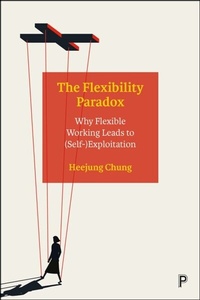
The Flexibility Paradox
Why Flexible Working Leads to (Self-)Exploitation
1st Edition
Published on 4. March 2022
270 pages
978-1-4473-5479-6 (ISBN)
Description

Does flexible working really provide a better work-life balance?
Throughout the COVID-19 pandemic, flexible working has become the norm for many workers. This volume offers an original examination of flexible working using data from 30 European countries and drawing on studies conducted in Australia, the US and India. Rather than providing a better work-life balance, the book reveals how flexible working can lead to exploitation, which manifests differently for women and men, such as more care responsibilities or increased working hours.
Taking a critical stance, this book investigates the potential risks and benefits of flexible working and provides crucial policy recommendations for overcoming the negative consequences.
Throughout the COVID-19 pandemic, flexible working has become the norm for many workers. This volume offers an original examination of flexible working using data from 30 European countries and drawing on studies conducted in Australia, the US and India. Rather than providing a better work-life balance, the book reveals how flexible working can lead to exploitation, which manifests differently for women and men, such as more care responsibilities or increased working hours.
Taking a critical stance, this book investigates the potential risks and benefits of flexible working and provides crucial policy recommendations for overcoming the negative consequences.
Reviews / Votes
"... In addition to its scholarly qualities, The Flexibility Paradox is of great value to society at large because of the social project it represents." Etnofoor "... three decades after the publications of The Second Shift (1989) by Hochschild and The Overworked American (1992) by Schor, Chung's book provides a necessary update on the state of work and leisure, particularly in light of the social changes wrought by the global pandemic." Social Forces "Flexible work is a priority for many workers and yet remains a puzzle to many employers. This book provides much-needed clarity about the critical role schedule control will play in creating equitable work systems and cultures." Brigid Schulte, New America "Be careful what you wish for with regard to flexible work. Chung's savvy analysis and fresh perspective explains the reasons that flexible work so often creates more work." Erin L. Kelly, Massachusetts Institute of Technology "This is a well-written and well-researched study which should be required reading for anyone interested in how our society is changing and in the interaction between gender norms and the market system in moulding the world in which we live." Peter Taylor-Gooby, University of Kent "...a welcome and timely contribution to the disciplines of sociology, social policy, and management studies. Readers interested in gender inequalities in the interface between work and family life would find this book interesting and informative... an excellent primer for anyone researching or studying flexible working." Gender, Work and OrganizationMore details
Edition
First Edition
Language
English
Place of publication
Bristol
United Kingdom
Publishing group
Bristol University Press
Target group
Professional and scholarly
Illustrations
37 s/w Abbildungen, 11 s/w Tabellen
11 Tables, black and white; 37 Illustrations, black and white
ISBN-13
978-1-4473-5479-6 (9781447354796)
DOI
https://doi.org/10.51952/9781447354796
Copyright in bibliographic data and cover images is held by Nielsen Book Services Limited or by the publishers or by their respective licensors: all rights reserved.
Schweitzer Classification
Other editions
Additional editions
Book
09/2022
1st Edition
Policy Press
€46.50
Shipment within 15-20 days
Book
03/2022
1st Edition
Policy Press
€137.50
Shipment within 15-20 days
E-Book
03/2022
1st Edition
Policy Press
€44.99
Available for download
Person
Heejung Chung is Professor of Work and Employment in King's Business School at King's College London.
Content
Introduction: The flexibility paradox and contexts
The demand for and trends in flexible working
The dual nature of flexibility: Family-friendly or performance-oriented logic?
The outcomes of flexible working
The flexibility paradox: Why more freedom at work leads to more work
The empirical evidence of the flexibility paradox
Gendered flexibility paradox
Flexibility stigma and the rewards of flexible working
The importance of contexts
COVID- 19 and flexible working
Conclusion: Where do we go from here?
The demand for and trends in flexible working
The dual nature of flexibility: Family-friendly or performance-oriented logic?
The outcomes of flexible working
The flexibility paradox: Why more freedom at work leads to more work
The empirical evidence of the flexibility paradox
Gendered flexibility paradox
Flexibility stigma and the rewards of flexible working
The importance of contexts
COVID- 19 and flexible working
Conclusion: Where do we go from here?
