

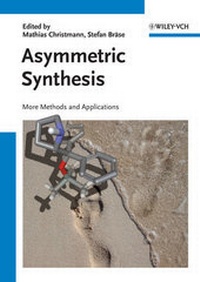
Asymmetric Synthesis II
More Methods and Applications
1st Edition
Published on 17. April 2013
XXVI, 404 pages
978-3-527-67259-2 (ISBN)
Description

After the overwhelming success of 'Asymmetric Synthesis - The Essentials', narrating the colorful history of asymmetric synthesis, this
is the second edition with latest subjects and authors. While the aim of the first edition was mainly to honor the achievements of the pioneers
in asymmetric syntheses, the aim of this new edition was bringing the current developments, especially from younger colleagues, to the
attention of students. The format of the book remained unchanged, i.e. short conceptual overviews by young leaders in their field including
a short biography of the authors. The growing multidisciplinary research within chemistry is reflected in the selection of topics including metal catalysis, organocatalysis, physical organic chemistry, analytical chemistry, and its applications in total synthesis. The prospective reader of this book is a graduate or undergraduate student of advanced organic chemistry as well as the industrial chemist who wants to get a brief update on the current developments in the field.
is the second edition with latest subjects and authors. While the aim of the first edition was mainly to honor the achievements of the pioneers
in asymmetric syntheses, the aim of this new edition was bringing the current developments, especially from younger colleagues, to the
attention of students. The format of the book remained unchanged, i.e. short conceptual overviews by young leaders in their field including
a short biography of the authors. The growing multidisciplinary research within chemistry is reflected in the selection of topics including metal catalysis, organocatalysis, physical organic chemistry, analytical chemistry, and its applications in total synthesis. The prospective reader of this book is a graduate or undergraduate student of advanced organic chemistry as well as the industrial chemist who wants to get a brief update on the current developments in the field.
More details
Other editions
Additional editions
Book
11/2012
1st Edition
Wiley-VCH
€125.00
Article exhausted; check different version
Book
11/2012
Wiley-VCH
€155.00
Article exhausted; check different version
Persons
Mathias Christmann studied chemistry at the Technical University of Braunschweig and received a PhD from the Leibniz University of Hannover with Markus Kalesse. After a postdoctoral research with Craig J. Forsyth at the University of Minnesota, he started his independent career at the RWTH Aachen as a Liebig-Fellow of the Fonds der Chemischen Industrie. Since 2008, Christmann is an Associate Professor at the Technical University of Dortmund working in the areas of organocatalysis, natural products synthesis and sustainable chemistry.
Stefan Bräse studied chemistry in Bangor, UK, Marseille, France, and Göttingen, Germany, where he gained his doctorate under Armin de Meijere in 1995. After post-doctoral appointments at Uppsala University, Sweden under J.-E. Bäckvall and The Scripps Research Institute, La Jolla, USA with K. C. Nicolaou, he began his research career at the RWTH Aachen with Dieter Enders in 1997, obtaining his lecturing
qualification in 2001. He became a professor at the University of Bonn that same year and since 2003 he has been Full Professor at the Karlsruhe Institute of Technology. Professor Bräse has more than 250 publications to his name and is a recipient of the ORCHEM award. His research interests include methods in drug discovery, combinatorial chemistry with a focus on the synthesis of biologically active compounds, total synthesis of natural products and nanotechnology.
Stefan Bräse studied chemistry in Bangor, UK, Marseille, France, and Göttingen, Germany, where he gained his doctorate under Armin de Meijere in 1995. After post-doctoral appointments at Uppsala University, Sweden under J.-E. Bäckvall and The Scripps Research Institute, La Jolla, USA with K. C. Nicolaou, he began his research career at the RWTH Aachen with Dieter Enders in 1997, obtaining his lecturing
qualification in 2001. He became a professor at the University of Bonn that same year and since 2003 he has been Full Professor at the Karlsruhe Institute of Technology. Professor Bräse has more than 250 publications to his name and is a recipient of the ORCHEM award. His research interests include methods in drug discovery, combinatorial chemistry with a focus on the synthesis of biologically active compounds, total synthesis of natural products and nanotechnology.
Content
CATALYTIC ENANTIOSELECTIVE ALKYLATION OF PROCHIRAL KETONE ENOLATES
Background
Strategy and Results
Asymmetric Allylic Alkylation in Total Synthesis
Conclusions
POINT-TO-PLANAR CHIRALITY TRANSFER IN TOTAL SYNTHESIS: SCALABLE AND PROGRAMMABLE SYNTHESIS OF HAOUAMINE A AND ITS ATROPISOMER
Introduction
Synthetic Strategy Featuring Point-to-Planar Chirality Transfer
Programmable Synthesis of Haouamine A and Its Atropisomer
TETHERED AMINOHYDROXYLATION
Introduction and Background
Tethered Aminohydroxylation
Amide-Based Reoxidants
Evidence for the Mechanism of the TA Reaction
Applications in Organic Synthesis
Conclusion and Future Work
ORGANOCATALYZED TRANSFORMATIONS OF A, B-UNSATURATED CARBONYL COMPOUNDS THROUGH IMINIUM ION INTERMEDIATES
THE RENAISSANCE OF SILICON-STEREOGENIC SILANES: A PERSONAL ACCOUNT
Background
Results
Conclusion
ASYMMETRIC DIENAMINE ACTIVATION
Introduction
Historic Background
Results
Conclusion
ASYMMETRIC BRØNSTED ACID CATALYSIS
Introduction and Background
Strategy
Results
Summary
QUATERNARY STEREOGENIC CENTERS BY ENANTIOSELECTIVE B-CARBON ELIMINATIONS FROM TERT-CYCLOBUTANOLS
Background
Objective: Enantioselective Formation of Quaternary Stereogenic Centers in Combination with Reactive Alkyl-Rhodium
Intermediates
Selective Generation of the Alkyl-Rhodium Species and Its Downstream Reactivities
TOTAL SYNTHESIS OF OSELTAMIVIR AND ABT-341 USING ONE-POT TECHNOLOGY
Introduction
Results
Conclusions
ENANTIOSELECTIVE ANNULATIONS WITH CHIRAL N-MESITYL N-HETEROCYCLIC CARBENES
Introduction
Catalytic Generation of Chiral Enolate Equivalents
Catalytic Generation of Homoenolate Equivalents
Enantioselective Cascade Reactions Catalyzed by Chiral N-Heterocyclic Carbenes
Catalytic Annulations via a, ß-Unsaturated Acyl Azoliums
Conclusions
ASYMMETRIC COUNTERANION-DIRECTED CATALYSIS (ACDC)
Concept
Application of ACDC to Organocatalysis
Application of ACDC to Transition Metal Catalysis
Application of ACDC to Lewis Acid Catalysis
ENANTIOSELECTIVE ORGANO-SOMO CATALYSIS: A NOVEL ACTIVATION MODE FOR ASYMMETRIC SYNTHESIS
Background
Objective
Results
ENANTIOSELECTIVE PASSERINI REACTION
Introduction
Background
Results
Conclusion and Perspective
RAPID ENANTIOMERIC EXCESS DETERMINATION
ASYMMETRIC CATALYSIS OF REVERSIBLE REACTIONS
Thermochemistry of Asymmetric Catalyses Close to the Equilibrium
Kinetic Modeling of a Reversible Asymmetric Catalytic Reaction
Case Study: a Reversible Asymmetric Organocatalytic Reaction
Conclusions
EXPLOITING FLUORINE CONFORMATIONAL EFFECTS IN ORGANOCATALYST DESIGN: THE FLUORINE?IMINIUM ION GAUCHE EFFECT
DUTCH RESOLUTION
CONSTRUCTION OF ANTI-ME-OH VICINAL RELATIONSHIPS IN POLYKETIDES
Introduction
Marshall - Tamaru Reaction
Conclusions
PHOTOSWITCHABLE GENERAL BASE CATALYSTS
Introduction and Background
Strategy and Results
Outlook
ASYMMETRIC HALONIUM ADDITION TO OLEFINS
Introduction
Intramolecular Lactonizations, Etherifications, and Aminations
Polyene Cyclizations
Intermolecular Additions to Alkenes
Conclusion
CATALYTIC ASYMMETRIC GOSTELI - CLAISEN REARRANGEMENT (CAGC)
BIOMIMETIC TOTAL SYNTHESIS OF THE PENIFULVIN FAMILY
Introduction
The Penifulvin Family: Isolation and Biogenetic Origin
Total Syntheses of Penifulvins A, B, and C
Summary
CATALYST-CONTROLLED 1,3-POLYOL SYNTHESES
ENANTIOSELECTIVE CARBONYL ALLYLATION AND CROTYLATION FROM THE ALCOHOL OXIDATION LEVEL VIA C?C BOND FORMING TRANSFER HYDROGENATION
Introduction and Background
Strategy
Results
STEREOSELECTIVE SYNTHESIS WITH HYPERVALENT IODINE REAGENTS
ASYMMETRIC GOLD-CATALYZED REACTIONS
Introduction
Diphosphine-Gold Complexes in Enantioselective Catalysis
Monophosphine-Gold Complexes in Enantioselective Catalysis
ASYMMETRIC CATALYSIS IN THE TOTAL SYNTHESIS OF LIPIDS AND POLYKETIDES
Background
Tuberculostearic Acid: One Isolated Methyl Group
Ant Pheromones: Vicinal Methyl Branches
Deoxypropionates: 1,3-Methyl Arrays
Membrane-Spanning Lipids:
Background
Strategy and Results
Asymmetric Allylic Alkylation in Total Synthesis
Conclusions
POINT-TO-PLANAR CHIRALITY TRANSFER IN TOTAL SYNTHESIS: SCALABLE AND PROGRAMMABLE SYNTHESIS OF HAOUAMINE A AND ITS ATROPISOMER
Introduction
Synthetic Strategy Featuring Point-to-Planar Chirality Transfer
Programmable Synthesis of Haouamine A and Its Atropisomer
TETHERED AMINOHYDROXYLATION
Introduction and Background
Tethered Aminohydroxylation
Amide-Based Reoxidants
Evidence for the Mechanism of the TA Reaction
Applications in Organic Synthesis
Conclusion and Future Work
ORGANOCATALYZED TRANSFORMATIONS OF A, B-UNSATURATED CARBONYL COMPOUNDS THROUGH IMINIUM ION INTERMEDIATES
THE RENAISSANCE OF SILICON-STEREOGENIC SILANES: A PERSONAL ACCOUNT
Background
Results
Conclusion
ASYMMETRIC DIENAMINE ACTIVATION
Introduction
Historic Background
Results
Conclusion
ASYMMETRIC BRØNSTED ACID CATALYSIS
Introduction and Background
Strategy
Results
Summary
QUATERNARY STEREOGENIC CENTERS BY ENANTIOSELECTIVE B-CARBON ELIMINATIONS FROM TERT-CYCLOBUTANOLS
Background
Objective: Enantioselective Formation of Quaternary Stereogenic Centers in Combination with Reactive Alkyl-Rhodium
Intermediates
Selective Generation of the Alkyl-Rhodium Species and Its Downstream Reactivities
TOTAL SYNTHESIS OF OSELTAMIVIR AND ABT-341 USING ONE-POT TECHNOLOGY
Introduction
Results
Conclusions
ENANTIOSELECTIVE ANNULATIONS WITH CHIRAL N-MESITYL N-HETEROCYCLIC CARBENES
Introduction
Catalytic Generation of Chiral Enolate Equivalents
Catalytic Generation of Homoenolate Equivalents
Enantioselective Cascade Reactions Catalyzed by Chiral N-Heterocyclic Carbenes
Catalytic Annulations via a, ß-Unsaturated Acyl Azoliums
Conclusions
ASYMMETRIC COUNTERANION-DIRECTED CATALYSIS (ACDC)
Concept
Application of ACDC to Organocatalysis
Application of ACDC to Transition Metal Catalysis
Application of ACDC to Lewis Acid Catalysis
ENANTIOSELECTIVE ORGANO-SOMO CATALYSIS: A NOVEL ACTIVATION MODE FOR ASYMMETRIC SYNTHESIS
Background
Objective
Results
ENANTIOSELECTIVE PASSERINI REACTION
Introduction
Background
Results
Conclusion and Perspective
RAPID ENANTIOMERIC EXCESS DETERMINATION
ASYMMETRIC CATALYSIS OF REVERSIBLE REACTIONS
Thermochemistry of Asymmetric Catalyses Close to the Equilibrium
Kinetic Modeling of a Reversible Asymmetric Catalytic Reaction
Case Study: a Reversible Asymmetric Organocatalytic Reaction
Conclusions
EXPLOITING FLUORINE CONFORMATIONAL EFFECTS IN ORGANOCATALYST DESIGN: THE FLUORINE?IMINIUM ION GAUCHE EFFECT
DUTCH RESOLUTION
CONSTRUCTION OF ANTI-ME-OH VICINAL RELATIONSHIPS IN POLYKETIDES
Introduction
Marshall - Tamaru Reaction
Conclusions
PHOTOSWITCHABLE GENERAL BASE CATALYSTS
Introduction and Background
Strategy and Results
Outlook
ASYMMETRIC HALONIUM ADDITION TO OLEFINS
Introduction
Intramolecular Lactonizations, Etherifications, and Aminations
Polyene Cyclizations
Intermolecular Additions to Alkenes
Conclusion
CATALYTIC ASYMMETRIC GOSTELI - CLAISEN REARRANGEMENT (CAGC)
BIOMIMETIC TOTAL SYNTHESIS OF THE PENIFULVIN FAMILY
Introduction
The Penifulvin Family: Isolation and Biogenetic Origin
Total Syntheses of Penifulvins A, B, and C
Summary
CATALYST-CONTROLLED 1,3-POLYOL SYNTHESES
ENANTIOSELECTIVE CARBONYL ALLYLATION AND CROTYLATION FROM THE ALCOHOL OXIDATION LEVEL VIA C?C BOND FORMING TRANSFER HYDROGENATION
Introduction and Background
Strategy
Results
STEREOSELECTIVE SYNTHESIS WITH HYPERVALENT IODINE REAGENTS
ASYMMETRIC GOLD-CATALYZED REACTIONS
Introduction
Diphosphine-Gold Complexes in Enantioselective Catalysis
Monophosphine-Gold Complexes in Enantioselective Catalysis
ASYMMETRIC CATALYSIS IN THE TOTAL SYNTHESIS OF LIPIDS AND POLYKETIDES
Background
Tuberculostearic Acid: One Isolated Methyl Group
Ant Pheromones: Vicinal Methyl Branches
Deoxypropionates: 1,3-Methyl Arrays
Membrane-Spanning Lipids:
