

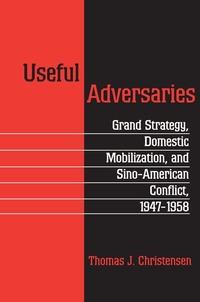
Useful Adversaries
Grand Strategy, Domestic Mobilization, and Sino-American Conflict, 1947-1958
1st Edition
Published on 18. May 2020
352 pages
978-0-691-21332-3 (ISBN)
Description

This book provides a new analysis of why relations between the United States and the Chinese Communists were so hostile in the first decade of the Cold War. Employing extensive documentation, it offers a fresh approach to long-debated questions such as why Truman refused to recognize the Chinese Communists, why the United States aided Chiang Kai-shek's KMT on Taiwan, why the Korean War escalated into a Sino-American conflict, and why Mao shelled islands in the Taiwan Straits in 1958, thus sparking a major crisis with the United States.
Christensen first develops a novel two-level approach that explains why leaders manipulate low-level conflicts to mobilize popular support for expensive, long-term security strategies. By linking "grand strategy," domestic politics, and the manipulation of ideology and conflict, Christensen provides a nuanced and sophisticated link between domestic politics and foreign policy. He then applies the approach to Truman's policy toward the Chinese Communists in 1947-50 and to Mao's initiation of the 1958 Taiwan Straits Crisis. In these cases the extension of short-term conflict was useful in gaining popular support for the overall grand strategy that each leader was promoting domestically: Truman's limited-containment strategy toward the USSR and Mao's self-strengthening programs during the Great Leap Forward. Christensen also explores how such low-level conflicts can escalate, as they did in Korea, despite leaders' desire to avoid actual warfare.
Christensen first develops a novel two-level approach that explains why leaders manipulate low-level conflicts to mobilize popular support for expensive, long-term security strategies. By linking "grand strategy," domestic politics, and the manipulation of ideology and conflict, Christensen provides a nuanced and sophisticated link between domestic politics and foreign policy. He then applies the approach to Truman's policy toward the Chinese Communists in 1947-50 and to Mao's initiation of the 1958 Taiwan Straits Crisis. In these cases the extension of short-term conflict was useful in gaining popular support for the overall grand strategy that each leader was promoting domestically: Truman's limited-containment strategy toward the USSR and Mao's self-strengthening programs during the Great Leap Forward. Christensen also explores how such low-level conflicts can escalate, as they did in Korea, despite leaders' desire to avoid actual warfare.
More details
Other editions
Additional editions
Thomas J. Christensen
Useful Adversaries
Grand Strategy, Domestic Mobilization, and Sino-American Conflict, 1947-1958
Book
12/1996
Princeton University Press
€68.20
Article exhausted; check different version
Thomas J. Christensen
Useful Adversaries
Grand Strategy, Domestic Mobilization, and Sino-American Conflict, 1947-1958
Book
11/1996
Princeton University Press
€52.10
Shipment within 10-20 days
Person
Thomas J. Christensen is currently Assistant Professor of Government at Cornell University. He formerly held an SSRC/MacArthur Foundation fellowship in international peace and security and was an Olin National Security Fellow at Harvard University.
Content
- Cover page
- Half-title page
- Title page
- Copyright page
- Dedication
- Contents
- List of Figures and Tables
- Preface
- Note on Translation and Romanization
- Chapter 1: Introduction
- Chapter 2: Grand Strategy, National Political Power, and Two-Level Foreign Policy Analysis
- Chapter 3: Moderate Strategies and Crusading Rhetoric: Truman Mobilizes for a Bipolar World
- Chapter 4: Absent at the Creation: Acheson's Decision to Forgo Relations with the Chinese Communists
- Chapter 5: The Real Lost Chance in China: Nonrecognition, Taiwan, and the Disaster at the Yalu
- Chapter 6: Continuing Conflict over Taiwan: Mao, the Great Leap Forward, and the 1958 Quemoy Crisis
- Chapter 7: Conclusion
- Appendix A: American Public Opinion Polls, 1947-1950
- Appendix B: Mao's Korean War Telegrams
- Bibliography
- Index
