

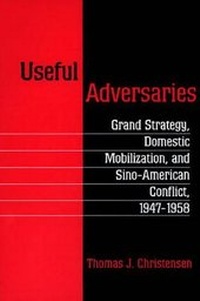
Useful Adversaries
Grand Strategy, Domestic Mobilization, and Sino-American Conflict, 1947-1958
Published on 1. December 1996
Book
Hardback
352 pages
978-0-691-02638-1 (ISBN)
Description
This book provides a new analysis of why relations between the United States and the Chinese Communists were so hostile in the first decade of the Cold War. Employing extensive documentation, it offers a fresh approach to long-debated questions such as why Truman refused to recognize the Chinese Communists, why the United States aided Chiang Kai-shek's KMT on Taiwan, why the Korean War escalated into a Sino-American conflict, and why Mao shelled islands in the Taiwan Straits in 1958, thus sparking a major crisis with the United States.
Christensen first develops a novel two-level approach that explains why leaders manipulate low-level conflicts to mobilize popular support for expensive, long-term security strategies. By linking "grand strategy," domestic politics, and the manipulation of ideology and conflict, Christensen provides a nuanced and sophisticated link between domestic politics and foreign policy. He then applies the approach to Truman's policy toward the Chinese Communists in 1947-50 and to Mao's initiation of the 1958 Taiwan Straits Crisis. In these cases the extension of short-term conflict was useful in gaining popular support for the overall grand strategy that each leader was promoting domestically: Truman's limited-containment strategy toward the USSR and Mao's self-strengthening programs during the Great Leap Forward. Christensen also explores how such low-level conflicts can escalate, as they did in Korea, despite leaders' desire to avoid actual warfare.
Christensen first develops a novel two-level approach that explains why leaders manipulate low-level conflicts to mobilize popular support for expensive, long-term security strategies. By linking "grand strategy," domestic politics, and the manipulation of ideology and conflict, Christensen provides a nuanced and sophisticated link between domestic politics and foreign policy. He then applies the approach to Truman's policy toward the Chinese Communists in 1947-50 and to Mao's initiation of the 1958 Taiwan Straits Crisis. In these cases the extension of short-term conflict was useful in gaining popular support for the overall grand strategy that each leader was promoting domestically: Truman's limited-containment strategy toward the USSR and Mao's self-strengthening programs during the Great Leap Forward. Christensen also explores how such low-level conflicts can escalate, as they did in Korea, despite leaders' desire to avoid actual warfare.
Reviews / Votes
"[Christensen] makes a convincing and original argument that political leaders, in order to secure public support for their fundamental grand strategy, may have to adopt a more hostile foreign policy than they would prefer . . . This volume is indispensable for anyone interested in Sino-American relations." * Foreign Affairs *More details
Language
English
Place of publication
New Jersey
United States
Target group
College/higher education
Professional and scholarly
Product notice
Trade binding
Illustrations
1 Maps
Dimensions
Height: 229 mm
Width: 152 mm
Weight
680 gr
ISBN-13
978-0-691-02638-1 (9780691026381)
Copyright in bibliographic data and cover images is held by Nielsen Book Services Limited or by the publishers or by their respective licensors: all rights reserved.
Schweitzer Classification
Other editions
Additional editions
Thomas J. Christensen
Useful Adversaries
Grand Strategy, Domestic Mobilization, and Sino-American Conflict, 1947-1958
E-Book
05/2020
1st Edition
Princeton University Press
€61.49
Available for download
Person
Thomas J. Christensen is currently Assistant Professor of Government at Cornell University. He formerly held an SSRC/MacArthur Foundation fellowship in international peace and security and was an Olin National Security Fellow at Harvard University.