

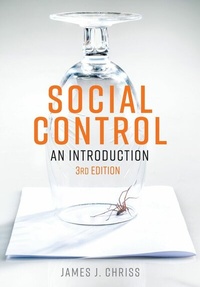
Social Control
Description

What is social control? How do social controls become part of everyday life? What role does the criminal justice system play in exerting control? Is the diagnosis and treatment of mental illness a form of social control? Do we need more social controls to prevent terrorist atrocities?
In this third edition of his popular introduction, James J. Chriss carefully guides readers through the debates about social control. The book provides a comprehensive guide to historical debates and more recent controversies, examining in detail the criminal justice system, medicine, national security, and everyday life. Chriss blends theoretical discussion with a rich range of contemporary examples to illustrate the ways in which social control is exerted and maintained. The updated edition includes new or expanded material on autism, trauma and PTSD, sports participation, the murder of George Floyd and the ensuing protests, domestic terrorism, the COVID-19 pandemic, and the growing importance of social media in surveillance and informal control, among other topics.
Social Control is essential reading for students taking courses in deviance and social control, and will also appeal to those studying criminology, the sociology of law, and medical sociology.
More details
Other editions
Additional editions
Person
Content
1 What Is Social Control?
2 A Typology of Social Control
3 Informal Control
4 Medical Control
5 Legal Control
PART II CASE STUDIES IN SOCIAL CONTROL
6 Informal Control: Housing Segregation, the Code of the Street, and Emerging Adulthood and Morality
7 Medical Control: Selective Mutism, Autism, and Violence as a Disease
8 Legal Control: Racial Profiling, Hate Crimes, and the Imprisonment Binge
9 Terrorism and Social Control
10 Conclusion: The Future of Social Control
Notes
References
Preface and Acknowledgments
While swimming in a pool in the jungle of Nool, Horton the elephant heard a small voice. Kangaroo is the matriarch of the tight and well-maintained social order of Nool. She is depicted as straight-laced and traditional, dripping with conservative "family values." For example, she proudly proclaims that her son, Rudy, is "pouch-schooled."
Horton is viewed by Kangaroo as far more than simply eccentric - in fact, he's downright dangerous - for holding to and spreading his ridiculous belief that he heard a voice coming from a small speck on a clover. Horton insists there are people living on that speck, and he goes about protecting it with every fiber in his being. Kangaroo casts Horton as a weirdo and possibly deranged, certainly a destabilizing influence in Nool. She says, "If you can't see it, feel it, or hear it, it doesn't exist." In no uncertain terms, these sorts of beliefs will not be tolerated in the jungle of Nool. Horton says in his defense, "A person's a person, no matter how small."
As Horton continues to maintain that the speck has life on it, which is his duty to protect and preserve, the dour Kangaroo makes a public case against Horton that he is deranged and deserves to be punished. Most of the jungle caves in to Kangaroo's view, and Horton is successfully made a pariah (except for a few close allies). Being deemed deserving of scorn and ridicule, Horton is harassed and treated shabbily almost until the end of the story.
This is the film adaptation of the classic Dr. Seuss children's book, Horton Hears a Who!, but it has profound implications for social control.1 After being immersed in the study of social control and having committed a good deal of effort grappling with it through these three editions of the book, I am not sure at all if the scholarly writings - and they are voluminous, as attested to by the bibliography - are much better on the subject than this simple, elegant Dr. Seuss tale. I believe that the further you get pulled into deviance and social control, you start realizing it is something akin to a bottomless pit and there is really no way out. There are no happy endings here. Horton did okay by the end of the story because, well, fairy tales are supposed to be uplifting for young and curious minds just starting on their long trek into the heart of the social system. But the stark reality is that this is really dismal stuff, and it will keep getting much worse before getting better, if it ever does.
This sour tone may reflect close to two years of hell dealing with a crazy virus and people losing their minds over politics. This book was delayed because of the strangeness of 2020 and most of 2021. Even under the best of circumstances, it is not easy to wrap your head around the endgame of social control, but with all the noise and cacophony and angst and turbulence and desperation and madness and anger and hostility and sanctimoniousness and virtue-signaling and punitiveness and prudishness and symbolic inflation and superciliousness and faddishness and querulousness - and so on and so forth - the task is nigh hopeless. I truly believe whatever order is created and maintained is pretty much arbitrary, and any order will do. The only thing you can really do is lay low and cover your ass, because the system is just a big grinder moving people and pieces around here and there according to the whims of those who are temporarily in charge. Yes, the only thing to look forward to is knowing that the assholes in charge won't be there for long, because there is a restlessness and the political system plays gotcha games for those ignorant enough to enter the arena.
This restlessness does not lead to the Marxist permanent revolution but to PISS, the perpetual investigative state squared. We are now at the point where we might as well pass a law that all elected officials will from day one have a special counsel assigned to them so that they can dig into their finances and private lives and affairs flush with unlimited cash. You know, the whole "indicting a ham sandwich" thing. And then when they are caught, they will play the silly game of the public confessional where they will grovel and claim trauma or addiction - sex is the juiciest one of course - and that having gone through the ordeal they'll be better and healthier persons for it. And all the while the social media mobs armed with their virtual torches and pitchforks and smartphones are out chasing Frankenstein's Monster into the night serenaded by wolves howling at the moon.
I want to thank my wife Mandy and my daughter and son, Ariana and John, for helping me get through the ordeal of writing this book over these past few years. The editorial team at Polity has been a delight to work with, including most prominently Karina Jákupsdóttir who was understanding about all the delays. And Ian Tuttle did a magnificent job with the copyediting.
Speaking of which, the world of books and publishing provides slivers of light in the vast darkness. You can escape to your favorite authors and spend time with them and learn from them. I have been spending some time with the great Giambattista Vico and thinking a lot about his eternal cycle of history.2 I could not figure out a way of working it into the book, so I will take this opportunity to share my take on his description of the rise and fall and rise again of civilizations through the three great eras of gods, heroes, and men.3
The ancients needed gods to bring them out from the caves, out of superstition and animal lust, and so the Word was brought to the people and enforced with rapaciousness into the era of heroes, where a myth arose that the lowly masses yearned for leaders to lead them out of the wilderness. The age of heroes delivered the fables and tales of heroic protagonists fighting evil and deadly sins, and on their backs kingdoms were built and defended in the earlier, absolutist version of government (the kingship model). Such king-gods became heroes and also appointed themselves as such through such cultural innovations as the divine right of kings, but, with the dawning of the age of enlightenment, the people - the humble citizens of the sovereign state - started growing restless and challenged the unquestioned rule of leaders and sought to share power with them. The toppling of kings and the ushering in of democracy gives rise to the era of people (men), and as satisfaction of wants and desires are met more systematically with the advent of labor-saving technologies along with the rise of the service city and numerous helping professions (medicine, psychotherapy, and social work to name a few), persons lose tolerance for even the small aches and pains of life, while at the same time demanding that the government protect them from the profanations of a hurdy-gurdy, dangerous world. Although launched in the antiquity of cosmological and theological speculation, this escape from the state of nature, which ushered in civilization along with the belief in a growing chasm between the animal and human, becomes a core cultural feature of modernity even as ecological movements emerge - hearkening back to the ancient Greek Cynics - which direct true believers to reject the distinctiveness of human beings in favor of a unitary theory of nature and life.
Along with this, the self, which used to be shored up through close and personal relationships with friends and family, now becomes a focal concern of governments as well, and subjectivity is mined further and deeper to protect fragile self-esteem and punish those who would violate it. In addition, the health tag, initially applied to the body and later to the mind, is continually extended and now we can talk about public health, behavioral health, family health, immigrant health, pet health, prisoner health, adolescent health, friendship health, and the real biggie: sexual health. With sexual health, eroticism is sought as an end for and of itself, the feeling part carved out of the functional aspect of sex, which is of course procreation. Of course, Lester Ward noted long ago that humanity slowly and inexorably circumvents and ensnares nature's method, producing an artificial human society alongside the state of nature from which humanity had continually worked to escape.4
But the focus on satisfying wants - erotic and otherwise - becomes a runaway norm, because human appetites are insatiable and, without sufficient constraints in place to moderate them, the pursuit of gratifications will bring a collapse to social order and return men to the caves - to animal or bare life - once again.5 And then at some point, lost in the wilderness, grunts and utterances will attain the minimal level of symbolic significance made intelligible to those particular human beings in that particular setting - the early poetry of the rude races - once again giving birth (or rather, rebirth) to the gods. And so, the cycle churns on.
Soon after the era of gods comes the era of heroes, the first attempt to inject humanity into the grandiosity of the cosmos and the mysteries of life that confront primitive minds just escaping savagery and barbarism. The early epic poetry of Homer and Virgil are well known, but we will move ahead to the late medieval period, specifically the early fifteenth century, where an unknown (perhaps Scottish or English) author wrote the poem 'The Alliterative Morte Arthure', in which the goddess Fortuna...
