

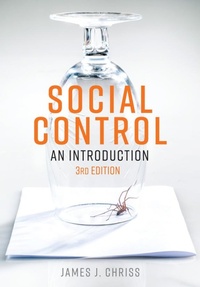
Social Control: An Introduction 3e
An Introduction
Published on 22. September 2022
Book
Paperback/Softback
306 pages
978-1-5095-3950-5 (ISBN)
Description
What is social control? How do social controls become part of everyday life? What role does the criminal justice system play in exerting control? Is the diagnosis and treatment of mental illness a form of social control? Do we need more social controls to prevent terrorist atrocities?
In this third edition of his popular introduction, James J. Chriss carefully guides readers through the debates about social control. The book provides a comprehensive guide to historical debates and more recent controversies, examining in detail the criminal justice system, medicine, national security, and everyday life. Chriss blends theoretical discussion with a rich range of contemporary examples to illustrate the ways in which social control is exerted and maintained. The updated edition includes new or expanded material on autism, trauma and PTSD, sports participation, the murder of George Floyd and ensuing protests, domestic terrorism, the COVID-19 pandemic, and the growing importance of social media in surveillance and informal control, among other topics.
Social Control is essential reading for students taking courses in deviance and social control, and will also appeal to those studying criminology, the sociology of law, and medical sociology.
In this third edition of his popular introduction, James J. Chriss carefully guides readers through the debates about social control. The book provides a comprehensive guide to historical debates and more recent controversies, examining in detail the criminal justice system, medicine, national security, and everyday life. Chriss blends theoretical discussion with a rich range of contemporary examples to illustrate the ways in which social control is exerted and maintained. The updated edition includes new or expanded material on autism, trauma and PTSD, sports participation, the murder of George Floyd and ensuing protests, domestic terrorism, the COVID-19 pandemic, and the growing importance of social media in surveillance and informal control, among other topics.
Social Control is essential reading for students taking courses in deviance and social control, and will also appeal to those studying criminology, the sociology of law, and medical sociology.
More details
Edition
3rd Edition
Language
English
Place of publication
Oxford
United Kingdom
Target group
Professional and scholarly
Dimensions
Height: 172 mm
Width: 246 mm
Thickness: 26 mm
Weight
568 gr
ISBN-13
978-1-5095-3950-5 (9781509539505)
Copyright in bibliographic data and cover images is held by Nielsen Book Services Limited or by the publishers or by their respective licensors: all rights reserved.
Schweitzer Classification
Other editions
Additional editions
Book
09/2022
Polity Press
€74.50
Shipment within 15-20 days
E-Book
09/2022
3rd Edition
Wiley
€19.99
Available for download
Previous edition
Book
12/2012
2nd Edition
Polity Press
Unfortunately, price unknown
Article exhausted; check for reprint
Person
James J. Chriss is Professor of Sociology at Cleveland State University.
Content
PART I UNDERSTANDING SOCIAL CONTROL
1 What Is Social Control?
2 A Typology of Social Control
3 Informal Control
4 Medical Control
5 Legal Control
PART II CASE STUDIES IN SOCIAL CONTROL
6 Informal Control: Housing Segregation, the Code of the Street, and Emerging Adulthood and Morality
7 Medical Control: Selective Mutism, Autism, and Violence as a Disease
8 Legal Control: Racial Profiling, Hate Crimes, and the Imprisonment Binge
9 Terrorism and Social Control
10 Conclusion: The Future of Social Control
Notes
References
1 What Is Social Control?
2 A Typology of Social Control
3 Informal Control
4 Medical Control
5 Legal Control
PART II CASE STUDIES IN SOCIAL CONTROL
6 Informal Control: Housing Segregation, the Code of the Street, and Emerging Adulthood and Morality
7 Medical Control: Selective Mutism, Autism, and Violence as a Disease
8 Legal Control: Racial Profiling, Hate Crimes, and the Imprisonment Binge
9 Terrorism and Social Control
10 Conclusion: The Future of Social Control
Notes
References