

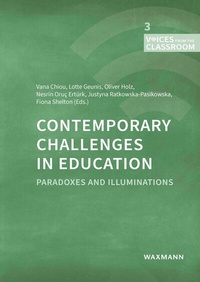
Contemporary Challenges in Education
Paradoxes and Illuminations
1st Edition
Published on 22. June 2023
552 pages
978-3-8309-9697-2 (ISBN)
Description

Every day educators are presented with enlightening insights, questions, and encounters which reveal how students engage in learning, how new ideas can impact positively on student outcomes and how - when challenges are uncovered - there can be a sense of puzzlement where rethinking of pedagogical approaches is critical for student success. In this volume of Voices from the Classroom, "Contemporary Challenges in Education - Paradoxes and Illuminations", an international team of authors explores paradoxes, shares illuminations and invites you to reflect on educational practices to enhance pedagogy, scaffold learning and keep pace with educational advancements.
This collection written by students, teachers, researchers and higher education instructors discusses education across all phases of learning. It explores issues such as instructional scaffolding in kindergarten, understanding transition through children's voices, youth participation in curriculum development of sex education, delivering crisis assistance to university students and staff in times of conflict in Ukraine, using augmented reality for transformative learning, co-creating university practices with staff and students, and how inclusive practices can help meet the needs of international postgraduate students. This comprehensive and diverse collection will have wide appeal for teachers, headmasters, stakeholders in the area of education and all those working in different educational contexts.
This collection written by students, teachers, researchers and higher education instructors discusses education across all phases of learning. It explores issues such as instructional scaffolding in kindergarten, understanding transition through children's voices, youth participation in curriculum development of sex education, delivering crisis assistance to university students and staff in times of conflict in Ukraine, using augmented reality for transformative learning, co-creating university practices with staff and students, and how inclusive practices can help meet the needs of international postgraduate students. This comprehensive and diverse collection will have wide appeal for teachers, headmasters, stakeholders in the area of education and all those working in different educational contexts.
More details
Other editions
Additional editions
Vana Chiou | Lotte Geunis | Oliver Holz
Contemporary Challenges in Education
Paradoxes and Illuminations
Book
06/2023
1st Edition
Waxmann
€59.00
Shipment within 7-9 days
Content
1 - Frontmatter [Seite 1]
1.1 - Cover [Seite 1]
1.2 - Imprint [Seite 4]
1.3 - Contents [Seite 5]
2 - Preface [Seite 9]
3 - Gender Identity and Stereotypes. The Role of Play in Kindergarten (Andromachi Bouna Vaila & Alexandra Theodorou) [Seite 10]
3.1 - Introduction [Seite 10]
3.2 - Gender theories [Seite 11]
3.3 - Gender discrimination through play [Seite 12]
3.4 - Methodology [Seite 13]
3.5 - Results [Seite 14]
3.6 - Discussion [Seite 16]
3.7 - Conclusions [Seite 18]
3.8 - References [Seite 18]
4 - Instructional Scaffolding in Kindergarten through the Use of Other-Initiations of Repair (Maria Boutzarelou) [Seite 21]
4.1 - 1 Introduction [Seite 21]
4.1.1 - 1.1 Organisation of repair in classroom contexts [Seite 22]
4.2 - 2 Methodology [Seite 23]
4.3 - 3 Data analysis [Seite 24]
4.4 - 4 Findings [Seite 26]
4.4.1 - 4.1 Formats and functions of other-initiations of repair [Seite 26]
4.4.2 - 4.2 Instructional scaffolding and other-initiations of repair [Seite 27]
4.5 - 5 Conclusion [Seite 28]
4.6 - 6 Limitations of the study [Seite 28]
4.7 - References [Seite 28]
5 - Listening to Young Children's Voices in Education. An Effective Way of Enhancing Active Participation and Emotional Well-being (Aimilia Rouvali & Vassiliki Riga) [Seite 30]
5.1 - Introduction [Seite 30]
5.2 - The study [Seite 32]
5.3 - Materials and methods [Seite 32]
5.3.1 - The participants [Seite 32]
5.3.2 - The tools [Seite 33]
5.3.3 - Neurotypically developing children [Seite 33]
5.3.4 - Mary's case study [Seite 36]
5.4 - Results (neurotypically developing children) [Seite 37]
5.4.1 - Digital cameras [Seite 37]
5.4.2 - The guided tours [Seite 38]
5.4.3 - The maps [Seite 38]
5.4.4 - The interviews [Seite 38]
5.4.5 - The parents' and teachers' questionnaires [Seite 38]
5.5 - Mary's case study [Seite 39]
5.5.1 - Observations [Seite 39]
5.5.2 - Intensive interaction [Seite 39]
5.5.3 - Digital camera [Seite 39]
5.5.4 - The "I like / I don't like" activities [Seite 39]
5.5.5 - The parent's and teacher's questionnaires [Seite 40]
5.6 - Discussion [Seite 40]
5.6.1 - The challenges [Seite 41]
5.6.2 - The benefits [Seite 42]
5.7 - Conclusion [Seite 42]
5.8 - References [Seite 43]
6 - Parents' and Kindergarten Teachers' Views on the Introduction of Communication Rules to Preschoolers (Panagiotis J. Stamatis, Vasiliki Kostoula, Tania Tourkomanoli & Maria E. Chatzinikola) [Seite 47]
6.1 - Introduction [Seite 47]
6.2 - Methodology [Seite 49]
6.3 - Results [Seite 50]
6.4 - Discussion [Seite 55]
6.5 - Conclusions [Seite 56]
6.6 - Survey limitations [Seite 57]
6.7 - Acknowledgements [Seite 57]
6.8 - References [Seite 57]
7 - From Transfer of Knowledge to Skills' Acquisition. Modern Trends of 21st Century Preschool Pedagogy (Panagiotis J. Stamatis, Eleni N. Nikolaou & Vasileios V. Papavasileiou) [Seite 59]
7.1 - Introduction [Seite 59]
7.2 - Skills for the 21st century schools [Seite 60]
7.3 - Skills for the century of globalization [Seite 61]
7.4 - Learning and innovation skills: a brief presentation of 4Cs and more [Seite 62]
7.5 - Social and emotional skills [Seite 64]
7.6 - Concluding statements [Seite 66]
7.7 - References [Seite 66]
8 - Children's Socio-Emotional Well-being and Resilience duringTransition from Family Home to Kindergarten (Sanja Tatalovi? Vorkapi?) [Seite 68]
8.1 - Introduction to children's transitions and well-being [Seite 68]
8.2 - Childhood transitions: definition, theoretical model and educational context [Seite 69]
8.3 - Socio-emotional well-being and resilience in children [Seite 70]
8.4 - The research aim and tasks [Seite 71]
8.5 - Method [Seite 71]
8.5.1 - Sample [Seite 71]
8.5.2 - Measures [Seite 71]
8.5.3 - Procedure [Seite 72]
8.6 - Results and discussion [Seite 72]
8.6.1 - Socio-emotional well-being and resilience of children during transition [Seite 72]
8.6.2 - Correlations between socio-emotional well-being and resilience dimensions and transition quality indicators [Seite 74]
8.7 - Conclusions with practice implications [Seite 76]
8.8 - Acknowledgements [Seite 77]
8.9 - References [Seite 77]
9 - Understanding Transition through the Children's Voices. The Application of Puppet Interview as the Research Method (Sanja Tatalovi? Vorkapi? & Dunja An?i?) [Seite 80]
9.1 - Introduction [Seite 80]
9.2 - Childrens' well-being during transitions [Seite 81]
9.3 - Interview based on role-play using hand-held puppets [Seite 83]
9.4 - Aim of this study [Seite 85]
9.5 - Method [Seite 85]
9.5.1 - Sample [Seite 85]
9.5.2 - Measure: Interview based on role-play using hand-held puppets [Seite 86]
9.5.3 - Procedure [Seite 87]
9.6 - Results and discussion [Seite 87]
9.7 - Conclusions [Seite 90]
9.8 - Acknowledgements [Seite 91]
9.9 - References [Seite 91]
10 - The Effectiveness of Geo-comics as an Instructional Tool. A Case Study of Teaching Geography in a Greek School (Christos Alpochoritis, Vana Chiou & Dimitrios Stafidas) [Seite 94]
10.1 - Introduction [Seite 94]
10.2 - Related literature [Seite 95]
10.2.1 - Geo-comics [Seite 96]
10.3 - Methodology [Seite 96]
10.3.1 - The purpose of the research [Seite 96]
10.3.2 - Research questions [Seite 97]
10.3.3 - Participants [Seite 97]
10.3.4 - Research material [Seite 97]
10.3.5 - The teaching scenario [Seite 98]
10.3.6 - The creation of the geo-comic [Seite 98]
10.3.7 - Method analysis [Seite 99]
10.4 - Results [Seite 100]
10.4.1 - Pre-test results [Seite 100]
10.4.2 - Post-test results [Seite 100]
10.4.3 - Students' views on the teaching process and the use of geo-comic as a teaching tool. [Seite 101]
10.4.4 - Independent teachers' observations [Seite 103]
10.5 - Discussion [Seite 104]
10.6 - Acknowledgements [Seite 105]
10.7 - References [Seite 106]
11 - The Use of the PREZI VIDEO Application in the Teaching of the Course of Religious Education in Greek Public Schools (Synchronous and Asynchronous Education) (Georgios Gaitanos) [Seite 108]
11.1 - 1 Introduction [Seite 108]
11.2 - 2 Short presentation of Prezi [Seite 109]
11.2.1 - 2.1 What is Prezi? [Seite 109]
11.2.2 - 2.2 The Prezi Video application [Seite 110]
11.2.3 - 2.3 Creating videos for the course of Religious Education [Seite 110]
11.3 - 3 Blended learning [Seite 111]
11.3.1 - 3.1 Theory [Seite 111]
11.3.2 - 3.2 Application to the course of Religious Education [Seite 112]
11.4 - 4 Research on the course of the method [Seite 114]
11.4.1 - 4.1 Gymnasium [Seite 115]
11.4.2 - 4.2 Lyceum [Seite 116]
11.5 - 5 Conclusions [Seite 117]
11.6 - References [Seite 117]
12 - Greek Teachers' Beliefs as Correlated with Students' Self-efficacy during a Nomination Procedure of Students with High Potential (Aikaterini Gari, Irina Mrvoljak-Theodoropoulou & Vasiliki Nikolopoulou) [Seite 120]
12.1 - The teacher's role in nominating students' high potential [Seite 120]
12.2 - Students' academic potential [Seite 121]
12.3 - Towards a systemic perspective of students' potential [Seite 122]
12.4 - The present study [Seite 122]
12.5 - Method [Seite 122]
12.5.1 - Sample and procedure [Seite 122]
12.5.2 - Tools [Seite 123]
12.6 - Results [Seite 124]
12.7 - Discussion [Seite 126]
12.8 - Conclusions [Seite 127]
12.9 - References [Seite 128]
13 - Reasons, Resources, and Reality. Investigating the Complexity of Pupils' Aspirations and How They Conceive Pathways to Their Future Adult Selves (Ruth Hudson, Gillian Forrester, Jane Rowley & Jim Pugh) [Seite 130]
13.1 - Introduction [Seite 130]
13.2 - Literature review [Seite 131]
13.2.1 - Pupil aspirations [Seite 131]
13.2.2 - Parents and teachers [Seite 132]
13.3 - Reasons and resources [Seite 133]
13.4 - Research design and methodology [Seite 133]
13.5 - Data collection and analysis [Seite 134]
13.6 - Findings and discussion [Seite 134]
13.7 - Reasons: the influence of family, job status and further and higher education [Seite 135]
13.8 - Resources: family and teacher information [Seite 136]
13.9 - Reality: working hard for future careers [Seite 137]
13.10 - Conclusion [Seite 139]
13.11 - Acknowledgements [Seite 139]
13.12 - References [Seite 139]
14 - A Systems Approach to School Culture in the Light of Niklas Luhmann's Theory (Stamatina Kioussi & Anastassios Kodakos) [Seite 141]
14.1 - Introduction [Seite 141]
14.2 - Brief bibliographical reference to the "traditional" approaches to school culture [Seite 142]
14.3 - A systems approach to the organizational culture phenomenon [Seite 143]
14.4 - Application of systems theory for organizational culture in the school environment [Seite 147]
14.5 - Epilogue [Seite 149]
14.6 - References [Seite 150]
15 - Sharpening the Definition of the "School as a Learning Organization" (Konstantinos Oikonomou & Angeliki Lazaridou) [Seite 153]
15.1 - Introduction [Seite 153]
15.2 - The ambiguities of the concept of SLO [Seite 154]
15.3 - Sharpening the concept of SLO [Seite 155]
15.3.1 - How did the scholars who introduced the LO concept in the educational field mean it? What has happened since then? [Seite 155]
15.3.2 - What is the larger educational context in which the discussion about SLO is framed? [Seite 156]
15.3.3 - Under what conditions can the understanding of the concept be considered improved? [Seite 157]
15.3.4 - Do varying or even contrasting understandings of SLO co-exist and why? [Seite 158]
15.3.5 - Is currently a resource available that can serve as a safe point of departure when dealing with the SLO? [Seite 159]
15.4 - Conclusion [Seite 160]
15.5 - References [Seite 161]
16 - Measurement Properties of the Adolescent Cyberdating Relationships. A Study of the Cyberdating Q_A Scale (S?awomir Pasikowski & Elisabeth Desiana Mayasari) [Seite 165]
16.1 - 1 Introduction [Seite 165]
16.2 - 2 Method [Seite 167]
16.2.1 - 2.1 Participants [Seite 167]
16.2.2 - 2.2 Instrument [Seite 167]
16.2.3 - 2.3 Procedure [Seite 167]
16.3 - 3 Results [Seite 168]
16.4 - 4 Discussion [Seite 172]
16.5 - 5 Conclusions [Seite 172]
16.6 - Acknowledgements [Seite 172]
16.7 - References [Seite 172]
17 - Demand from Thy Students as from Thyself. Reflections on Teaching Based on One's Own Example (Bartlomiej Pielak) [Seite 174]
17.1 - Build a school where students are at the centre of attention [Seite 174]
17.2 - Proposal of pan-European curriculum [Seite 175]
17.3 - European school system update [Seite 175]
17.4 - Setting high pedagogical standards [Seite 176]
17.5 - Acknowledgements [Seite 177]
18 - Secondary Teachers' Views on Evaluating a Web-based Platform (Ourania Rizou, Aikaterini Klonari & Dimitrios Kavroudakis) [Seite 178]
18.1 - 1 Introduction [Seite 178]
18.2 - 2 Research questions [Seite 180]
18.3 - 3 Research methodology [Seite 180]
18.4 - 4 Research and results [Seite 181]
18.5 - 5 Discussion [Seite 184]
18.6 - 6 Conclusions [Seite 186]
18.7 - References [Seite 187]
19 - Family Counselling for Parents of Bullied School Children. What Parents are Looking for and What They Get in This Area (Ma?gorzata S?owik) [Seite 189]
19.1 - 1 Introduction [Seite 189]
19.2 - 2 Methodological assumptions [Seite 190]
19.3 - 3 Survey results [Seite 192]
19.3.1 - 3.1 Characteristics of the respondents and their children [Seite 192]
19.3.2 - 3.2 Types of help parents seek in family counselling in the broad sense [Seite 192]
19.3.3 - 3.3 Types of help parents receive in family counselling in the broad sense (with evaluation) [Seite 193]
19.4 - 4 Discussion [Seite 194]
19.5 - 5 Conclusions and recommendations [Seite 197]
19.6 - References [Seite 199]
20 - In-service Training towards the Transformation of the State-school Teacher's Role in the 21st Century. A Case Study (Maria Tzotzou & Maria Poulou) [Seite 202]
20.1 - Introduction [Seite 202]
20.2 - Literature review [Seite 203]
20.2.1 - The 21st century socio-educational context [Seite 203]
20.2.2 - Transformation of 21st century teachers' role [Seite 203]
20.2.3 - INSET contribution [Seite 205]
20.3 - Methodology [Seite 206]
20.3.1 - Aim and research questions [Seite 206]
20.3.2 - Research approach [Seite 206]
20.3.3 - Tool and data analysis [Seite 206]
20.3.4 - Population and sampling [Seite 207]
20.4 - Research findings [Seite 208]
20.4.1 - Demographics [Seite 208]
20.4.2 - Academic qualifications [Seite 208]
20.4.3 - Teaching experience [Seite 208]
20.4.4 - Answers to research questions [Seite 208]
20.5 - Discussion [Seite 210]
20.5.1 - Critical analysis [Seite 210]
20.5.2 - Implications [Seite 211]
20.5.3 - Research limitations [Seite 211]
20.5.4 - Suggestions for further research [Seite 212]
20.6 - Conclusion [Seite 212]
20.7 - References [Seite 212]
21 - Delivering Crisis Assistance and Psychological Services to University Students and Staff in Times of Military Conflict in Ukraine (Maria Aleksandrovich) [Seite 216]
21.1 - Introduction [Seite 216]
21.2 - Crisis assistance [Seite 217]
21.3 - Psychological help [Seite 219]
21.4 - Support group [Seite 220]
21.5 - Conclusion [Seite 221]
21.6 - Acknowledgements [Seite 221]
21.7 - References [Seite 222]
22 - Co-creation in Higher Education Milieus. From Concepts to Actions (Melanie Brook, Megan Carr, Golam Jamil, James Knight, Katie Lupton, Catherine O'Connor, Syra Shakir, Fiona Shelton, Alison Torn & Ruth Wilson) [Seite 223]
22.1 - Introduction [Seite 223]
22.2 - Overview of the co-creation project [Seite 224]
22.3 - Narratives of personal experience [Seite 226]
22.4 - Melanie Brook: Forensic Psychology, Student Research Associate [Seite 226]
22.5 - Megan Carr: Psychology, Student Research Associate [Seite 227]
22.6 - James Knight, Sport and Exercise Sciences, Student Research Associate [Seite 228]
22.7 - Katie Lupton: Lead in International Academic Partnerships [Seite 230]
22.8 - Syra Shakir: Associate Professor in Learning and Teaching [Seite 231]
22.9 - Alison Torn: Associate Professor in Learning and Teaching [Seite 232]
22.10 - Ruth Wilson: Director of Student Support and Engagement [Seite 233]
22.11 - Conclusions [Seite 234]
22.12 - Acknowledgements [Seite 235]
22.13 - References [Seite 235]
23 - Bridging Cultures. Meeting the Needs of International Postgraduate Students Undertaking Postgraduate Studies in Disability and Inclusion (Wendy Conrad) [Seite 238]
23.1 - Introduction [Seite 238]
23.2 - Broad challenges [Seite 239]
23.3 - Internationalisation in special educational needs, disability, and inclusion [Seite 240]
23.4 - What specific interventions / adaptations would be helpful? [Seite 242]
23.5 - Summary and implications [Seite 244]
23.6 - Method [Seite 245]
23.7 - References [Seite 245]
24 - International Teachers in Flanders. Voices from the Field (Katrijn D'Herdt & Oliver Holz) [Seite 248]
24.1 - 1 Introduction [Seite 248]
24.2 - 2 International Teachers for Tomorrow's School - the history [Seite 248]
24.2.1 - 2.1 Target groups [Seite 250]
24.2.2 - 2.2 Objectives [Seite 250]
24.3 - 3 Voices from the field: interviews with teachers and principals [Seite 252]
24.3.1 - 3.1 Language requirements [Seite 253]
24.3.2 - 3.2 Degree recognition [Seite 254]
24.3.3 - 3.3 Employment [Seite 255]
24.3.4 - 3.4 General acknowledgement of efforts and motivation [Seite 256]
24.3.5 - 3.5 Professionalization and continuous education [Seite 256]
24.4 - 4 Conclusions [Seite 258]
24.5 - References [Seite 258]
25 - (Get to) Know your Students! Designing Virtual Teaching Settings Consciously and Actively for an Interaction-oriented Teaching (Henrik Dindas) [Seite 260]
25.1 - Introduction [Seite 260]
25.2 - Relationship-orientation & (virtual) teaching [Seite 261]
25.3 - Virtual teaching: how can students be met in virtual teaching? [Seite 262]
25.4 - Interaction designers and communication facilitators in virtual courses [Seite 263]
25.5 - Virtual teaching at FOM University - an example [Seite 265]
25.6 - Empirical observations [Seite 267]
25.7 - Concluding remarks [Seite 269]
25.8 - References [Seite 270]
26 - Prospective English Teachers' Views on Teacher Education Program (Berna Güryay) [Seite 272]
26.1 - 1 Introduction [Seite 272]
26.1.1 - 1.1 Literature review [Seite 273]
26.2 - 2 Methodology [Seite 274]
26.2.1 - 2.1 Participants of the study [Seite 274]
26.2.2 - 2.2 Research question [Seite 275]
26.2.3 - 2.3 Data Collection Tools [Seite 275]
26.2.4 - 2.4 Data Analysis Process [Seite 276]
26.3 - 3 Results [Seite 276]
26.3.1 - 3.1 Results of the open-ended questionnaire: [Seite 276]
26.3.2 - 3.2 Results of the written reflections [Seite 279]
26.4 - 4 English medium instruction (S4, 10) [Seite 283]
26.5 - 5 Discussion & conclusion [Seite 283]
26.6 - References [Seite 284]
27 - Pedagogical Differentiation in Higher Education. Conceptual Determinants and Definitions (Eurydice-Maria Kanellopoulou & Maria Darra) [Seite 286]
27.1 - Introduction [Seite 286]
27.2 - Pedagogical differentiation in higher education: a theoretical approach [Seite 287]
27.3 - Methodology [Seite 288]
27.4 - Process of identification of dimensions of pedagogical differentiation [Seite 288]
27.5 - Results [Seite 291]
27.6 - Discussion [Seite 294]
27.7 - Conclusions [Seite 296]
27.8 - References [Seite 298]
28 - Teachers' and Students' Attitudes Toward Science and Research Methodology. The Measurement in Higher Education (Elisabeth Desiana Mayasari & S?awomir Pasikowski) [Seite 300]
28.1 - 1 Introduction [Seite 300]
28.2 - 2 Attitude [Seite 302]
28.3 - 3 Science and research methodology as an object of attitude [Seite 304]
28.4 - 4 Measurement of attitudes [Seite 306]
28.5 - 5 Conclusions [Seite 307]
28.6 - References [Seite 308]
29 - Students' Views on the Psychological Well-being of Children in Preschool Age (Eleni N. Nikolaou, Panagiotis J. Stamatis & Vasileios F. Papavasileiou) [Seite 313]
29.1 - Introduction [Seite 313]
29.2 - Conceptualization of well-being [Seite 313]
29.3 - Previous research [Seite 315]
29.4 - Methodology [Seite 317]
29.5 - Results and discussion [Seite 317]
29.6 - Conclusions [Seite 321]
29.7 - References [Seite 321]
30 - Voices from an ESP Classroom at a Greek University. Examples from Educational Practices (Ekaterini Nikolarea) [Seite 324]
30.1 - An ESP classroom situation - (a) "Process" (n.): An example of Interscientificity[English: Greek] revealed through Maieutics (as a teaching method) [Seite 324]
30.2 - An ESP classroom situation - (b) "??????????" ("Leitourgia") (n.): an example of reverse inter-scientificity revealed through a deepening of Maieutics [Seite 326]
30.3 - (????) ?????????? [Thia Leitourgia - Divine Liturgy]: Religious and Cultural Differences [Seite 327]
30.4 - ?????????? (Leitourgia - Liturgy): One more term historically and socioculturally grounded - When teaching becomes the teacher's learning experience [Seite 328]
30.5 - The issue and importance of reverse inter-scientificity through Maeutics - When the ESP teacher's learning experience becomes a teaching method [Seite 328]
30.6 - A definition of reverse inter-scientificity and how to handle it [Seite 328]
30.7 - General remarks and conclusions [Seite 329]
30.8 - Maieutics - the topos (locus or place) where teaching and learning methods can coalesce and become almost interchangeable [Seite 329]
30.9 - A paradigm shift in teaching ESP at non-English Universities [Seite 329]
30.10 - Acknowledgements [Seite 331]
30.11 - References [Seite 331]
31 - 'Becoming Something Bigger and Better than You Were'. One Teacher's Experience of Identity Transition[s] during Master's Level Research (Amanda Nuttall) [Seite 332]
31.1 - Introduction [Seite 332]
31.2 - Research questions [Seite 333]
31.3 - Conceptual framework: idenity[ies] [Seite 334]
31.3.1 - Teacher and researcher identity[ies] [Seite 335]
31.4 - Empirical work [Seite 336]
31.4.1 - A case study approach [Seite 337]
31.4.2 - Video diary 1: starting to research [Seite 339]
31.4.3 - Video diary 2: Covid-19 lockdown [Seite 340]
31.4.4 - Video diary 3: Learning to be a researcher [Seite 340]
31.4.5 - Video diary 4: research is part of me [Seite 341]
31.5 - Discussion [Seite 342]
31.6 - Conclusion [Seite 343]
31.7 - References [Seite 344]
32 - Trends and Innovation in Interpreter Training. Remote Interpreting and Innovation in University Studies (Marina Pappa) [Seite 347]
32.1 - Translation and interpreting and community interpreting [Seite 347]
32.2 - The context of the research [Seite 349]
32.3 - Findings [Seite 350]
32.4 - Conclusions [Seite 353]
32.5 - References [Seite 353]
33 - Enabling Participation through UNITE. Potential and Limitations of International Cooperation in a Teacher Education Project (Jan Springob, Anna Krämer & Ina Berninger) [Seite 355]
33.1 - 1 Introduction [Seite 355]
33.2 - 2 International networking: characteristics and consequences for teacher education [Seite 356]
33.3 - 3 Methodological approach of the empirical study [Seite 357]
33.4 - 4 Enabling participation: findings on possibilities and limitations [Seite 359]
33.4.1 - 4.1 Confirmation of known opportunities and challenges in internationalisation of teacher education [Seite 359]
33.4.2 - 4.2 Virtual cooperation is possible and profitable to differing degrees [Seite 360]
33.4.3 - 4.3 Networking on different levels and with different duties [Seite 362]
33.5 - 5 Recommendations [Seite 363]
33.6 - 6 Conclusion [Seite 364]
33.7 - Acknowledgements [Seite 364]
33.8 - References [Seite 364]
34 - Communication and Collaboration as Life-long Learning Skills. Students' Perspectives (Vassiliki Tzika, Stavroula Kaldi, Christos Govaris & Konstantina Koutrouba) [Seite 366]
34.1 - Introduction [Seite 366]
34.2 - Literature review [Seite 367]
34.2.1 - Life-long learning skills [Seite 367]
34.2.2 - Communication and Collaboration Skills (CCSs) [Seite 368]
34.3 - Research method [Seite 369]
34.3.1 - Participants and procedure [Seite 369]
34.4 - Findings [Seite 370]
34.4.1 - Students' perspectives about the development of the CCSs in the classroom - RQ1 [Seite 370]
34.4.2 - Communication [Seite 370]
34.4.3 - Collaboration [Seite 371]
34.4.4 - Extent of the cultivation of CCSs which is happening in classrooms [Seite 372]
34.4.5 - Obstacles which students meet regarding the cultivation of CCSs- RQ2 [Seite 372]
34.4.6 - Communication obstacles [Seite 373]
34.4.7 - Collaboration obstacles [Seite 373]
34.4.8 - Differences between the voices of students with- or without an immigrant background about CCSs- RQ3 [Seite 373]
34.5 - Discussion [Seite 374]
34.6 - Limitations [Seite 375]
34.7 - Acknowledgments [Seite 375]
34.8 - References [Seite 375]
35 - The Socioemotional Aspect of Classroom Climate in Song-based EFL Classes (Helena Zitková & Marek Vít) [Seite 378]
35.1 - Introduction [Seite 378]
35.2 - Song-based English classes [Seite 379]
35.3 - Classroom climate [Seite 380]
35.4 - Methodology [Seite 381]
35.5 - Context of the study and its participants [Seite 381]
35.6 - Data collection [Seite 382]
35.7 - Data analysis [Seite 382]
35.8 - Findings and discussion [Seite 383]
35.9 - Perceived atmosphere in the classes [Seite 383]
35.10 - Aspects influencing the atmosphere in the classes [Seite 385]
35.11 - Conclusion [Seite 387]
35.12 - References [Seite 388]
36 - Is there Sustainability in Art or Art in Sustainability? Early Childhood Education Students' Understanding about Interconnectedness of the Art and Sustainability (Marijana Zupani? Beni? & Adrijana Visnji?-Jevti?) [Seite 391]
36.1 - Introduction [Seite 391]
36.2 - Teachers as promoters of sustainable development [Seite 392]
36.3 - Artistic activities and sustainable development in early childhood [Seite 392]
36.4 - Methods [Seite 393]
36.5 - Instrument [Seite 393]
36.6 - Sample [Seite 394]
36.7 - Results and discussion [Seite 395]
36.8 - Conclusion [Seite 397]
36.9 - References [Seite 398]
37 - Utilizing Augmented Reality to a Transformative Learning Process through Aesthetic Experience. A Case Study (Sissy Barakari & Anastasia Dimitra) [Seite 400]
37.1 - 1 Introduction [Seite 400]
37.2 - 2 Literature review [Seite 401]
37.2.1 - Transformative learning and aesthetic experience [Seite 401]
37.2.2 - Augmented reality, art and education [Seite 402]
37.3 - 3 Method [Seite 403]
37.3.1 - 3.1 Designing the course [Seite 404]
37.3.1.1 - Determining the main topic and selecting the artworks [Seite 405]
37.3.1.2 - Designing the AR experience [Seite 406]
37.3.1.3 - Designing the interactive talk [Seite 408]
37.3.2 - 3.2 Evaluation procedure [Seite 409]
37.3.2.1 - Participants, limitations and pre-tests [Seite 410]
37.4 - 4 Findings [Seite 410]
37.5 - 5 Conclusion and future work [Seite 412]
37.6 - References [Seite 413]
38 - Inclusion in German Adult Education and Intersectional Perspectives on the Professionalization in Inclusive Adult Education (Franziska Bonna) [Seite 415]
38.1 - Introduction [Seite 415]
38.2 - German literature review on inclusion in adult education [Seite 416]
38.3 - Main findings of the literature review [Seite 417]
38.4 - Professionalization for inclusive adult education [Seite 419]
38.5 - Intersectionally-oriented professionalization for inclusive adult education [Seite 421]
38.6 - Conclusions [Seite 423]
38.7 - References [Seite 424]
39 - Youth Participation in Curriculum Development of Sexuality Education. A Review of International Guidance (Lotte Geunis) [Seite 427]
39.1 - 1 Introduction [Seite 427]
39.2 - 2 International guidance on sexuality education: a review [Seite 429]
39.3 - 3 Sexuality education curriculum development: the case of Ireland [Seite 433]
39.4 - 4 Recommendations for further research [Seite 434]
39.5 - 5 Conclusion [Seite 435]
39.6 - References [Seite 436]
40 - Interculturalism or Assimilation? Institutional Contradictions in the Education of Students with Heterogeneous Cultural Background in Greece (Christos Parthenis, Paraskevi Eleftheriou & Lambrini Siouli) [Seite 439]
40.1 - Introduction: the immigration phenomenon in Greece [Seite 439]
40.2 - Policy models and their link to multicultural education approaches [Seite 440]
40.3 - Approaches based on liberalism [Seite 440]
40.4 - Approaches based on neo-liberalism [Seite 441]
40.5 - Approaches based on social democracy [Seite 441]
40.6 - Radical approaches [Seite 442]
40.7 - Research methodology [Seite 442]
40.8 - Purpose of the research [Seite 443]
40.9 - Results of analysis of the legislative framework of immigrant education. The institutional framework of the years 1990-2000 [Seite 443]
40.10 - The institutional framework regarding the years 2001-2010 [Seite 444]
40.11 - The institutional framework regarding the years 2011-2021 [Seite 445]
40.12 - Conclusions regarding the institutional response of Greece to the education of immigrants and refugees [Seite 446]
40.13 - References [Seite 447]
41 - The Effectiveness of LGB Diversity Policies in Organizations. A Qualitative Research Contribution on How Ally Confrontation Can Constitute to a More LGB Inclusive Environment in the Workplace (Arno Reynaert & Oliver Holz) [Seite 450]
41.1 - 1 Introduction [Seite 450]
41.2 - 2 Literature review [Seite 451]
41.2.1 - 2.1 LGB diversity policies in organizations [Seite 452]
41.2.2 - 2.2 Effectiveness of LGB diversity policies [Seite 453]
41.2.3 - 2.3 Sociocultural stigmatization of sexual minority groups [Seite 453]
41.2.4 - 2.4 Allyship [Seite 454]
41.2.4.1 - 2.4.1 Ally development [Seite 454]
41.2.4.2 - 2.4.2 Ally confrontation [Seite 455]
41.3 - 3 Methodology [Seite 456]
41.4 - 4 Results [Seite 457]
41.4.1 - 4.1 LGB diversity and inclusion policies [Seite 457]
41.4.2 - 4.2 LGB support in organizations [Seite 458]
41.4.2.1 - 4.2.1 Internal signals of support [Seite 458]
41.4.2.2 - 4.2.2 External signals of support [Seite 459]
41.4.3 - 4.3 Valuation measures for LGB representation and well-being [Seite 460]
41.4.4 - 4.4 Individual experiences of LGB individuals in the workplace [Seite 460]
41.4.5 - 4.5 Allyship [Seite 461]
41.4.5.1 - 4.5.1 Becoming an ally, and reasons why not to speak up [Seite 461]
41.4.5.2 - 4.5.2 Ally confrontation [Seite 462]
41.5 - 5 Discussion and conclusion [Seite 463]
41.6 - References [Seite 465]
42 - Conditions for Online Lessons in the Czech Republic during the COVID-19 Pandemic (Ond?ej Duda & Alena J?vová) [Seite 468]
42.1 - Introduction [Seite 468]
42.2 - Pupils and students [Seite 469]
42.3 - Online teaching and lessons [Seite 469]
42.3.1 - Online platforms for teaching [Seite 470]
42.3.2 - Online teaching in the Czech Republic [Seite 470]
42.4 - Research design [Seite 471]
42.5 - Research limitations [Seite 472]
42.6 - Research results [Seite 472]
42.6.1 - Condition 1: platforms and tools used for online lessons [Seite 473]
42.6.2 - Condition 2: Internet connection stability during online lessons [Seite 473]
42.6.3 - Condition 3: negative aspects of online lessons [Seite 474]
42.6.4 - Condition 4: Preparation for online lessons [Seite 474]
42.6.5 - Condition 5: Students' satisfaction with online lessons [Seite 475]
42.7 - Discussion [Seite 475]
42.8 - Conclusion [Seite 476]
42.9 - Acknowledgement [Seite 476]
42.10 - References [Seite 476]
43 - "Portraits and Scenes from the Quarantine". Emotional Awareness and Positive Psychology in Children's Drawings (Stavroula Kaldi, Aikaterini Vassiou, Vassiliki Tzika & Zoi Hajopoulou) [Seite 478]
43.1 - Introduction [Seite 478]
43.2 - Theoretical framework [Seite 479]
43.2.1 - Emotional Intelligence and emotional awareness [Seite 479]
43.2.2 - Positive psychology and positive education [Seite 480]
43.2.3 - Drawings in challenging periods [Seite 480]
43.3 - Research method [Seite 481]
43.3.1 - Participants and procedure [Seite 481]
43.4 - Findings [Seite 482]
43.4.1 - 1. Children's emotional awareness [Seite 482]
43.4.1.1 - 1.1 Joy because of love and daily contact with family [Seite 482]
43.4.1.2 - 1.2 Joy because of socializing with friends [Seite 483]
43.4.1.3 - 1.3 Joy for another reason [Seite 484]
43.4.1.4 - 1.4 Boredom [Seite 486]
43.4.2 - 2. Children's pleasant experiences [Seite 486]
43.4.2.1 - 2.1 Games inside the house [Seite 486]
43.4.2.2 - 2.2 Games outdoors [Seite 488]
43.4.2.3 - 2.3 Playing with family members [Seite 489]
43.4.2.4 - 2.4 Using technology [Seite 490]
43.5 - Discussion [Seite 491]
43.6 - References [Seite 492]
44 - Teacher Emotions during the Pandemic (Nesrin Oruç-Ertürk & Yesim Bektas-Cetinkaya) [Seite 495]
44.1 - Introduction [Seite 495]
44.2 - Literature review [Seite 496]
44.3 - Method [Seite 498]
44.4 - Participants [Seite 499]
44.5 - Data collection and analysis [Seite 499]
44.6 - Results [Seite 499]
44.7 - Discussion [Seite 502]
44.8 - References [Seite 503]
45 - Self-efficacy of University Students with and without Special Educational Needs and Disabilities during the COVID-19 Pandemic. The Case of Greece (Assimina Tsibidaki) [Seite 505]
45.1 - Introduction [Seite 505]
45.1.1 - The present research [Seite 507]
45.2 - Methodology [Seite 508]
45.2.1 - Participants [Seite 508]
45.2.2 - Instruments [Seite 508]
45.2.3 - Procedure and data analysis [Seite 510]
45.3 - Findings [Seite 510]
45.3.1 - Degree of self-efficacy [Seite 510]
45.3.2 - Factors of self-efficacy in relation to demographic characteristics [Seite 510]
45.4 - Discussion [Seite 511]
45.5 - Conclusions [Seite 512]
45.6 - References [Seite 512]
46 - Meaning in Life and Demographic Characteristics of University Students' Families with Members with and without Special Educational Needs and Disabilities during the COVID-19 Pandemic in Greece (Assimina Tsibidaki) [Seite 515]
46.1 - Introduction [Seite 515]
46.1.1 - The present study [Seite 516]
46.2 - Methodology [Seite 517]
46.2.1 - Participants [Seite 517]
46.2.2 - Instruments [Seite 518]
46.2.3 - Procedure and data analysis [Seite 519]
46.3 - Findings [Seite 519]
46.3.1 - Degree of meaning in life [Seite 519]
46.3.2 - Factors of meaning in life in relation to demographic characteristics [Seite 522]
46.4 - Discussion [Seite 522]
46.5 - Conclusions [Seite 523]
46.6 - References [Seite 524]
47 - The Revival of the VLE during the Pandemic (Gloria Visintini) [Seite 526]
47.1 - 1 Introduction [Seite 526]
47.2 - 2 Literature review and research questions [Seite 527]
47.3 - 3 My case study [Seite 528]
47.3.1 - 3.1 Was Blackboard used before COVID-19 in the Faculty of Arts? [Seite 528]
47.3.2 - 3.2 The use of Blackboard during COVID-19 in the faculty [Seite 529]
47.3.2.1 - 3.2.1 Blackboard at the beginning of the pandemic (March-June 2020) [Seite 529]
47.3.2.2 - 3.2.2 The Blackboard Revamp [Seite 531]
47.4 - 4 Initial findings and discussion [Seite 533]
47.5 - References [Seite 534]
48 - Backmatter [Seite 537]
48.1 - Scientific Committee [Seite 537]
48.2 - About the Authors [Seite 538]
1.1 - Cover [Seite 1]
1.2 - Imprint [Seite 4]
1.3 - Contents [Seite 5]
2 - Preface [Seite 9]
3 - Gender Identity and Stereotypes. The Role of Play in Kindergarten (Andromachi Bouna Vaila & Alexandra Theodorou) [Seite 10]
3.1 - Introduction [Seite 10]
3.2 - Gender theories [Seite 11]
3.3 - Gender discrimination through play [Seite 12]
3.4 - Methodology [Seite 13]
3.5 - Results [Seite 14]
3.6 - Discussion [Seite 16]
3.7 - Conclusions [Seite 18]
3.8 - References [Seite 18]
4 - Instructional Scaffolding in Kindergarten through the Use of Other-Initiations of Repair (Maria Boutzarelou) [Seite 21]
4.1 - 1 Introduction [Seite 21]
4.1.1 - 1.1 Organisation of repair in classroom contexts [Seite 22]
4.2 - 2 Methodology [Seite 23]
4.3 - 3 Data analysis [Seite 24]
4.4 - 4 Findings [Seite 26]
4.4.1 - 4.1 Formats and functions of other-initiations of repair [Seite 26]
4.4.2 - 4.2 Instructional scaffolding and other-initiations of repair [Seite 27]
4.5 - 5 Conclusion [Seite 28]
4.6 - 6 Limitations of the study [Seite 28]
4.7 - References [Seite 28]
5 - Listening to Young Children's Voices in Education. An Effective Way of Enhancing Active Participation and Emotional Well-being (Aimilia Rouvali & Vassiliki Riga) [Seite 30]
5.1 - Introduction [Seite 30]
5.2 - The study [Seite 32]
5.3 - Materials and methods [Seite 32]
5.3.1 - The participants [Seite 32]
5.3.2 - The tools [Seite 33]
5.3.3 - Neurotypically developing children [Seite 33]
5.3.4 - Mary's case study [Seite 36]
5.4 - Results (neurotypically developing children) [Seite 37]
5.4.1 - Digital cameras [Seite 37]
5.4.2 - The guided tours [Seite 38]
5.4.3 - The maps [Seite 38]
5.4.4 - The interviews [Seite 38]
5.4.5 - The parents' and teachers' questionnaires [Seite 38]
5.5 - Mary's case study [Seite 39]
5.5.1 - Observations [Seite 39]
5.5.2 - Intensive interaction [Seite 39]
5.5.3 - Digital camera [Seite 39]
5.5.4 - The "I like / I don't like" activities [Seite 39]
5.5.5 - The parent's and teacher's questionnaires [Seite 40]
5.6 - Discussion [Seite 40]
5.6.1 - The challenges [Seite 41]
5.6.2 - The benefits [Seite 42]
5.7 - Conclusion [Seite 42]
5.8 - References [Seite 43]
6 - Parents' and Kindergarten Teachers' Views on the Introduction of Communication Rules to Preschoolers (Panagiotis J. Stamatis, Vasiliki Kostoula, Tania Tourkomanoli & Maria E. Chatzinikola) [Seite 47]
6.1 - Introduction [Seite 47]
6.2 - Methodology [Seite 49]
6.3 - Results [Seite 50]
6.4 - Discussion [Seite 55]
6.5 - Conclusions [Seite 56]
6.6 - Survey limitations [Seite 57]
6.7 - Acknowledgements [Seite 57]
6.8 - References [Seite 57]
7 - From Transfer of Knowledge to Skills' Acquisition. Modern Trends of 21st Century Preschool Pedagogy (Panagiotis J. Stamatis, Eleni N. Nikolaou & Vasileios V. Papavasileiou) [Seite 59]
7.1 - Introduction [Seite 59]
7.2 - Skills for the 21st century schools [Seite 60]
7.3 - Skills for the century of globalization [Seite 61]
7.4 - Learning and innovation skills: a brief presentation of 4Cs and more [Seite 62]
7.5 - Social and emotional skills [Seite 64]
7.6 - Concluding statements [Seite 66]
7.7 - References [Seite 66]
8 - Children's Socio-Emotional Well-being and Resilience duringTransition from Family Home to Kindergarten (Sanja Tatalovi? Vorkapi?) [Seite 68]
8.1 - Introduction to children's transitions and well-being [Seite 68]
8.2 - Childhood transitions: definition, theoretical model and educational context [Seite 69]
8.3 - Socio-emotional well-being and resilience in children [Seite 70]
8.4 - The research aim and tasks [Seite 71]
8.5 - Method [Seite 71]
8.5.1 - Sample [Seite 71]
8.5.2 - Measures [Seite 71]
8.5.3 - Procedure [Seite 72]
8.6 - Results and discussion [Seite 72]
8.6.1 - Socio-emotional well-being and resilience of children during transition [Seite 72]
8.6.2 - Correlations between socio-emotional well-being and resilience dimensions and transition quality indicators [Seite 74]
8.7 - Conclusions with practice implications [Seite 76]
8.8 - Acknowledgements [Seite 77]
8.9 - References [Seite 77]
9 - Understanding Transition through the Children's Voices. The Application of Puppet Interview as the Research Method (Sanja Tatalovi? Vorkapi? & Dunja An?i?) [Seite 80]
9.1 - Introduction [Seite 80]
9.2 - Childrens' well-being during transitions [Seite 81]
9.3 - Interview based on role-play using hand-held puppets [Seite 83]
9.4 - Aim of this study [Seite 85]
9.5 - Method [Seite 85]
9.5.1 - Sample [Seite 85]
9.5.2 - Measure: Interview based on role-play using hand-held puppets [Seite 86]
9.5.3 - Procedure [Seite 87]
9.6 - Results and discussion [Seite 87]
9.7 - Conclusions [Seite 90]
9.8 - Acknowledgements [Seite 91]
9.9 - References [Seite 91]
10 - The Effectiveness of Geo-comics as an Instructional Tool. A Case Study of Teaching Geography in a Greek School (Christos Alpochoritis, Vana Chiou & Dimitrios Stafidas) [Seite 94]
10.1 - Introduction [Seite 94]
10.2 - Related literature [Seite 95]
10.2.1 - Geo-comics [Seite 96]
10.3 - Methodology [Seite 96]
10.3.1 - The purpose of the research [Seite 96]
10.3.2 - Research questions [Seite 97]
10.3.3 - Participants [Seite 97]
10.3.4 - Research material [Seite 97]
10.3.5 - The teaching scenario [Seite 98]
10.3.6 - The creation of the geo-comic [Seite 98]
10.3.7 - Method analysis [Seite 99]
10.4 - Results [Seite 100]
10.4.1 - Pre-test results [Seite 100]
10.4.2 - Post-test results [Seite 100]
10.4.3 - Students' views on the teaching process and the use of geo-comic as a teaching tool. [Seite 101]
10.4.4 - Independent teachers' observations [Seite 103]
10.5 - Discussion [Seite 104]
10.6 - Acknowledgements [Seite 105]
10.7 - References [Seite 106]
11 - The Use of the PREZI VIDEO Application in the Teaching of the Course of Religious Education in Greek Public Schools (Synchronous and Asynchronous Education) (Georgios Gaitanos) [Seite 108]
11.1 - 1 Introduction [Seite 108]
11.2 - 2 Short presentation of Prezi [Seite 109]
11.2.1 - 2.1 What is Prezi? [Seite 109]
11.2.2 - 2.2 The Prezi Video application [Seite 110]
11.2.3 - 2.3 Creating videos for the course of Religious Education [Seite 110]
11.3 - 3 Blended learning [Seite 111]
11.3.1 - 3.1 Theory [Seite 111]
11.3.2 - 3.2 Application to the course of Religious Education [Seite 112]
11.4 - 4 Research on the course of the method [Seite 114]
11.4.1 - 4.1 Gymnasium [Seite 115]
11.4.2 - 4.2 Lyceum [Seite 116]
11.5 - 5 Conclusions [Seite 117]
11.6 - References [Seite 117]
12 - Greek Teachers' Beliefs as Correlated with Students' Self-efficacy during a Nomination Procedure of Students with High Potential (Aikaterini Gari, Irina Mrvoljak-Theodoropoulou & Vasiliki Nikolopoulou) [Seite 120]
12.1 - The teacher's role in nominating students' high potential [Seite 120]
12.2 - Students' academic potential [Seite 121]
12.3 - Towards a systemic perspective of students' potential [Seite 122]
12.4 - The present study [Seite 122]
12.5 - Method [Seite 122]
12.5.1 - Sample and procedure [Seite 122]
12.5.2 - Tools [Seite 123]
12.6 - Results [Seite 124]
12.7 - Discussion [Seite 126]
12.8 - Conclusions [Seite 127]
12.9 - References [Seite 128]
13 - Reasons, Resources, and Reality. Investigating the Complexity of Pupils' Aspirations and How They Conceive Pathways to Their Future Adult Selves (Ruth Hudson, Gillian Forrester, Jane Rowley & Jim Pugh) [Seite 130]
13.1 - Introduction [Seite 130]
13.2 - Literature review [Seite 131]
13.2.1 - Pupil aspirations [Seite 131]
13.2.2 - Parents and teachers [Seite 132]
13.3 - Reasons and resources [Seite 133]
13.4 - Research design and methodology [Seite 133]
13.5 - Data collection and analysis [Seite 134]
13.6 - Findings and discussion [Seite 134]
13.7 - Reasons: the influence of family, job status and further and higher education [Seite 135]
13.8 - Resources: family and teacher information [Seite 136]
13.9 - Reality: working hard for future careers [Seite 137]
13.10 - Conclusion [Seite 139]
13.11 - Acknowledgements [Seite 139]
13.12 - References [Seite 139]
14 - A Systems Approach to School Culture in the Light of Niklas Luhmann's Theory (Stamatina Kioussi & Anastassios Kodakos) [Seite 141]
14.1 - Introduction [Seite 141]
14.2 - Brief bibliographical reference to the "traditional" approaches to school culture [Seite 142]
14.3 - A systems approach to the organizational culture phenomenon [Seite 143]
14.4 - Application of systems theory for organizational culture in the school environment [Seite 147]
14.5 - Epilogue [Seite 149]
14.6 - References [Seite 150]
15 - Sharpening the Definition of the "School as a Learning Organization" (Konstantinos Oikonomou & Angeliki Lazaridou) [Seite 153]
15.1 - Introduction [Seite 153]
15.2 - The ambiguities of the concept of SLO [Seite 154]
15.3 - Sharpening the concept of SLO [Seite 155]
15.3.1 - How did the scholars who introduced the LO concept in the educational field mean it? What has happened since then? [Seite 155]
15.3.2 - What is the larger educational context in which the discussion about SLO is framed? [Seite 156]
15.3.3 - Under what conditions can the understanding of the concept be considered improved? [Seite 157]
15.3.4 - Do varying or even contrasting understandings of SLO co-exist and why? [Seite 158]
15.3.5 - Is currently a resource available that can serve as a safe point of departure when dealing with the SLO? [Seite 159]
15.4 - Conclusion [Seite 160]
15.5 - References [Seite 161]
16 - Measurement Properties of the Adolescent Cyberdating Relationships. A Study of the Cyberdating Q_A Scale (S?awomir Pasikowski & Elisabeth Desiana Mayasari) [Seite 165]
16.1 - 1 Introduction [Seite 165]
16.2 - 2 Method [Seite 167]
16.2.1 - 2.1 Participants [Seite 167]
16.2.2 - 2.2 Instrument [Seite 167]
16.2.3 - 2.3 Procedure [Seite 167]
16.3 - 3 Results [Seite 168]
16.4 - 4 Discussion [Seite 172]
16.5 - 5 Conclusions [Seite 172]
16.6 - Acknowledgements [Seite 172]
16.7 - References [Seite 172]
17 - Demand from Thy Students as from Thyself. Reflections on Teaching Based on One's Own Example (Bartlomiej Pielak) [Seite 174]
17.1 - Build a school where students are at the centre of attention [Seite 174]
17.2 - Proposal of pan-European curriculum [Seite 175]
17.3 - European school system update [Seite 175]
17.4 - Setting high pedagogical standards [Seite 176]
17.5 - Acknowledgements [Seite 177]
18 - Secondary Teachers' Views on Evaluating a Web-based Platform (Ourania Rizou, Aikaterini Klonari & Dimitrios Kavroudakis) [Seite 178]
18.1 - 1 Introduction [Seite 178]
18.2 - 2 Research questions [Seite 180]
18.3 - 3 Research methodology [Seite 180]
18.4 - 4 Research and results [Seite 181]
18.5 - 5 Discussion [Seite 184]
18.6 - 6 Conclusions [Seite 186]
18.7 - References [Seite 187]
19 - Family Counselling for Parents of Bullied School Children. What Parents are Looking for and What They Get in This Area (Ma?gorzata S?owik) [Seite 189]
19.1 - 1 Introduction [Seite 189]
19.2 - 2 Methodological assumptions [Seite 190]
19.3 - 3 Survey results [Seite 192]
19.3.1 - 3.1 Characteristics of the respondents and their children [Seite 192]
19.3.2 - 3.2 Types of help parents seek in family counselling in the broad sense [Seite 192]
19.3.3 - 3.3 Types of help parents receive in family counselling in the broad sense (with evaluation) [Seite 193]
19.4 - 4 Discussion [Seite 194]
19.5 - 5 Conclusions and recommendations [Seite 197]
19.6 - References [Seite 199]
20 - In-service Training towards the Transformation of the State-school Teacher's Role in the 21st Century. A Case Study (Maria Tzotzou & Maria Poulou) [Seite 202]
20.1 - Introduction [Seite 202]
20.2 - Literature review [Seite 203]
20.2.1 - The 21st century socio-educational context [Seite 203]
20.2.2 - Transformation of 21st century teachers' role [Seite 203]
20.2.3 - INSET contribution [Seite 205]
20.3 - Methodology [Seite 206]
20.3.1 - Aim and research questions [Seite 206]
20.3.2 - Research approach [Seite 206]
20.3.3 - Tool and data analysis [Seite 206]
20.3.4 - Population and sampling [Seite 207]
20.4 - Research findings [Seite 208]
20.4.1 - Demographics [Seite 208]
20.4.2 - Academic qualifications [Seite 208]
20.4.3 - Teaching experience [Seite 208]
20.4.4 - Answers to research questions [Seite 208]
20.5 - Discussion [Seite 210]
20.5.1 - Critical analysis [Seite 210]
20.5.2 - Implications [Seite 211]
20.5.3 - Research limitations [Seite 211]
20.5.4 - Suggestions for further research [Seite 212]
20.6 - Conclusion [Seite 212]
20.7 - References [Seite 212]
21 - Delivering Crisis Assistance and Psychological Services to University Students and Staff in Times of Military Conflict in Ukraine (Maria Aleksandrovich) [Seite 216]
21.1 - Introduction [Seite 216]
21.2 - Crisis assistance [Seite 217]
21.3 - Psychological help [Seite 219]
21.4 - Support group [Seite 220]
21.5 - Conclusion [Seite 221]
21.6 - Acknowledgements [Seite 221]
21.7 - References [Seite 222]
22 - Co-creation in Higher Education Milieus. From Concepts to Actions (Melanie Brook, Megan Carr, Golam Jamil, James Knight, Katie Lupton, Catherine O'Connor, Syra Shakir, Fiona Shelton, Alison Torn & Ruth Wilson) [Seite 223]
22.1 - Introduction [Seite 223]
22.2 - Overview of the co-creation project [Seite 224]
22.3 - Narratives of personal experience [Seite 226]
22.4 - Melanie Brook: Forensic Psychology, Student Research Associate [Seite 226]
22.5 - Megan Carr: Psychology, Student Research Associate [Seite 227]
22.6 - James Knight, Sport and Exercise Sciences, Student Research Associate [Seite 228]
22.7 - Katie Lupton: Lead in International Academic Partnerships [Seite 230]
22.8 - Syra Shakir: Associate Professor in Learning and Teaching [Seite 231]
22.9 - Alison Torn: Associate Professor in Learning and Teaching [Seite 232]
22.10 - Ruth Wilson: Director of Student Support and Engagement [Seite 233]
22.11 - Conclusions [Seite 234]
22.12 - Acknowledgements [Seite 235]
22.13 - References [Seite 235]
23 - Bridging Cultures. Meeting the Needs of International Postgraduate Students Undertaking Postgraduate Studies in Disability and Inclusion (Wendy Conrad) [Seite 238]
23.1 - Introduction [Seite 238]
23.2 - Broad challenges [Seite 239]
23.3 - Internationalisation in special educational needs, disability, and inclusion [Seite 240]
23.4 - What specific interventions / adaptations would be helpful? [Seite 242]
23.5 - Summary and implications [Seite 244]
23.6 - Method [Seite 245]
23.7 - References [Seite 245]
24 - International Teachers in Flanders. Voices from the Field (Katrijn D'Herdt & Oliver Holz) [Seite 248]
24.1 - 1 Introduction [Seite 248]
24.2 - 2 International Teachers for Tomorrow's School - the history [Seite 248]
24.2.1 - 2.1 Target groups [Seite 250]
24.2.2 - 2.2 Objectives [Seite 250]
24.3 - 3 Voices from the field: interviews with teachers and principals [Seite 252]
24.3.1 - 3.1 Language requirements [Seite 253]
24.3.2 - 3.2 Degree recognition [Seite 254]
24.3.3 - 3.3 Employment [Seite 255]
24.3.4 - 3.4 General acknowledgement of efforts and motivation [Seite 256]
24.3.5 - 3.5 Professionalization and continuous education [Seite 256]
24.4 - 4 Conclusions [Seite 258]
24.5 - References [Seite 258]
25 - (Get to) Know your Students! Designing Virtual Teaching Settings Consciously and Actively for an Interaction-oriented Teaching (Henrik Dindas) [Seite 260]
25.1 - Introduction [Seite 260]
25.2 - Relationship-orientation & (virtual) teaching [Seite 261]
25.3 - Virtual teaching: how can students be met in virtual teaching? [Seite 262]
25.4 - Interaction designers and communication facilitators in virtual courses [Seite 263]
25.5 - Virtual teaching at FOM University - an example [Seite 265]
25.6 - Empirical observations [Seite 267]
25.7 - Concluding remarks [Seite 269]
25.8 - References [Seite 270]
26 - Prospective English Teachers' Views on Teacher Education Program (Berna Güryay) [Seite 272]
26.1 - 1 Introduction [Seite 272]
26.1.1 - 1.1 Literature review [Seite 273]
26.2 - 2 Methodology [Seite 274]
26.2.1 - 2.1 Participants of the study [Seite 274]
26.2.2 - 2.2 Research question [Seite 275]
26.2.3 - 2.3 Data Collection Tools [Seite 275]
26.2.4 - 2.4 Data Analysis Process [Seite 276]
26.3 - 3 Results [Seite 276]
26.3.1 - 3.1 Results of the open-ended questionnaire: [Seite 276]
26.3.2 - 3.2 Results of the written reflections [Seite 279]
26.4 - 4 English medium instruction (S4, 10) [Seite 283]
26.5 - 5 Discussion & conclusion [Seite 283]
26.6 - References [Seite 284]
27 - Pedagogical Differentiation in Higher Education. Conceptual Determinants and Definitions (Eurydice-Maria Kanellopoulou & Maria Darra) [Seite 286]
27.1 - Introduction [Seite 286]
27.2 - Pedagogical differentiation in higher education: a theoretical approach [Seite 287]
27.3 - Methodology [Seite 288]
27.4 - Process of identification of dimensions of pedagogical differentiation [Seite 288]
27.5 - Results [Seite 291]
27.6 - Discussion [Seite 294]
27.7 - Conclusions [Seite 296]
27.8 - References [Seite 298]
28 - Teachers' and Students' Attitudes Toward Science and Research Methodology. The Measurement in Higher Education (Elisabeth Desiana Mayasari & S?awomir Pasikowski) [Seite 300]
28.1 - 1 Introduction [Seite 300]
28.2 - 2 Attitude [Seite 302]
28.3 - 3 Science and research methodology as an object of attitude [Seite 304]
28.4 - 4 Measurement of attitudes [Seite 306]
28.5 - 5 Conclusions [Seite 307]
28.6 - References [Seite 308]
29 - Students' Views on the Psychological Well-being of Children in Preschool Age (Eleni N. Nikolaou, Panagiotis J. Stamatis & Vasileios F. Papavasileiou) [Seite 313]
29.1 - Introduction [Seite 313]
29.2 - Conceptualization of well-being [Seite 313]
29.3 - Previous research [Seite 315]
29.4 - Methodology [Seite 317]
29.5 - Results and discussion [Seite 317]
29.6 - Conclusions [Seite 321]
29.7 - References [Seite 321]
30 - Voices from an ESP Classroom at a Greek University. Examples from Educational Practices (Ekaterini Nikolarea) [Seite 324]
30.1 - An ESP classroom situation - (a) "Process" (n.): An example of Interscientificity[English: Greek] revealed through Maieutics (as a teaching method) [Seite 324]
30.2 - An ESP classroom situation - (b) "??????????" ("Leitourgia") (n.): an example of reverse inter-scientificity revealed through a deepening of Maieutics [Seite 326]
30.3 - (????) ?????????? [Thia Leitourgia - Divine Liturgy]: Religious and Cultural Differences [Seite 327]
30.4 - ?????????? (Leitourgia - Liturgy): One more term historically and socioculturally grounded - When teaching becomes the teacher's learning experience [Seite 328]
30.5 - The issue and importance of reverse inter-scientificity through Maeutics - When the ESP teacher's learning experience becomes a teaching method [Seite 328]
30.6 - A definition of reverse inter-scientificity and how to handle it [Seite 328]
30.7 - General remarks and conclusions [Seite 329]
30.8 - Maieutics - the topos (locus or place) where teaching and learning methods can coalesce and become almost interchangeable [Seite 329]
30.9 - A paradigm shift in teaching ESP at non-English Universities [Seite 329]
30.10 - Acknowledgements [Seite 331]
30.11 - References [Seite 331]
31 - 'Becoming Something Bigger and Better than You Were'. One Teacher's Experience of Identity Transition[s] during Master's Level Research (Amanda Nuttall) [Seite 332]
31.1 - Introduction [Seite 332]
31.2 - Research questions [Seite 333]
31.3 - Conceptual framework: idenity[ies] [Seite 334]
31.3.1 - Teacher and researcher identity[ies] [Seite 335]
31.4 - Empirical work [Seite 336]
31.4.1 - A case study approach [Seite 337]
31.4.2 - Video diary 1: starting to research [Seite 339]
31.4.3 - Video diary 2: Covid-19 lockdown [Seite 340]
31.4.4 - Video diary 3: Learning to be a researcher [Seite 340]
31.4.5 - Video diary 4: research is part of me [Seite 341]
31.5 - Discussion [Seite 342]
31.6 - Conclusion [Seite 343]
31.7 - References [Seite 344]
32 - Trends and Innovation in Interpreter Training. Remote Interpreting and Innovation in University Studies (Marina Pappa) [Seite 347]
32.1 - Translation and interpreting and community interpreting [Seite 347]
32.2 - The context of the research [Seite 349]
32.3 - Findings [Seite 350]
32.4 - Conclusions [Seite 353]
32.5 - References [Seite 353]
33 - Enabling Participation through UNITE. Potential and Limitations of International Cooperation in a Teacher Education Project (Jan Springob, Anna Krämer & Ina Berninger) [Seite 355]
33.1 - 1 Introduction [Seite 355]
33.2 - 2 International networking: characteristics and consequences for teacher education [Seite 356]
33.3 - 3 Methodological approach of the empirical study [Seite 357]
33.4 - 4 Enabling participation: findings on possibilities and limitations [Seite 359]
33.4.1 - 4.1 Confirmation of known opportunities and challenges in internationalisation of teacher education [Seite 359]
33.4.2 - 4.2 Virtual cooperation is possible and profitable to differing degrees [Seite 360]
33.4.3 - 4.3 Networking on different levels and with different duties [Seite 362]
33.5 - 5 Recommendations [Seite 363]
33.6 - 6 Conclusion [Seite 364]
33.7 - Acknowledgements [Seite 364]
33.8 - References [Seite 364]
34 - Communication and Collaboration as Life-long Learning Skills. Students' Perspectives (Vassiliki Tzika, Stavroula Kaldi, Christos Govaris & Konstantina Koutrouba) [Seite 366]
34.1 - Introduction [Seite 366]
34.2 - Literature review [Seite 367]
34.2.1 - Life-long learning skills [Seite 367]
34.2.2 - Communication and Collaboration Skills (CCSs) [Seite 368]
34.3 - Research method [Seite 369]
34.3.1 - Participants and procedure [Seite 369]
34.4 - Findings [Seite 370]
34.4.1 - Students' perspectives about the development of the CCSs in the classroom - RQ1 [Seite 370]
34.4.2 - Communication [Seite 370]
34.4.3 - Collaboration [Seite 371]
34.4.4 - Extent of the cultivation of CCSs which is happening in classrooms [Seite 372]
34.4.5 - Obstacles which students meet regarding the cultivation of CCSs- RQ2 [Seite 372]
34.4.6 - Communication obstacles [Seite 373]
34.4.7 - Collaboration obstacles [Seite 373]
34.4.8 - Differences between the voices of students with- or without an immigrant background about CCSs- RQ3 [Seite 373]
34.5 - Discussion [Seite 374]
34.6 - Limitations [Seite 375]
34.7 - Acknowledgments [Seite 375]
34.8 - References [Seite 375]
35 - The Socioemotional Aspect of Classroom Climate in Song-based EFL Classes (Helena Zitková & Marek Vít) [Seite 378]
35.1 - Introduction [Seite 378]
35.2 - Song-based English classes [Seite 379]
35.3 - Classroom climate [Seite 380]
35.4 - Methodology [Seite 381]
35.5 - Context of the study and its participants [Seite 381]
35.6 - Data collection [Seite 382]
35.7 - Data analysis [Seite 382]
35.8 - Findings and discussion [Seite 383]
35.9 - Perceived atmosphere in the classes [Seite 383]
35.10 - Aspects influencing the atmosphere in the classes [Seite 385]
35.11 - Conclusion [Seite 387]
35.12 - References [Seite 388]
36 - Is there Sustainability in Art or Art in Sustainability? Early Childhood Education Students' Understanding about Interconnectedness of the Art and Sustainability (Marijana Zupani? Beni? & Adrijana Visnji?-Jevti?) [Seite 391]
36.1 - Introduction [Seite 391]
36.2 - Teachers as promoters of sustainable development [Seite 392]
36.3 - Artistic activities and sustainable development in early childhood [Seite 392]
36.4 - Methods [Seite 393]
36.5 - Instrument [Seite 393]
36.6 - Sample [Seite 394]
36.7 - Results and discussion [Seite 395]
36.8 - Conclusion [Seite 397]
36.9 - References [Seite 398]
37 - Utilizing Augmented Reality to a Transformative Learning Process through Aesthetic Experience. A Case Study (Sissy Barakari & Anastasia Dimitra) [Seite 400]
37.1 - 1 Introduction [Seite 400]
37.2 - 2 Literature review [Seite 401]
37.2.1 - Transformative learning and aesthetic experience [Seite 401]
37.2.2 - Augmented reality, art and education [Seite 402]
37.3 - 3 Method [Seite 403]
37.3.1 - 3.1 Designing the course [Seite 404]
37.3.1.1 - Determining the main topic and selecting the artworks [Seite 405]
37.3.1.2 - Designing the AR experience [Seite 406]
37.3.1.3 - Designing the interactive talk [Seite 408]
37.3.2 - 3.2 Evaluation procedure [Seite 409]
37.3.2.1 - Participants, limitations and pre-tests [Seite 410]
37.4 - 4 Findings [Seite 410]
37.5 - 5 Conclusion and future work [Seite 412]
37.6 - References [Seite 413]
38 - Inclusion in German Adult Education and Intersectional Perspectives on the Professionalization in Inclusive Adult Education (Franziska Bonna) [Seite 415]
38.1 - Introduction [Seite 415]
38.2 - German literature review on inclusion in adult education [Seite 416]
38.3 - Main findings of the literature review [Seite 417]
38.4 - Professionalization for inclusive adult education [Seite 419]
38.5 - Intersectionally-oriented professionalization for inclusive adult education [Seite 421]
38.6 - Conclusions [Seite 423]
38.7 - References [Seite 424]
39 - Youth Participation in Curriculum Development of Sexuality Education. A Review of International Guidance (Lotte Geunis) [Seite 427]
39.1 - 1 Introduction [Seite 427]
39.2 - 2 International guidance on sexuality education: a review [Seite 429]
39.3 - 3 Sexuality education curriculum development: the case of Ireland [Seite 433]
39.4 - 4 Recommendations for further research [Seite 434]
39.5 - 5 Conclusion [Seite 435]
39.6 - References [Seite 436]
40 - Interculturalism or Assimilation? Institutional Contradictions in the Education of Students with Heterogeneous Cultural Background in Greece (Christos Parthenis, Paraskevi Eleftheriou & Lambrini Siouli) [Seite 439]
40.1 - Introduction: the immigration phenomenon in Greece [Seite 439]
40.2 - Policy models and their link to multicultural education approaches [Seite 440]
40.3 - Approaches based on liberalism [Seite 440]
40.4 - Approaches based on neo-liberalism [Seite 441]
40.5 - Approaches based on social democracy [Seite 441]
40.6 - Radical approaches [Seite 442]
40.7 - Research methodology [Seite 442]
40.8 - Purpose of the research [Seite 443]
40.9 - Results of analysis of the legislative framework of immigrant education. The institutional framework of the years 1990-2000 [Seite 443]
40.10 - The institutional framework regarding the years 2001-2010 [Seite 444]
40.11 - The institutional framework regarding the years 2011-2021 [Seite 445]
40.12 - Conclusions regarding the institutional response of Greece to the education of immigrants and refugees [Seite 446]
40.13 - References [Seite 447]
41 - The Effectiveness of LGB Diversity Policies in Organizations. A Qualitative Research Contribution on How Ally Confrontation Can Constitute to a More LGB Inclusive Environment in the Workplace (Arno Reynaert & Oliver Holz) [Seite 450]
41.1 - 1 Introduction [Seite 450]
41.2 - 2 Literature review [Seite 451]
41.2.1 - 2.1 LGB diversity policies in organizations [Seite 452]
41.2.2 - 2.2 Effectiveness of LGB diversity policies [Seite 453]
41.2.3 - 2.3 Sociocultural stigmatization of sexual minority groups [Seite 453]
41.2.4 - 2.4 Allyship [Seite 454]
41.2.4.1 - 2.4.1 Ally development [Seite 454]
41.2.4.2 - 2.4.2 Ally confrontation [Seite 455]
41.3 - 3 Methodology [Seite 456]
41.4 - 4 Results [Seite 457]
41.4.1 - 4.1 LGB diversity and inclusion policies [Seite 457]
41.4.2 - 4.2 LGB support in organizations [Seite 458]
41.4.2.1 - 4.2.1 Internal signals of support [Seite 458]
41.4.2.2 - 4.2.2 External signals of support [Seite 459]
41.4.3 - 4.3 Valuation measures for LGB representation and well-being [Seite 460]
41.4.4 - 4.4 Individual experiences of LGB individuals in the workplace [Seite 460]
41.4.5 - 4.5 Allyship [Seite 461]
41.4.5.1 - 4.5.1 Becoming an ally, and reasons why not to speak up [Seite 461]
41.4.5.2 - 4.5.2 Ally confrontation [Seite 462]
41.5 - 5 Discussion and conclusion [Seite 463]
41.6 - References [Seite 465]
42 - Conditions for Online Lessons in the Czech Republic during the COVID-19 Pandemic (Ond?ej Duda & Alena J?vová) [Seite 468]
42.1 - Introduction [Seite 468]
42.2 - Pupils and students [Seite 469]
42.3 - Online teaching and lessons [Seite 469]
42.3.1 - Online platforms for teaching [Seite 470]
42.3.2 - Online teaching in the Czech Republic [Seite 470]
42.4 - Research design [Seite 471]
42.5 - Research limitations [Seite 472]
42.6 - Research results [Seite 472]
42.6.1 - Condition 1: platforms and tools used for online lessons [Seite 473]
42.6.2 - Condition 2: Internet connection stability during online lessons [Seite 473]
42.6.3 - Condition 3: negative aspects of online lessons [Seite 474]
42.6.4 - Condition 4: Preparation for online lessons [Seite 474]
42.6.5 - Condition 5: Students' satisfaction with online lessons [Seite 475]
42.7 - Discussion [Seite 475]
42.8 - Conclusion [Seite 476]
42.9 - Acknowledgement [Seite 476]
42.10 - References [Seite 476]
43 - "Portraits and Scenes from the Quarantine". Emotional Awareness and Positive Psychology in Children's Drawings (Stavroula Kaldi, Aikaterini Vassiou, Vassiliki Tzika & Zoi Hajopoulou) [Seite 478]
43.1 - Introduction [Seite 478]
43.2 - Theoretical framework [Seite 479]
43.2.1 - Emotional Intelligence and emotional awareness [Seite 479]
43.2.2 - Positive psychology and positive education [Seite 480]
43.2.3 - Drawings in challenging periods [Seite 480]
43.3 - Research method [Seite 481]
43.3.1 - Participants and procedure [Seite 481]
43.4 - Findings [Seite 482]
43.4.1 - 1. Children's emotional awareness [Seite 482]
43.4.1.1 - 1.1 Joy because of love and daily contact with family [Seite 482]
43.4.1.2 - 1.2 Joy because of socializing with friends [Seite 483]
43.4.1.3 - 1.3 Joy for another reason [Seite 484]
43.4.1.4 - 1.4 Boredom [Seite 486]
43.4.2 - 2. Children's pleasant experiences [Seite 486]
43.4.2.1 - 2.1 Games inside the house [Seite 486]
43.4.2.2 - 2.2 Games outdoors [Seite 488]
43.4.2.3 - 2.3 Playing with family members [Seite 489]
43.4.2.4 - 2.4 Using technology [Seite 490]
43.5 - Discussion [Seite 491]
43.6 - References [Seite 492]
44 - Teacher Emotions during the Pandemic (Nesrin Oruç-Ertürk & Yesim Bektas-Cetinkaya) [Seite 495]
44.1 - Introduction [Seite 495]
44.2 - Literature review [Seite 496]
44.3 - Method [Seite 498]
44.4 - Participants [Seite 499]
44.5 - Data collection and analysis [Seite 499]
44.6 - Results [Seite 499]
44.7 - Discussion [Seite 502]
44.8 - References [Seite 503]
45 - Self-efficacy of University Students with and without Special Educational Needs and Disabilities during the COVID-19 Pandemic. The Case of Greece (Assimina Tsibidaki) [Seite 505]
45.1 - Introduction [Seite 505]
45.1.1 - The present research [Seite 507]
45.2 - Methodology [Seite 508]
45.2.1 - Participants [Seite 508]
45.2.2 - Instruments [Seite 508]
45.2.3 - Procedure and data analysis [Seite 510]
45.3 - Findings [Seite 510]
45.3.1 - Degree of self-efficacy [Seite 510]
45.3.2 - Factors of self-efficacy in relation to demographic characteristics [Seite 510]
45.4 - Discussion [Seite 511]
45.5 - Conclusions [Seite 512]
45.6 - References [Seite 512]
46 - Meaning in Life and Demographic Characteristics of University Students' Families with Members with and without Special Educational Needs and Disabilities during the COVID-19 Pandemic in Greece (Assimina Tsibidaki) [Seite 515]
46.1 - Introduction [Seite 515]
46.1.1 - The present study [Seite 516]
46.2 - Methodology [Seite 517]
46.2.1 - Participants [Seite 517]
46.2.2 - Instruments [Seite 518]
46.2.3 - Procedure and data analysis [Seite 519]
46.3 - Findings [Seite 519]
46.3.1 - Degree of meaning in life [Seite 519]
46.3.2 - Factors of meaning in life in relation to demographic characteristics [Seite 522]
46.4 - Discussion [Seite 522]
46.5 - Conclusions [Seite 523]
46.6 - References [Seite 524]
47 - The Revival of the VLE during the Pandemic (Gloria Visintini) [Seite 526]
47.1 - 1 Introduction [Seite 526]
47.2 - 2 Literature review and research questions [Seite 527]
47.3 - 3 My case study [Seite 528]
47.3.1 - 3.1 Was Blackboard used before COVID-19 in the Faculty of Arts? [Seite 528]
47.3.2 - 3.2 The use of Blackboard during COVID-19 in the faculty [Seite 529]
47.3.2.1 - 3.2.1 Blackboard at the beginning of the pandemic (March-June 2020) [Seite 529]
47.3.2.2 - 3.2.2 The Blackboard Revamp [Seite 531]
47.4 - 4 Initial findings and discussion [Seite 533]
47.5 - References [Seite 534]
48 - Backmatter [Seite 537]
48.1 - Scientific Committee [Seite 537]
48.2 - About the Authors [Seite 538]
