

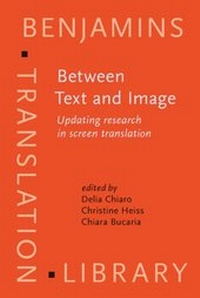
Between Text and Image
Updating research in screen translation
1st Edition
Published on 14. August 2008
X, 292 pages
978-90-272-9110-3 (ISBN)
Description

Over the past decade interest in research on screen translation has increased sharply while at the same time fast moving technological breakthroughs are continually modifying and renewing both products and well-established methods of linguistic mediation. Thus, as more scholars choose to devote their energies to investigating this multi-faceted field, there is an ever-growing need to map out where the discipline stands and where it is going in terms of research.
This book sets out to establish the state of the art of this ever expanding field and at the same time to underscore the work of scholars following new paths of investigation both in terms of innovative linguistic mediations being examined and pioneering experimental design.
The volume includes descriptions of sophisticated electronic databases and corpora of audiovisual products for the big and small screen, and the rationale behind them, e.g. how they are created and programmed for querying; technical limitations; homogeneity in querying languages. Furthermore, Between Text and Image also includes a number of cutting edge studies in audience perception of audiovisual products, i.e. empirically based viewer centred studies which are still rare yet essential if we wish to gain a thorough understanding of the field.
Finally, the volume does not fail to ignore examples of original research carried out from both a traditional linguistic viewpoint and from a more cultural perspective.
This book sets out to establish the state of the art of this ever expanding field and at the same time to underscore the work of scholars following new paths of investigation both in terms of innovative linguistic mediations being examined and pioneering experimental design.
The volume includes descriptions of sophisticated electronic databases and corpora of audiovisual products for the big and small screen, and the rationale behind them, e.g. how they are created and programmed for querying; technical limitations; homogeneity in querying languages. Furthermore, Between Text and Image also includes a number of cutting edge studies in audience perception of audiovisual products, i.e. empirically based viewer centred studies which are still rare yet essential if we wish to gain a thorough understanding of the field.
Finally, the volume does not fail to ignore examples of original research carried out from both a traditional linguistic viewpoint and from a more cultural perspective.
More details
Other editions
Additional editions
Delia Chiaro | Christine Heiss | Chiara Bucaria
Between Text and Image
Updating research in screen translation
Book
08/2008
John Benjamins Publishing Co
€104.94
Shipment within 10-15 days
Persons
Content
- Between Text and Image
- Editorial page
- Title page
- LCC data
- Table of contents
- Preface
- Audiovisual translation comes of age
- Recent developments and challenges in audiovisual translation research
- 1. A domain in its own right
- 1.1 A key year: 1995
- 1.2 Rapid institutionalisation
- 2. Piecemeal research
- 2.1 Before the turning point of the 1990s
- 2.2 A genre which has gained gradual recognition
- 2.3 Interlinguistic subtitling: the fragmented nature of studies
- 2.4 Isolated studies on other AVT modalities
- 3. AVT and translation studies: underlying research concepts
- 4. New challenges
- 4.1 The digital challenge
- 4.2 The challenge of accessibility and reception
- 4.3 The challenge of applied research
- 4.4 The challenge of training
- 5. Towards a conclusion
- Electronic databases and corpora
- ICT approaches
- Forlixt 1 - The Forlì Corpus of Screen Translation
- 1. Introduction
- 2. Forlixt 1 - The Corpus
- 3. The Database: general architecture
- Figure 1 Browsing system
- 4. Methods of analysis: how to investigate the link between linguistic data and the multimedia conte
- 5. Examples of macro-structures.
- Figure 4. Distribution of the category body language in the corpus
- Figure 5. Distribution of prosody among original and dubbed films
- Figure 7. Joint distribution of prosody and discourse markers in original and dubbed films
- 6. Conclusions
- Forlixt 1 - The Forlì Corpus of screen translation
- 1. New patterns in exploring microstructures
- 1.1 Words, dialogue and prosody
- 2. Approaches towards the classification of discourse markers
- Figure1. Tree of categories for guided search
- 3. "dai" as a discourse marker
- 3.1 "dai" in original Italian dialogues
- 3.2 "dai" in dubbed dialogues
- 3.3 "dai" in compensatory strategies
- 4. Forlixt and the sociolinguistic description
- New tools for translators
- 1. Introduction
- 2. Background
- 2.1 Interjections: a definition
- 2.2 Theoretical framework: moulding two perspectives
- 3. Aims and applicability of this prototype
- 3.1 Is there really a need to create a dictionary of interjections?
- 3.2 General characteristics
- 3.2.1 Superstructure
- 3.2.2 Macrostructure
- 3.2.3 Microstructure
- 4. Conclusions
- Linguistic approaches
- Spoken language in film dubbing
- 1. Introduction
- 1.1 A target-language perspective in the study of spoken language in dubbing
- 2. A selection of spoken features
- 2.1 Personal pronouns
- 2.2 Syntactic organization
- 2.3 Weak connectors
- 2.4 Marked word orders
- 2.5 Summary of findings
- 3. A closer look at marked word orders
- 3.1 Interference
- 3.2 Routines in dubbed language
- 4. Conclusions
- High felicity
- 1. Introduction
- 2. Background
- 2.1 Extralinguistic Culture-bound References (ECRs)
- 2.2 Taxonomy of subtitling strategies
- 2.3 Limiting parameters: Media-specific constraints and Transculturality
- 3. Quality assessment
- 4. The basic unit of translation in subtitling
- 5. Locution
- 6. Communication structure
- 7. Primary illocutionary point analysis
- 8. Conclusion
- Inserts in modern script-writing and their translation into Spanish
- 1. Introduction
- 2. The translation of inserts into Spanish
- 2.1 Interjections
- 2.2 Greetings and farewells
- 2.3 Attention signals
- 2.4 Hesitators
- 2.5 Politeness formulae
- 2.6 Discourse markers
- 3. Conclusions
- Perception and quality
- Empirical approaches
- The perception of dubbese
- 1. Introduction
- 2. Dubbese
- 3. The Audiovisual Market in Italy
- 4. The Study
- 4.1 Research questions
- 4.2 The methodology
- 4.2.1 The corpus
- 4.2.2 A working taxonomy: Four operational categories
- 4.2.3 The questionnaire: Design and administration
- Figure 4. The sample: demographic and socioeconomic data
- 5. The results
- 5.1 Attitudes and preferences
- 5.2 Declared versus actual understanding
- Table 1. Declared vs. Actual understanding
- 6. Conclusions
- Acceptance of the norm or suspension of disbelief?
- 1. Introduction
- 2. The study
- 2.1 The methodology
- 2.1.1 The questionnaire
- 2.1.2 The sample
- 2.2 Formulaic language
- Figure 1. Graphic metric rating scale
- 3. Results and observations
- Figure 2. Likelihood of occurrence average scores
- Table 1. Average likelihood scores for the three audience samples
- Table 2. Comparison of partial GPLO scores according to education
- 4. Conclusions
- Measuring the perception of the screen translation of Un Posto al Sole
- 1. Introduction
- 2. About the research
- 3. About the programme
- 3.1 Ratings and audience composition
- 3.2 Settings and content
- 4. Subtitles
- 4.1 Chosen strategies
- 4.2 Formal and textual constraints
- 5. Methodology
- 5.1 Main hypothesis
- 5.2. The videotape
- 5.2.1 Out-of-awareness elements
- 5.3 The sample
- 5.4 The questionnaire
- 6. Survey queries and results
- 6.1 Familiarity with Neapolitan culture
- 6.2 Knowledge of the programme and of its subtitled version
- 6.3 Neapolitan dialectal expressions
- Table 1. Examples of Neapolitan utterances translated into standard English
- 6.4 The shift from standard Italian to dialectal inflections
- 6.5 The 'caciucco' scene
- 7. Conclusions
- Cultural and psycholinguistic approaches
- Taming teen-language
- 1. Introduction
- 2. Buffy the Vampire Slayer, language and teenage identity
- 3. The Italian adaptation of Buffy the Vampire Slayer
- 3.1 Normalizing Buffyspeak
- Table 1. Register differences in the adaptation of Buffyspeak
- Table 2. Standardization of Buffyspeak
- Table 3. Neutralization of pop culture references
- Table 4. Slang features retained in the Italian adaptation
- 3.2 Normalizing gender
- Table 5. Normalization of gender in Italian adaptation (1)
- Table 6. Normalization of gender in Italian adaptation (2)
- 4. Television dubbing, ideology and the representation of teenagers
- 5. Conclusions
- From darkness to light in subtitling
- 1. From darkness to light in subtitling
- 2. Human rights and films: activism through production, distribution and translation
- 3. The multifarious language of the films and the subtitlers' experience
- 3.1 Original Child Bomb
- Figure 1. Shot from the initial sequence of Original Child Bomb
- Table 1. Original Child Bomb: Italian subtitles for one of the opening scenes
- Table 2: Original Child Bomb: English subtitles and their Italian translation
- Figure 2. Tales of Japanese survivors as subtitled in Original Child Bomb
- 3.2 The other side of burka
- Table 3. The Other Side of Burka: the pitfalls of interpreting incorrect pivot titles
- Table 4. The Other Side of Burka: the burden of emotional words in translation
- Figure 3. A woman speaking out on her rights in The Other Side of Burka
- 4. Subtitlers' training and research: opportunities and hopes
- Subtitles and line-breaks
- Introduction
- 1. Subtitling and reading
- 2. Premises
- Table 1. Corpus
- 3. Analysis and discussion
- 3.1 Noun phrases
- 3.2 Prepositional phrases
- 3.3 Verb phrases
- 3.4 The sentence level
- 4. Concluding remarks
- The localization of promotional discourse on the internet
- 1. Introduction
- 2. Promotional discourse
- 2.1 Hybridity based on the combination of non-verbal and verbal elements
- 2.2 Hybridity based on language selection
- 3. The Internet as a medium for promotion and translation
- 3.1 A new concept of text
- 4. The translation of promotional discourse on the Internet
- 4.1 The localization of a website: Lancôme
- 4.1.1 The product
- 4.1.2 Medium restrictions
- 4.1.3 Lexical choice and style
- 5. Conclusions
- Issues of quality in screen translation
- 1. Introduction
- 2. Quality and translation
- 2.1 Approaches to quality assessment in Translation Studies
- 2.2 Quality assessment in Screen Translation
- 2.2.1 Europe and the issue of quality standards in st
- 3. Potential solutions
- 3.1 Total Quality Management
- 3.2 Customer satisfaction
- 3.3 The Kano model
- 3.3.1 Applying the model
- 4. Conclusions
- Figure 1. The dubbing cycle
- Figure 2. Kano model
- Filmography
- Films
- Index
- The series Benjamins Translation Library
