

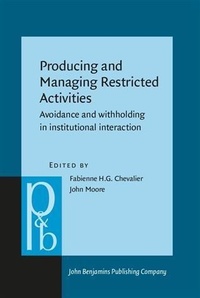
Producing and Managing Restricted Activities
Avoidance and withholding in institutional interaction
1st Edition
Published on 27. March 2015
VI, 382 pages
978-90-272-6909-6 (ISBN)
Description

This book examines the kinds of talk that service providers working in various settings (e.g. doctors, healthcare providers, helpline call takers, tourist officers) seek to avoid in their interactions with clients, when such talk may be expected or due in some way. The studies utilise Conversation Analysis to demonstrate how participants use the interactional practices of avoidance and withholding to construct specific activities as restricted. The various authors also show how, in contributing to the restricted character of certain activities, withholding and avoidance in turn contribute to both the accomplishment of the particular work of the specific organisations and to the construction of the specific institutional identities of the professionals. Overall, the collection offers an authoritative account of restriction and avoidance in workplace interaction.
More details
Other editions
Additional editions
Fabienne H.G. Chevalier | John Moore
Producing and Managing Restricted Activities
Avoidance and withholding in institutional interaction
Book
03/2015
John Benjamins Publishing Co
€104.94
Shipment within 10-15 days
Persons
Content
- Producing and Managing Restricted Activities
- Editorial page
- Title page
- LCC data
- Table of contents
- Producing and managing restricted activities: An introduction to avoidance and withholding in instit
- 1. Overview
- 2. Methodological and theoretical background
- 3. Prior work on avoidance
- 4. Terminological issues in the CA literature
- 5. Situating the collection
- References
- Assessments, interrogatives, and semi-scripted talk in managing a restriction on advising
- 1. Introduction
- 2. The management of advice in institutional interactions
- 3. Interrogatives in institutional interactions
- 4. Assessments as advice
- 5. About the data
- 6. Analysis
- 7. Discussion
- 8. Conclusion
- Acknowledgements
- References
- Avoiding giving advice in telephone counselling for children and young people: Empowerment as practi
- 1. Introduction
- 2. Problem presentation and the relevance of help
- 3. Minimising normativity and asymmetry in proposing solutions
- 4. Focusing on the 'teller and her experiences' in managing advice and advice resistance
- 5. Pursuing client engagement
- 6. Inviting (re-)assessment
- 7. Attributing ownership of ideas to the client
- 8. Avoiding giving advice: Empowerment as practical action
- Acknowledgements
- References
- Withholding explicit assessments in tourist-office talk
- 1. Introduction
- 2. Data
- 3. Previous work on assessments
- 4. Withholding explicit assessments in tourist-office talk
- 5. Discussion
- References
- "But whose side are you on?" Doing being independent in telephone-mediated dispute resolution
- 1. Introduction
- 2. Affiliation, troubles talk and complaints
- 3. Independence and institutional talk-in-interaction
- 4. The institutional context of the present study
- 5. Independent dispute resolution in practice
- 6. Responding to the initial formulation of trouble
- 7. Explanation of the service as independent
- 8. Launching institutionally relevant actions
- 9. Acknowledging emotional displays
- 10. Affiliation prior to call closing
- 11. Discussion
- References
- "Don't tell him just help him": Restricted interactional activity during a classroom writing lesson
- 1. Introduction
- 2. The data
- 3. Analysis
- 4. Discussion
- 5. Conclusion
- References
- "I'll suggest that to your doctor": Managing interactional restrictions to treatment provision in se
- 1. Introduction
- 2. Treatment discussions in healthcare encounters
- 3. Analysis
- 4. Discussion: Managing restricted interactional practices in the obesity clinic
- Acknowledgements
- References
- Linguistic and interactional restrictions in an outpatient clinic: The challenge of delivering the d
- 1. Introduction
- 2. The data
- 3. Conclusions
- References
- Responses to indirect complaints as restricted activities in Therapeutic Community meetings
- 1. Introduction
- 2. Data
- 3. Ignoring a resident's turn carrying a complaint
- 4. Avoiding attending the complaint-components of a resident's turn
- 5. Summary and comment
- 6. Disaffiliating with a resident's complaint
- 7. Summary
- 8. A deviant case
- 9. Restricted responses to indirect complaints and institutionally-relevant identities
- 10. Contribution to the understanding of restricted activities
- References
- Talking to/through the baby to produce and manage disaffiliation during well-child visits
- 1. Introduction
- 2. Analysis
- 3. Discussion and conclusion
- References
- Concessions in audiology
- 1. Introduction
- 2. Data and background
- 3. Concessions
- 4. Discussion
- References
- Transcription conventions
- Notes on contributors
- Author index
- Subject index
