

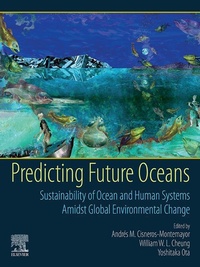
Predicting Future Oceans
Sustainability of Ocean and Human Systems Amidst Global Environmental Change
Published on 17. August 2019
582 pages
978-0-12-817946-8 (ISBN)
Description

Predicting Future Oceans: Sustainability of Ocean and Human Systems Amidst Global Environmental Change provides a synthesis of our knowledge of the future state of the oceans. The editors undertake the challenge of integrating diverse perspectives-from oceanography to anthropology-to exhibit the changes in ecological conditions and their socioeconomic implications. Each contributing author provides a novel perspective, with the book as a whole collating scholarly understandings of future oceans and coastal communities across the world. The diverse perspectives, syntheses and state-of-the-art natural and social sciences contributions are led by past and current research fellows and principal investigators of the Nereus Program network.
This includes members at 17 leading research institutes, addressing themes such as oceanography, biodiversity, fisheries, mariculture production, economics, pollution, public health and marine policy.
This book is a comprehensive resource for senior undergraduate and postgraduate readers studying social and natural science, as well as practitioners working in the field of natural resources management and marine conservation.
- Provides a synthesis of our knowledge on the future state of the oceans
- Includes recommendations on how to move forwards
- Highlights key social aspects linked to ocean ecosystems, including health, equity and sovereignty
More details
Other editions
Additional editions
William Cheung | Yoshitaka Ota | Andres Cisneros-Montemayor
Predicting Future Oceans
Sustainability of Ocean and Human Systems Amidst Global Environmental Change
Book
08/2019
Elsevier
€164.65
Shipment within 15-20 days
Content
Section 1: Predicting future oceans1. Rethinking oceans as coupled human-natural systems to achieve sustainability
Section 2: Changing ocean systems2. Synthesis: Changing ocean systems3. Drivers of fisheries production in complex social-ecological systems4. Changing Seasonality of the Sea: Past, Present, and Future5. Extreme climate events in the oceans6. Pathways of methylmercury accumulation in a changing ocean7. Building confidence in projections of future ocean capacity8. Coastal upwelling and climate change
Section 3: Changing marine ecosystems and biodiversity9. Sythesis: Changing marine ecosystems and biodiversity10. Current and future biogeography of marine exploited groups under climate change11. The role of cyclical oscillations in species distributions shifts under climate change12. Changing biomass flows in marine ecosystems: From the past to the future13. Jellyfishes in a changing ocean14. Understanding fisheries using time series data: importance and opportunities emerging from models of bottom up forcing15. The Sea Around Us as provider of global fisheries catch and related marine biodiversity data to the Nereus Program and civil society16. Life history of marine fishes and their implications for the future oceans
Section 4: Changing fisheries and seafood supply17. Synthesis: Changing fisheries and seafood supply18. Projecting fishing effort dynamics and the economics of fishing in the 21st century under climate change19. Prospect of mariculture under climate change20. Tourist seafood consumption's role in tourism adaptation in Pacific Island Countries for coastal food security under climate change 21. Integrating environmental information into stock assessment models for fisheries management22. The future landscape of the global seafood market23. Climate change adaptations and spatial fisheries management24. Climate Change, Contaminants, and Country Food: Collaborating with Communities to Promote Food Security in the Arctic
Section 5: Changing social world of the ocean25. Synthesis: Changing social world of the oceans26. The relevance of human rights to socially responsible seafood 27. The impact of environmental change on small-scale fishing communities: Moving beyond adaptive capacity to community response28. Coastal Indigenous Peoples in global ocean governance29. The role of corporate social responsibility for ocean sustainability30. Ocean policy on the water - incorporating fishermen's perspectives31. Traditional ecological knowledge in displacement and migration32. Can aspirations lead us to the oceans we want?
Section 6: Governance and well-being in changing oceans33. Synthesis: The opportunities of changing ocean governance for sustainability34. A Blue Economy: Equitable, Sustainable, and Viable Development in the World's Oceans35. Exploring the knowns and unknowns of international fishery conflicts36. The future of mangrove fishing communities37. The last commons: (Re)constructing an ocean future38. New actors, new possibilities, new challenges - Non-state actor participation in global fisheries management39. Climate change vulnerability and ocean governance
Section 7: Ocean governance beyond boundaries40. Synthesis: The opportunities of changing ocean governance for sustainability with Erik41. Conserving the great blue "beyond." Incorporating the dynamic and connected nature of the open ocean in the biodiversity beyond national jurisdiction (BBNJ) negotiations42. Legitimacy as a resource for effective international marine management43. Improving fisheries governance in a fragmented and decentralized world44. The Trouble with Tunas: International Fisheries Science and Policy in an Uncertain Future45. The road to implementing an ecosystem-based approach to high seas fisheries management46. Ocean Pollution in an Era of Changing Oceans and Climate Change: Towards Ocean Conservation Solutions47.
