

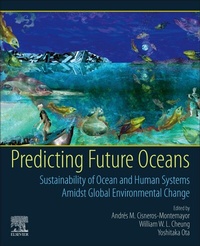
Predicting Future Oceans
Sustainability of Ocean and Human Systems Amidst Global Environmental Change
Published on 20. August 2019
Book
Paperback/Softback
582 pages
978-0-12-817945-1 (ISBN)
Description
Predicting Future Oceans: Sustainability of Ocean and Human Systems Amidst Global Environmental Change provides a synthesis of our knowledge of the future state of the oceans. The editors undertake the challenge of integrating diverse perspectives-from oceanography to anthropology-to exhibit the changes in ecological conditions and their socioeconomic implications. Each contributing author provides a novel perspective, with the book as a whole collating scholarly understandings of future oceans and coastal communities across the world. The diverse perspectives, syntheses and state-of-the-art natural and social sciences contributions are led by past and current research fellows and principal investigators of the Nereus Program network.
This includes members at 17 leading research institutes, addressing themes such as oceanography, biodiversity, fisheries, mariculture production, economics, pollution, public health and marine policy.
This book is a comprehensive resource for senior undergraduate and postgraduate readers studying social and natural science, as well as practitioners working in the field of natural resources management and marine conservation.
This includes members at 17 leading research institutes, addressing themes such as oceanography, biodiversity, fisheries, mariculture production, economics, pollution, public health and marine policy.
This book is a comprehensive resource for senior undergraduate and postgraduate readers studying social and natural science, as well as practitioners working in the field of natural resources management and marine conservation.
Reviews / Votes
"This valuable book examines the changing ocean in the context of both environment and human society with the goal of framing how coastal and marine systems can survive. Many of us in the ocean conservation community have been saying we need to change the human relationship with the ocean for greater sustainability. What is useful is this book's attempt to make the leap to predictions that take these biophysical changes, adaptation by humans, and a myriad of other factors into account in order to "see? how to get to the best possible future. Rather than predict doom, the volume strives to define a better relationship between human societies and the ocean, based on sustainability and equity. The challenge will be to redesign ocean governance for true sustainability at subnational, national, inter-governmental, and regional, as well as international levels-in the context of unprecedented and unpredictable global change in ocean systems. Meeting these challengeswill require changes of similar magnitude in governance including substantially increased accountability, transparency, and equity in the distribution of costs and benefits to be legitimate and successful. Such equity, and thus sustainability, must be intergenerational, local, and global-and this well-designed and well-written book helps us understand how we got here and where we can go." --The Quarterly Review of BiologyMore details
Language
English
Place of publication
United States
Target group
College/higher education
Professional and scholarly
Illustrations
Approx. 300 illustrations (300 in full color)
Dimensions
Height: 235 mm
Width: 191 mm
Weight
1110 gr
ISBN-13
978-0-12-817945-1 (9780128179451)
Copyright in bibliographic data and cover images is held by Nielsen Book Services Limited or by the publishers or by their respective licensors: all rights reserved.
Schweitzer Classification
Other editions
Additional editions
William Cheung | Yoshitaka Ota | Andres Cisneros-Montemayor
Predicting Future Oceans
Sustainability of Ocean and Human Systems Amidst Global Environmental Change
E-Book
08/2019
Elsevier
€148.00
Available for download
Persons
Dr. William Cheung is Associate Professor in the Institute for the Oceans and Fisheries at the University of British Columbia, and Director (Science) of the Nippon Foundation-UBC Nereus Program. He is an internationally-recognized expert in the effects of climate change on marine ecosystems and fisheries, and is a lead author for the Fifth Assessment of the Intergovernmental Panel on Climate Change (IPCC) and coordinating lead author for the IPCC Special Report on the Ocean and Cryosphere in the Changing Climate. Dr. Cheung has published over 100 peer-reviewed articles, and is the 2017 laureate of the Prix'd Excellence Award of the International Council for the Exploration of the Seas for his contributions to marine sciences. Dr. Yoshitaka Ota is Research Assistant Professor in the School of Marine and Environmental Affairs at the University of Washington, and Director (Policy) of the Nippon Foundation-UBC Nereus Program. Yoshitaka Ota has a background in social anthropology at the University College London. Dr. Ota has conducted ethnographic research on various coastal communities, including Palau, UK, Indonesia and Japan, studying the socialization and cultural meanings associated with fishing practices. For the last ten years, he has been engaged in policy research involving coastal indigenous communities, marine spatial planning and human security. Dr. Ota also is the Director (Policy) of the Nippon Foundation Nereus Program, an international initiative comprising an interdisciplinary team of 20 institutes. His core research interest is to understand how to strengthen social equity in ocean governance while we face global environmental changes. His unit consists of a team of cross-disciplinary scholars. Dr. Andres Cisneros-Montemayor is a marine resource economist specializing in complex social-ecological systems, particularly in developing regions. This includes estimating the social and economic benefits of ecotourism and artisanal fisheries, anticipating ecological and social impacts and challenges, and finding best strategies to achieve equitable and inclusive sustainable development.
Editor
Associate Professor, Institute for the Oceans and Fisheries, The University of British Columbia, Vancouver, Canada
Assistant Professor, School of Marine and Environmental Affairs, University of Washington, USA
Research Associate at the Institute for the Oceans and Fisheries, University of British Columbia, Program Manager of the Nippon Foundation Nereus Program
Content
Section 1: Predicting future oceans
1. Rethinking oceans as coupled human-natural systems to achieve sustainability
Section 2: Changing ocean systems
2. Synthesis: Changing ocean systems
3. Drivers of fisheries production in complex social-ecological systems
4. Changing Seasonality of the Sea: Past, Present, and Future
5. Extreme climate events in the oceans
6. Pathways of methylmercury accumulation in a changing ocean
7. Building confidence in projections of future ocean capacity
8. Coastal upwelling and climate change
Section 3: Changing marine ecosystems and biodiversity
9. Sythesis: Changing marine ecosystems and biodiversity
10. Current and future biogeography of marine exploited groups under climate change
11. The role of cyclical oscillations in species distributions shifts under climate change
12. Changing biomass flows in marine ecosystems: From the past to the future
13. Jellyfishes in a changing ocean
14. Understanding fisheries using time series data: importance and opportunities emerging from models of bottom up forcing
15. The Sea Around Us as provider of global fisheries catch and related marine biodiversity data to the Nereus Program and civil society
16. Life history of marine fishes and their implications for the future oceans
Section 4: Changing fisheries and seafood supply
17. Synthesis: Changing fisheries and seafood supply
18. Projecting fishing effort dynamics and the economics of fishing in the 21st century under climate change
19. Prospect of mariculture under climate change
20. Tourist seafood consumption's role in tourism adaptation in Pacific Island Countries for coastal food security under climate change
21. Integrating environmental information into stock assessment models for fisheries management
22. The future landscape of the global seafood market
23. Climate change adaptations and spatial fisheries management
24. Climate Change, Contaminants, and Country Food: Collaborating with Communities to Promote Food Security in the Arctic
Section 5: Changing social world of the ocean
25. Synthesis: Changing social world of the oceans
26. The relevance of human rights to socially responsible seafood
27. The impact of environmental change on small-scale fishing communities: Moving beyond adaptive capacity to community response
28. Coastal Indigenous Peoples in global ocean governance
29. The role of corporate social responsibility for ocean sustainability
30. Ocean policy on the water - incorporating fishermen's perspectives
31. Traditional ecological knowledge in displacement and migration
32. Can aspirations lead us to the oceans we want?
Section 6: Governance and well-being in changing oceans
33. Synthesis: The opportunities of changing ocean governance for sustainability
34. A Blue Economy: Equitable, Sustainable, and Viable Development in the World's Oceans
35. Exploring the knowns and unknowns of international fishery conflicts
36. The future of mangrove fishing communities
37. The last commons: (Re)constructing an ocean future
38. New actors, new possibilities, new challenges - Non-state actor participation in global fisheries management
39. Climate change vulnerability and ocean governance
Section 7: Ocean governance beyond boundaries
40. Synthesis: The opportunities of changing ocean governance for sustainability with Erik
41. Conserving the great blue "beyond." Incorporating the dynamic and connected nature of the open ocean in the biodiversity beyond national jurisdiction (BBNJ) negotiations
42. Legitimacy as a resource for effective international marine management
43. Improving fisheries governance in a fragmented and decentralized world
44. The Trouble with Tunas: International Fisheries Science and Policy in an Uncertain Future
45. The road to implementing an ecosystem-based approach to high seas fisheries management
46. Ocean Pollution in an Era of Changing Oceans and Climate Change: Towards Ocean Conservation Solutions
47. Beyond prediction: Radical Ocean Futures- A science fiction prototyping approach to imagining our future oceans
Section 8: Conclusion
48. Future pathways for the oceans considering climate change and social equity
1. Rethinking oceans as coupled human-natural systems to achieve sustainability
Section 2: Changing ocean systems
2. Synthesis: Changing ocean systems
3. Drivers of fisheries production in complex social-ecological systems
4. Changing Seasonality of the Sea: Past, Present, and Future
5. Extreme climate events in the oceans
6. Pathways of methylmercury accumulation in a changing ocean
7. Building confidence in projections of future ocean capacity
8. Coastal upwelling and climate change
Section 3: Changing marine ecosystems and biodiversity
9. Sythesis: Changing marine ecosystems and biodiversity
10. Current and future biogeography of marine exploited groups under climate change
11. The role of cyclical oscillations in species distributions shifts under climate change
12. Changing biomass flows in marine ecosystems: From the past to the future
13. Jellyfishes in a changing ocean
14. Understanding fisheries using time series data: importance and opportunities emerging from models of bottom up forcing
15. The Sea Around Us as provider of global fisheries catch and related marine biodiversity data to the Nereus Program and civil society
16. Life history of marine fishes and their implications for the future oceans
Section 4: Changing fisheries and seafood supply
17. Synthesis: Changing fisheries and seafood supply
18. Projecting fishing effort dynamics and the economics of fishing in the 21st century under climate change
19. Prospect of mariculture under climate change
20. Tourist seafood consumption's role in tourism adaptation in Pacific Island Countries for coastal food security under climate change
21. Integrating environmental information into stock assessment models for fisheries management
22. The future landscape of the global seafood market
23. Climate change adaptations and spatial fisheries management
24. Climate Change, Contaminants, and Country Food: Collaborating with Communities to Promote Food Security in the Arctic
Section 5: Changing social world of the ocean
25. Synthesis: Changing social world of the oceans
26. The relevance of human rights to socially responsible seafood
27. The impact of environmental change on small-scale fishing communities: Moving beyond adaptive capacity to community response
28. Coastal Indigenous Peoples in global ocean governance
29. The role of corporate social responsibility for ocean sustainability
30. Ocean policy on the water - incorporating fishermen's perspectives
31. Traditional ecological knowledge in displacement and migration
32. Can aspirations lead us to the oceans we want?
Section 6: Governance and well-being in changing oceans
33. Synthesis: The opportunities of changing ocean governance for sustainability
34. A Blue Economy: Equitable, Sustainable, and Viable Development in the World's Oceans
35. Exploring the knowns and unknowns of international fishery conflicts
36. The future of mangrove fishing communities
37. The last commons: (Re)constructing an ocean future
38. New actors, new possibilities, new challenges - Non-state actor participation in global fisheries management
39. Climate change vulnerability and ocean governance
Section 7: Ocean governance beyond boundaries
40. Synthesis: The opportunities of changing ocean governance for sustainability with Erik
41. Conserving the great blue "beyond." Incorporating the dynamic and connected nature of the open ocean in the biodiversity beyond national jurisdiction (BBNJ) negotiations
42. Legitimacy as a resource for effective international marine management
43. Improving fisheries governance in a fragmented and decentralized world
44. The Trouble with Tunas: International Fisheries Science and Policy in an Uncertain Future
45. The road to implementing an ecosystem-based approach to high seas fisheries management
46. Ocean Pollution in an Era of Changing Oceans and Climate Change: Towards Ocean Conservation Solutions
47. Beyond prediction: Radical Ocean Futures- A science fiction prototyping approach to imagining our future oceans
Section 8: Conclusion
48. Future pathways for the oceans considering climate change and social equity