

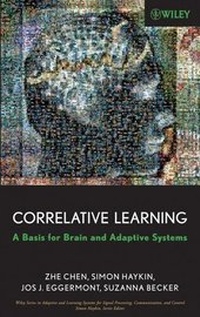
Correlative Learning
Description

More details
Other editions
Additional editions
Persons
Content
Preface.
Acknowledgments.
Acronyms.
Introduction.
1. The Correlative Brain.
1.1 Background.
1.1.1 Spiking Neurons.
1.1.2 Neocortex.
1.1.3 Receptive fields.
1.1.4 Thalamus.
1.1.5 Hippocampus.
1.2 Correlation Detection in Single Neurons.
1.3 Correlation in Ensembles of Neurons: Synchrony and Population Coding.
1.4 Correlation is the Basis of Novelty Detection and Learning.
1.5 Correlation in Sensory Systems: Coding, Perception, and Development.
1.6 Correlation in Memory Systems.
1.7 Correlation in Sensory-Motor Learning.
1.8 Correlation, Feature Binding, and Attention.
1.9 Correlation and Cortical Map Changes after Peripheral Lesions and Brain Stimulation.
1.10 Discussion.
2. Correlation in Signal Processing.
2.1 Correlation and Spectrum Analysis.
2.1.1 Stationary Process.
2.1.2 Non-stationary Process.
2.1.3 Locally Stationary Process.
2.1.4 Cyclostationary Process.
2.1.5 Hilbert Spectrum Analysis.
2.1.6 Higher Order Correlation-based Bispectra Analysis.
2.1.7 Higher Order Functions of Time, Frequency, Lag, and Doppler.
2.1.8 Spectrum Analysis of Random Point Process.
2.2 Wiener Filter.
2.3 Least-Mean-Square Filter.
2.4 Recursive Least-Squares Filter.
2.5 Matched Filter.
2.6 Higher Order Correlation-Based Filtering.
2.7 Correlation Detector.
2.7.1 Coherent Detection.
2.7.2 Correlation Filter for Spatial Target Detection.
2.8 Correlation Method for Time-Delay Estimation.
2.9 Correlation-Based Statistical Analysis.
2.9.1 Principal Component Analysis.
2.9.2 Factor Analysis.
2.9.3 Canonical Correlation Analysis.
2.9.4 Fisher Linear Discriminant Analysis.
2.9.5 Common Spatial Pattern Analysis.
2.10 Discussion.
Appendix: Eigenanalysis of Autocorrelation Function of Nonstationary Process.
Appendix: Estimation of the Intensity and Correlation Functions of Stationary Random Point Process.
Appendix: Derivation of Learning Rules with Quasi-Newton Method.
3. Correlation-Based Neural Learning and Machine Learning.
3.1 Correlation as a Mathematical Basis for Learning.
3.1.1 Hebbian and Anti-Hebbian Rules (Revisited).
3.1.2 Covariance Rule.
3.1.3 Grossberg's Gated Steepest Descent.
3.1.4 Competitive Learning Rule.
3.1.5 BCM Learning Rule.
3.1.6 Local PCA Learning Rule.
3.1.7 Generalizations of PCA Learning.
3.1.8 CCA Learning Rule.
3.1.9 Wake-Sleep Learning Rule for Factor Analysis.
3.1.10 Boltzmann Learning Rule.
3.1.11 Perceptron Rule and Error-Correcting Learning Rule.
3.1.12 Differential Hebbian Rule and Temporal Hebbian Learning.
3.1.13 Temporal Difference and Reinforcement Learning.
3.1.14 General Correlative Learning and Potential Function.
3.2 Information-Theoretic Learning.
3.2.1 Mutual Information vs. Correlation.
3.2.2 Barlow's Postulate.
3.2.3 Hebbian Learning and Maximum Entropy.
3.2.4 Imax Algorithm.
3.2.5 Local Decorrelative Learning.
3.2.6 Blind Source Separation.
3.2.7 Independent Component Analysis.
3.2.8 Slow Feature Analysis.
3.2.9 Energy-Efficient Hebbian Learning.
3.2.10 Discussion.
3.3 Correlation-Based Computational Neural Models.
3.3.1 Correlation Matrix Memory.
3.3.2 Hopfield Network.
3.3.3 Brain-State-in-a-Box Model.
3.3.4 Autoencoder Network.
3.3.5 Novelty Filter.
3.3.6 Neuronal Synchrony and Binding.
3.3.7 Oscillatory Correlation.
3.3.8 Modeling Auditory Functions.
3.3.9 Correlations in the Olfactory System.
3.3.10 Correlations in the Visual System.
3.3.11 Elastic Net.
3.3.12 CMAC and Motor Learning.
3.3.13 Summarizing Remarks.
Appendix: Mathematical Analysis of Hebbian Learning.
Appendix: Necessity and Convergence of Anti-Hebbian Learning.
Appendix: Link Between the Hebbian Rule and Gradient Descent.
Appendix: Reconstruction Error in Linear and Quadratic PCA.
4. Correlation-Based Kernel Learning.
4.1 Background.
4.2 Kernel PCA and Kernelized GHA.
4.3 Kernel CCA and Kernel ICA.
4.4 Kernel Principal Angles.
4.5 Kernel Discriminant Analysis.
4.6 KernelWiener Filter.
4.7 Kernel-Based Correlation Analysis: Generalized Correlation Function and Correntropy.
4.8 Kernel Matched Filter.
4.9 Discussion.
5. Correlative Learning in a Complex-Valued Domain.
5.1 Preliminaries.
5.2 Complex-Valued Extensions of Correlation-Based Learning.
5.2.1 Complex-Valued Associative Memory.
5.2.2 Complex-Valued Boltzmann Machine.
5.2.3 Complex-Valued LMS Rule.
5.2.4 Complex-Valued PCA Learning.
5.2.5 Complex-Valued ICA Learning.
5.2.6 Constant Modulus Algorithm.
5.3 Kernel Methods for Complex-Valued Data.
5.3.1 Reproducing Kernels in the Complex Domain.
5.3.2 Complex-Valued Kernel PCA.
5.4 Discussion.
6. ALOPEX: A Correlation-Based Learning Paradigm.
6.1 Background.
6.2 The Basic ALOPEX Rule.
6.3 Variants of the ALOPEX Algorithm.
6.3.1 Unnikrishnan and Venugopal's ALOPEX.
6.3.2 Bia's ALOPEX-B.
6.3.3 An Improved Version of the ALOPEX-B.
6.3.4 Two-Timescale ALOPEX.
6.3.5 Other Types of Correlation Mechanisms.
6.4 Discussion.
6.5 Monte Carlo Sampling-Based ALOPEX Algorithms.
6.5.1 Sequential Monte Carlo Estimation.
6.5.2 Sampling-Based ALOPEX Algorithms.
6.5.3 Remarks.
Appendix: Asymptotical Analysis of the ALOPEX Process.
Appendix: Asymptotic Convergence Analysis of the 2t-ALOPEX Algorithm.
7. Case Studies.
7.1 Hebbian Competition as the Basis for Cortical Map Reorganization?
7.2 Learning Neurocompensator: A Model-Based Hearing Compensation Strategy.
7.2.1 Background.
7.2.2 Model-Based Hearing Compensation Strategy.
7.2.3 Optimization.
7.2.4 Experimental Results.
7.2.5 Summary.
7.3 Online Training of Artificial Neural Networks.
7.3.1 Background.
7.3.2 Parameters Setup.
7.3.3 Online Option Prices Prediction.
7.3.4 Online System Identification.
7.3.5 Summary.
7.4 Kalman Filtering in Computational Neural Modeling.
7.4.1 Background.
7.4.2 Overview of Kalman Filter in Modeling Brain Functions.
7.4.3 Kalman Filter for Learning Shape and Motion from Image Sequences.
7.4.4 General Remarks and Implications.
8. Discussion.
8.1 Summary: Why Correlation?
8.1.1 Hebbian Plasticity and the Correlative Brain.
8.1.2 Correlation-Based Signal Processing.
8.1.3 Correlation-Based Machine Learning.
8.2 Epilogue: What Next?
8.2.1 Generalizing the Correlation Measure.
8.2.2 Deciphering the Correlative Brain.
Appendix A: Autocorrelation and Cross-correlation Functions.
Appendix B: Stochastic Approximation.
Appendix C: A Primer on Linear Algebra.
Appendix D: Probability Density and Entropy Estimators.
Appendix E: EM Algorithm.
Topic Index.
