

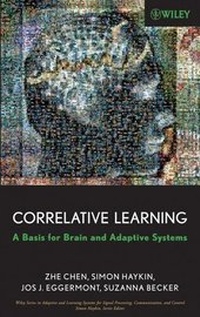
Correlative Learning
A Basis for Brain and Adaptive Systems
Will be published approx. on 6. November 2007
Book
Hardback
480 pages
978-0-470-04488-9 (ISBN)
Description
Correlative Learning: A Basis for Brain and Adaptive Systems provides a bridge between three disciplines: computational neuroscience, neural networks, and signal processing. First, the authors lay down the preliminary neuroscience background for engineers. The book also presents an overview of the role of correlation in the human brain as well as in the adaptive signal processing world; unifies many well-established synaptic adaptations (learning) rules within the correlation-based learning framework, focusing on a particular correlative learning paradigm, ALOPEX; and presents case studies that illustrate how to use different computational tools and ALOPEX to help readers understand certain brain functions or fit specific engineering applications.
More details
Product info
gebunden
Series
Edition
1. Auflage
Language
English
Place of publication
United States
Publishing group
John Wiley & Sons Inc
Target group
Professional and scholarly
Product notice
sewn/stitched
Cloth over boards
Dimensions
Height: 240 mm
Width: 161 mm
Thickness: 30 mm
Weight
877 gr
ISBN-13
978-0-470-04488-9 (9780470044889)
Schweitzer Classification
Other editions
Additional editions
Zhengxin Chen | Simon Haykin | Jos J. Eggermont
Correlative Learning
A Basis for Brain and Adaptive Systems
E-Book
06/2008
Wiley
€158.99
Available for download
Persons
Zhe Chen, PhD, is currently a Research Fellow in the Neuroscience Statistics Research Laboratory at Harvard Medical School.
Simon Haykin, PhD, DSc, is a Distinguished University Professor in the Department of Electrical and Computer Engineering at McMaster University, Ontario, Canada.
Jos J. Eggermont, PhD, is a Professor in the Departments of Physiology & Biophysics and Psychology at the University of Calgary, Alberta, Canada.
Suzanna Becker, PhD, is a Professor in the Department of Psychology, Neuroscience, and Behavior at McMaster University, Ontario, Canada.
Simon Haykin, PhD, DSc, is a Distinguished University Professor in the Department of Electrical and Computer Engineering at McMaster University, Ontario, Canada.
Jos J. Eggermont, PhD, is a Professor in the Departments of Physiology & Biophysics and Psychology at the University of Calgary, Alberta, Canada.
Suzanna Becker, PhD, is a Professor in the Department of Psychology, Neuroscience, and Behavior at McMaster University, Ontario, Canada.
Content
Foreword.
Preface.
Acknowledgments.
Acronyms.
Introduction.
1. The Correlative Brain.
1.1 Background.
1.2 Correlation Detection in Single Neurons.
1.3 Correlation in Ensembles of Neurons: Synchrony and Population Coding.
1.4 Correlation is the Basis of Novelty Detection and Learning.
1.5 Correlation in Sensory Systems: Coding, Perception, and Development.
1.6 Correlation in Memory Systems.
1.7 Correlation in Sensory-Motor Learning.
1.8 Correlation, Feature Binding, and Attention.
1.9 Correlation and Cortical Map Changes after Peripheral Lesions and Brain Stimulation.
1.10 Discussion.
2. Correlation in Signal Processing.
2.1 Correlation and Spectrum Analysis.
2.2 Wiener Filter.
2.3 Least-Mean-Square Filter.
2.4 Recursive Least-Squares Filter.
2.5 Matched Filter.
2.6 Higher Order Correlation-Based Filtering.
2.7 Correlation Detector.
2.8 Correlation Method for Time-Delay Estimation.
2.9 Correlation-Based Statistical Analysis.
2.10 Discussion.
Appendix: Eigenanalysis of Autocorrelation Function of Nonstationary Process.
Appendix: Estimation of the Intensity and Correlation Functions of Stationary Random Point Process.
Appendix: Derivation of Learning Rules with Quasi-Newton Method.
3. Correlation-Based Neural Learning and Machine Learning.
3.1 Correlation as a Mathematical Basis for Learning.
3.2 Information-Theoretic Learning.
3.3 Correlation-Based Computational Neural Models.
Appendix: Mathematical Analysis of Hebbian Learning.
Appendix: Necessity and Convergence of Anti-Hebbian Learning.
Appendix: Link Between the Hebbian Rule and Gradient Descent.
Appendix: Reconstruction Error in Linear and Quadratic PCA.
4. Correlation-Based Kernel Learning.
4.1 Background.
4.2 Kernel PCA and Kernelized GHA.
4.3 Kernel CCA and Kernel ICA.
4.4 Kernel Principal Angles.
4.5 Kernel Discriminant Analysis.
4.6 KernelWiener Filter.
4.7 Kernel-Based Correlation Analysis: Generalized Correlation Function and Correntropy.
4.8 Kernel Matched Filter.
4.9 Discussion.
5. Correlative Learning in a Complex-Valued Domain.
5.1 Preliminaries.
5.2 Complex-Valued Extensions of Correlation-Based Learning.
5.3 Kernel Methods for Complex-Valued Data.
5.4 Discussion.
6. ALOPEX: A Correlation-Based Learning Paradigm.
6.1 Background.
6.2 The Basic ALOPEX Rule.
6.3 Variants of the ALOPEX Algorithm.
6.4 Discussion.
6.5 Monte Carlo Sampling-Based ALOPEX Algorithms.
Appendix: Asymptotical Analysis of the ALOPEX Process.
Appendix: Asymptotic Convergence Analysis of the 2t-ALOPEX Algorithm.
7. Case Studies.
7.1 Hebbian Competition as the Basis for Cortical Map Reorganization?
7.2 Learning Neurocompensator: A Model-Based Hearing Compensation Strategy.
7.3 Online Training of Artificial Neural Networks.
7.4 Kalman Filtering in Computational Neural Modeling.
8. Discussion.
8.1 Summary: Why Correlation?
8.2 Epilogue: What Next?
Appendix A: Autocorrelation and Cross-correlation Functions.
Appendix B: Stochastic Approximation.
Appendix C: A Primer on Linear Algebra.
Appendix D: Probability Density and Entropy Estimators.
Appendix E: EM Algorithm.
Topic Index.