

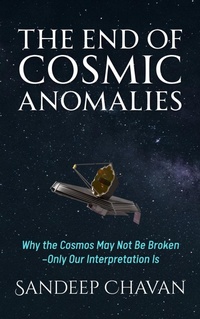
The End of Cosmic Anomalies
Description

The End of Cosmic Anomalies is a bold and original exploration of modern cosmology, the James Webb Space Telescope, redshift, black holes, mature galaxies, Little Red Dots, Hubble tension, and the deeper meaning of cosmic observation.
Modern cosmology is increasingly surrounded by tensions. JWST has revealed mature-looking galaxies at cosmic depth. Compact red structures appear brighter and more intense than expected. Supermassive black-hole-like regions challenge the idea of slow chronological growth. Redshift is being asked to carry enormous historical certainty. The Hubble tension continues to resist one clean expansion reading.
Are these truly anomalies of the universe?
Or are they signs that our interpretation has become too narrow?
In this thought-provoking book, Sandeep Chavan presents a field-based reinterpretation of cosmic anomalies through his broader framework of Universal Energy Dynamics. Rather than dismissing scientific observation, the book takes modern astronomical data seriously and asks whether many so-called anomalies arise from reading a field-based cosmos through a matter-first, time-first, movie-reel model of the universe.
The book challenges the assumption that cosmic depth always means cosmic past. It questions whether redshift should be treated only as a timestamp of expansion and distance. It reopens the meaning of black holes, suggesting that they may be better understood as Ripple Saturation Zones rather than infinite-density monsters. It reframes galactic centers as central regulators, galaxies as field architectures, and cosmic maturity as coherence rather than chronological age.
Through Universal Energy Dynamics, matter is reinterpreted as ripple condensation within Structured Vacuum Energy. Gravity becomes energy-gradient equilibrium. Redshift becomes a layered signal carrying field strain, ripple tension, resistance, and alignment delay. Time becomes Alignment Threshold Time and conscious narration rather than an independent cosmic road. Hubble tension becomes evidence of state-dependent resolution delay rather than cosmic contradiction.
This book does not claim that all mystery ends. It does not reject science, observation, or measurement. Instead, it separates mystery from confusion and observation from interpretation. It argues that many cosmic anomalies may cease to be anomalies when seen through a deeper field-based lens.
For readers interested in cosmology, astrophysics, philosophy of science, JWST discoveries, black holes, redshift, Hubble tension, alternative cosmology, and the deeper structure of reality, The End of Cosmic Anomalies offers a powerful new way to think about the universe.
The cosmos was never broken.
The frame was.
More details
Person
Sandeep J. Chavan is an independent researcher, system thinker, and prolific author whose work spans physics, philosophy, psychology, artificial intelligence, and civilization studies. His writing forms a unified intellectual framework known as the Chavanian Ecosystem?a continuously evolving body of work that seeks to understand reality through the principles of energy, intelligence, consequence, and alignment.
With a background in physics and years of teaching experience, Sandeep approaches complex subjects with clarity and structural depth. His work challenges conventional assumptions across disciplines, offering alternative perspectives on topics such as the nature of energy, the structure of the mind, the role of consciousness, and the future of human systems in an AI-driven world.
At the core of his research lies Universal Energy Dynamics (UED)?a consequence-based framework that reinterprets physical, biological, and social systems as interconnected processes rather than isolated entities. Through this lens, his books explore everything from cosmology and quantum theory to human behavior, decision-making, and global dynamics.
Unlike traditional academic or self-help approaches, Sandeep's work operates across domains. His books are not isolated topics but interconnected explorations that collectively build a broader understanding of reality and human existence. This cross-disciplinary approach allows readers to connect scientific reasoning with everyday life, philosophy with action, and theory with experience.
His catalogue includes works on physics and cosmology, consciousness and the mind, human psychology, artificial intelligence, geopolitics, and narrative thought experiments. Each book stands independently while contributing to a larger, coherent framework.
Sandeep's writing is characterized by clarity, structural thinking, and a consistent focus on simplifying complex ideas without diluting their depth. His goal is not to promote belief systems, but to encourage understanding?helping readers see reality more clearly and navigate life with awareness and alignment.
Through the Chavanian Ecosystem, he continues to build a living library of ideas that evolves with observation, inquiry, and dialogue.
