

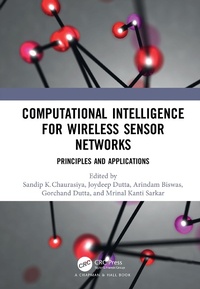
Computational Intelligence for Wireless Sensor Networks
Principles and Applications
1st Edition
Published on 25. July 2022
214 pages
978-1-000-59416-4 (ISBN)
Description

Computational Intelligence for Wireless Sensor Networks: Principles and Applications provides an integrative overview of the computational intelligence (CI) in wireless sensor networks and enabled technologies. It aims to demonstrate how the paradigm of computational intelligence can benefit Wireless Sensor Networks (WSNs) and sensor-enabled technologies to overcome their existing issues.
This book provides extensive coverage of the multiple design challenges of WSNs and associated technologies such as clustering, routing, media access, security, mobility, and design of energy-efficient network operations.
It also describes various CI strategies such as fuzzy computing, evolutionary computing, reinforcement learning, artificial intelligence, swarm intelligence, teaching learning-based optimization, etc. It also discusses applying the techniques mentioned above in wireless sensor networks and sensor-enabled technologies to improve their design.
The book offers comprehensive coverage of related topics, including:
Emergence of intelligence in wireless sensor networks
Taxonomy of computational intelligence
Detailed discussion of various metaheuristic techniques
Development of intelligent MAC protocols
Development of intelligent routing protocols
Security management in WSNs
This book mainly addresses the challenges pertaining to the development of intelligent network systems via computational intelligence. It provides insights into how intelligence has been pursued and can be further integrated in the development of sensor-enabled applications.
This book provides extensive coverage of the multiple design challenges of WSNs and associated technologies such as clustering, routing, media access, security, mobility, and design of energy-efficient network operations.
It also describes various CI strategies such as fuzzy computing, evolutionary computing, reinforcement learning, artificial intelligence, swarm intelligence, teaching learning-based optimization, etc. It also discusses applying the techniques mentioned above in wireless sensor networks and sensor-enabled technologies to improve their design.
The book offers comprehensive coverage of related topics, including:
Emergence of intelligence in wireless sensor networks
Taxonomy of computational intelligence
Detailed discussion of various metaheuristic techniques
Development of intelligent MAC protocols
Development of intelligent routing protocols
Security management in WSNs
This book mainly addresses the challenges pertaining to the development of intelligent network systems via computational intelligence. It provides insights into how intelligence has been pursued and can be further integrated in the development of sensor-enabled applications.
More details
Edition
1. Auflage
Language
English
Place of publication
London
United Kingdom
Publishing group
Taylor & Francis Ltd
Target group
College/higher education
Professional and scholarly
Illustrations
6 Tables, black and white; 62 Line drawings, black and white; 31 Halftones, black and white; 93 Illustrations, black and white
ISBN-13
978-1-000-59416-4 (9781000594164)
Copyright in bibliographic data and cover images is held by Nielsen Book Services Limited or by the publishers or by their respective licensors: all rights reserved.
Schweitzer Classification
Other editions
Additional editions
Sandip Kumar Chaurasiya | Joydeep Dutta | Arindam Biswas
Computational Intelligence for Wireless Sensor Networks
Principles and Applications
Book
10/2024
1st Edition
Chapman & Hall/CRC
€63.40
Shipment within 15-20 days
Sandip Kumar Chaurasiya | Joydeep Dutta | Arindam Biswas
Computational Intelligence for Wireless Sensor Networks
Principles and Applications
Book
07/2022
1st Edition
Chapman & Hall/CRC
€124.90
Shipment within 15-20 days
Persons
Dr. Sandip K Chaurasiya received his M.E degree in Computer Science and Technology from the Indian Institute of Engineering Science and Technology Shibpur, Howrah, West Bengal, INDIA, in June 2010. He is working as an Assistant Professor in the University of Petroleum and Energy Studies, Dehradun, Uttarakhand, INDIA. His research interest includes Mobile Computing, Wireless Sensor Networks, and Internet of Things. He has authored a book, "A Complete Guide to Wireless Sensor Networks: from Inception to Current Trends (2019)" and contributed many technical papers in various journals and conferences. He has reviewed a number of research articles in several reputed international conferences/journals. He is an active member of the Institution of Electronics & Communication Engineers (INDIA), New Delhi.
Dr. Joydeep Dutta completed his Ph.D degree from the Department of Computer Science and Engineering, NIT Durgapur in 2020. He completed M.E. in Computer Science and Engineering from the West Bengal University of Technology in 2008. Mr Dutta was also awarded Bronze Medal for his first-class 3rd position in the university. Mr. Dutta had qualified UGC NET in Computer Science and Applications in 2013. He is currently working as an Assistant Professor in the Department of Computer Science of Kazi Nazrul University, Asansol, India. He has more than 9 years of teaching experience in several reputed engineering colleges of West Bengal and 2 years of industrial experience in MNC's like Wipro Technologies and Oracle Financial Services Software Ltd. His current research interests include Network Optimization Problems, Artificial Intelligence, Evolutionary Algorithms, Combinatorial Optimization etc. He has several high impact SCI indexed publications like Neural Computing and Applications, Transport etc. Mr Dutta acted as a reviewer of different reputed journals and conferences. He has chaired, organized and presented paper in different seminars and conferences of international repute.
Dr. Arindam Biswas was born in West Bengal, India in 1984. He received M-Tech degree in Radio Physics and Electronics from University of Calcutta, India in 2010 and PhD from NIT Durgapur in 2013. He was a Post-Doctoral Researcher at Pusan National University, South Korea with prestigious BK21PLUS Fellowship, Republic of Korea. He got Visiting Professor at Research Institute of Electronics, Shizouka University, Japan. He has been selected for IE(I) Young Engineer Award : 2019-20 in Electronics & Telecommunication Engineering discipline, Institute of Engineers, India. Dr. Biswas has 11 years'of experience in teaching research and administration. Presently Dr. Biswas is working as an Assistant Professor in School of Mines and Metallurgy at Kazi Nazrul University, Asansol, WB, India. He has 48 technical paper in different journals and 30 conference proceedings and 6 books, 01 Edited Volume and 01 book chapter with international repute. Dr. Biswas received research grant from Science and Engineering Research Board, Govt of India, under Early Career Research Scheme for research in Terahertz based GaN Source. He also received Research Grant from Centre of Biomedical Engineering, Tokoyo Medical and Dental University in association with RIE, Shizouka University, Japan for study of biomedical Thz Imaging based on WBG semiconductor IMPATT Source. Presently Dr. Biswas is serving as an Associate Editor of Cluster Computing, Springer (SCI Indexed) and as a guest editor of Nanoscience and Nanotechnology-Asia (Scopus Indexed), Recent Patent in Material Science (Scopus Indexed), Benthamscience Publisher. Dr. Biswas has produced 04 PhD students in different topics of applied optics and high frequency semiconductor device. He has organized and chaired difference International Conferences in India and abroad. His research interest is in carrier transport in low dimensional system and electronic device, non-linear optical communication, THz Semiconductor Source. Dr. Biswas acted as reviewer for reputed journals, and member of the Institute of Engineers (India) and Regular Fellow of Optical Society of India (India).
Dr. Gorachand Dutta is an Assistant Professor at School of Medical Science and Technology, IIT Khragpur. He received M.Sc. degree in Chemistry from Indian Institute of Technology, Guwahati, India. His research interests include the design and characterization of portable biosensors, biodevices and sensor interfaces for miniaturized systems and biomedical applicationsfor point-of-care testing. He received his Ph.D in Biosensor and Electrochemistry from Pusan National University, South Korea, where he developed different class of electrochemical sensors and studied the electrochemical properties of gold, platinum, and palladium based metal electrodes. He completed his Post-doctoral fellowships in the Department of Mechanical Engineering, Michigan State University, USA and Department of Chemistry, Pusan National University, South Korea, Centre for Biosensors, Bioelectronics and Biodevices at University of Bath, UK. During his research tenure in USA and South Korea, Dr. Dutta invented an enzyme-free, disposable miniaturized immunosensor chip using micropatterned electrode and wash-free method for the development of mobile phone-based platforms for fast and simple point-of-care testing of infectious and metabolic disease biomarkers. He has expertise on label-free multichannel electrochemical biosensors, electronically addressable biosensor arrays, aptamer- and DNA-based sensors and surface bio-functionalization.
Dr. Mrinal Kanti Sarkar (Senior Member, IEEE) received the Ph.D. degree in Electrical Engineering from National Institute of Technology Durgapur, India in 2015. Presently, he is an Assistant Professor of Electrical Engineering Department at NIT Manipur, India. Dr. Sarkar served as Departmental Head for the duration of January, 2017 to January, 2019. Presently, he is serving as Controller of Examinations in addition to his normal duties. His research interests include magnetic levitation systems, dc-dc converters, optimal control, sliding mode control, event Triggered Control and Networked control systems.
Dr. Joydeep Dutta completed his Ph.D degree from the Department of Computer Science and Engineering, NIT Durgapur in 2020. He completed M.E. in Computer Science and Engineering from the West Bengal University of Technology in 2008. Mr Dutta was also awarded Bronze Medal for his first-class 3rd position in the university. Mr. Dutta had qualified UGC NET in Computer Science and Applications in 2013. He is currently working as an Assistant Professor in the Department of Computer Science of Kazi Nazrul University, Asansol, India. He has more than 9 years of teaching experience in several reputed engineering colleges of West Bengal and 2 years of industrial experience in MNC's like Wipro Technologies and Oracle Financial Services Software Ltd. His current research interests include Network Optimization Problems, Artificial Intelligence, Evolutionary Algorithms, Combinatorial Optimization etc. He has several high impact SCI indexed publications like Neural Computing and Applications, Transport etc. Mr Dutta acted as a reviewer of different reputed journals and conferences. He has chaired, organized and presented paper in different seminars and conferences of international repute.
Dr. Arindam Biswas was born in West Bengal, India in 1984. He received M-Tech degree in Radio Physics and Electronics from University of Calcutta, India in 2010 and PhD from NIT Durgapur in 2013. He was a Post-Doctoral Researcher at Pusan National University, South Korea with prestigious BK21PLUS Fellowship, Republic of Korea. He got Visiting Professor at Research Institute of Electronics, Shizouka University, Japan. He has been selected for IE(I) Young Engineer Award : 2019-20 in Electronics & Telecommunication Engineering discipline, Institute of Engineers, India. Dr. Biswas has 11 years'of experience in teaching research and administration. Presently Dr. Biswas is working as an Assistant Professor in School of Mines and Metallurgy at Kazi Nazrul University, Asansol, WB, India. He has 48 technical paper in different journals and 30 conference proceedings and 6 books, 01 Edited Volume and 01 book chapter with international repute. Dr. Biswas received research grant from Science and Engineering Research Board, Govt of India, under Early Career Research Scheme for research in Terahertz based GaN Source. He also received Research Grant from Centre of Biomedical Engineering, Tokoyo Medical and Dental University in association with RIE, Shizouka University, Japan for study of biomedical Thz Imaging based on WBG semiconductor IMPATT Source. Presently Dr. Biswas is serving as an Associate Editor of Cluster Computing, Springer (SCI Indexed) and as a guest editor of Nanoscience and Nanotechnology-Asia (Scopus Indexed), Recent Patent in Material Science (Scopus Indexed), Benthamscience Publisher. Dr. Biswas has produced 04 PhD students in different topics of applied optics and high frequency semiconductor device. He has organized and chaired difference International Conferences in India and abroad. His research interest is in carrier transport in low dimensional system and electronic device, non-linear optical communication, THz Semiconductor Source. Dr. Biswas acted as reviewer for reputed journals, and member of the Institute of Engineers (India) and Regular Fellow of Optical Society of India (India).
Dr. Gorachand Dutta is an Assistant Professor at School of Medical Science and Technology, IIT Khragpur. He received M.Sc. degree in Chemistry from Indian Institute of Technology, Guwahati, India. His research interests include the design and characterization of portable biosensors, biodevices and sensor interfaces for miniaturized systems and biomedical applicationsfor point-of-care testing. He received his Ph.D in Biosensor and Electrochemistry from Pusan National University, South Korea, where he developed different class of electrochemical sensors and studied the electrochemical properties of gold, platinum, and palladium based metal electrodes. He completed his Post-doctoral fellowships in the Department of Mechanical Engineering, Michigan State University, USA and Department of Chemistry, Pusan National University, South Korea, Centre for Biosensors, Bioelectronics and Biodevices at University of Bath, UK. During his research tenure in USA and South Korea, Dr. Dutta invented an enzyme-free, disposable miniaturized immunosensor chip using micropatterned electrode and wash-free method for the development of mobile phone-based platforms for fast and simple point-of-care testing of infectious and metabolic disease biomarkers. He has expertise on label-free multichannel electrochemical biosensors, electronically addressable biosensor arrays, aptamer- and DNA-based sensors and surface bio-functionalization.
Dr. Mrinal Kanti Sarkar (Senior Member, IEEE) received the Ph.D. degree in Electrical Engineering from National Institute of Technology Durgapur, India in 2015. Presently, he is an Assistant Professor of Electrical Engineering Department at NIT Manipur, India. Dr. Sarkar served as Departmental Head for the duration of January, 2017 to January, 2019. Presently, he is serving as Controller of Examinations in addition to his normal duties. His research interests include magnetic levitation systems, dc-dc converters, optimal control, sliding mode control, event Triggered Control and Networked control systems.
Content
Chapter 1: Wireless Sensor Network (WSN) Vis-a-Vis Internet of Things (IoT): Foundation and Emergence
P. K. Paul
Chapter 2: Computational Intelligence in Wireless Sensor & Actuator Networks- A Thorough Review
T. Santosh and Sandip K Chaurasiya
Chapter 3: Metaheuristic Clustering in Wireless Sensor Networks
Sandip K Chaurasiya, Suman Ghosh, and Rajib Banerjee
Chapter 4: Protocols Development using Computational Intelligence in WSNs
Dhirendra Kumar Sharma
Chapter 5: Intelligent IoT for Precision Agriculture
Hitesh Kumar Sharma
Chapter 6: A Study of Blockchain Based Energy-Aware Intelligent Routing Protocols for Wireless Sensor Networks
Aroop Sarkar and Geetansh Atrey
Chapter 7: Intelligent Vehicular Ad-Hoc Networks and their Pursuance in LTE Networks
Arjun Arora
Chapter 8: Intelligent Routing in Vehicular Ad-Hoc Networks
Rohit Srivastava
Chapter 9: WSN Security: Intrusion Detection Approaches Using Machine Learning
Gaytri Bakshi and Himanshu Sahu
Chapter 10: Security in Communication for Intelligent Wireless Sensor Networks: Issues and Challenges
Shiwangi Singh, Ritwik Saurabh, Tanmoy Maitra, and Debasis Giri
P. K. Paul
Chapter 2: Computational Intelligence in Wireless Sensor & Actuator Networks- A Thorough Review
T. Santosh and Sandip K Chaurasiya
Chapter 3: Metaheuristic Clustering in Wireless Sensor Networks
Sandip K Chaurasiya, Suman Ghosh, and Rajib Banerjee
Chapter 4: Protocols Development using Computational Intelligence in WSNs
Dhirendra Kumar Sharma
Chapter 5: Intelligent IoT for Precision Agriculture
Hitesh Kumar Sharma
Chapter 6: A Study of Blockchain Based Energy-Aware Intelligent Routing Protocols for Wireless Sensor Networks
Aroop Sarkar and Geetansh Atrey
Chapter 7: Intelligent Vehicular Ad-Hoc Networks and their Pursuance in LTE Networks
Arjun Arora
Chapter 8: Intelligent Routing in Vehicular Ad-Hoc Networks
Rohit Srivastava
Chapter 9: WSN Security: Intrusion Detection Approaches Using Machine Learning
Gaytri Bakshi and Himanshu Sahu
Chapter 10: Security in Communication for Intelligent Wireless Sensor Networks: Issues and Challenges
Shiwangi Singh, Ritwik Saurabh, Tanmoy Maitra, and Debasis Giri
