

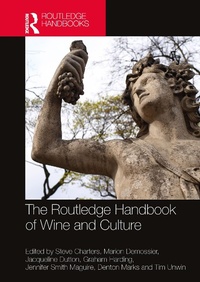
The Routledge Handbook of Wine and Culture
1st Edition
Published on 26. April 2022
494 pages
978-1-000-53391-0 (ISBN)
Description

This title was a prize winner at the OIV (International Organisation of Vine and Wine) Awards 2023.
The link between culture and wine reaches back into the earliest history of humanity. The Routledge Handbook of Wine and Culture brings together a newly comprehensive, interdisciplinary overview of contemporary research and thinking on how wine fits into the cultural frameworks of production, intermediation and consumption.
Bringing together many leading researchers engaged in studying these phenomena, it explores the different ways in which wine is constructed as a social artefact and how its representation and use acquire symbolic meaning. Wine can be analysed in different ways by varying disciplines involved in exploring wine and culture (anthropology, economics and business, geography, history and sociology, and as text). The Handbook uses these as lenses to consider how producers, intermediaries and consumers use and create cultural significance. Specifically, the work addresses the following: how wine relates to place, belief systems and accompanying rituals; how it may be used as a marker of the identity and mechanisms of civilising processes (often in conjunction with food and the arts); how its framing intersects with science and nature; the ideologies and power relations which arise around all these activities; and the relation of this to wine markets and public institutions.
This is essential reading for researchers and students in education for the wine industry and in the humanities and social sciences engaged in understanding patterns of human ingenuity and interaction, such as sociology, anthropology, economics, health, geography, business, tourism, cultural studies, food studies and history.
The link between culture and wine reaches back into the earliest history of humanity. The Routledge Handbook of Wine and Culture brings together a newly comprehensive, interdisciplinary overview of contemporary research and thinking on how wine fits into the cultural frameworks of production, intermediation and consumption.
Bringing together many leading researchers engaged in studying these phenomena, it explores the different ways in which wine is constructed as a social artefact and how its representation and use acquire symbolic meaning. Wine can be analysed in different ways by varying disciplines involved in exploring wine and culture (anthropology, economics and business, geography, history and sociology, and as text). The Handbook uses these as lenses to consider how producers, intermediaries and consumers use and create cultural significance. Specifically, the work addresses the following: how wine relates to place, belief systems and accompanying rituals; how it may be used as a marker of the identity and mechanisms of civilising processes (often in conjunction with food and the arts); how its framing intersects with science and nature; the ideologies and power relations which arise around all these activities; and the relation of this to wine markets and public institutions.
This is essential reading for researchers and students in education for the wine industry and in the humanities and social sciences engaged in understanding patterns of human ingenuity and interaction, such as sociology, anthropology, economics, health, geography, business, tourism, cultural studies, food studies and history.
Reviews / Votes
'Food and eating as a component of culture has been a prosperous field of study for the last few decades. For myself, I always felt a bit daunted at taking on the often esoteric-seeming culture of wine. But in this book, the international, interdisciplinary and learned team of editors have produced a wonderful introduction to the field that allays all anxieties. It is an impressive collection, and written in a lively fashion.'Stephen Mennell, author of All Manners of Food, Professor Emeritus of Sociology, University College Dublin.
'With a massive all star cast of social scientists and more this new compendium does nothing less than show how that heavenly beverage, wine, touches every part of the culture of much of the world. ?Extravagantly edited and carefully written, this is a handbook for the ages.'
Orley Ashenfelter, Princeton University, American Association of Wine Economists (President), and Editorial Boards, Journal of Wine Economics and Journal of Cultural Economics?.
'An enchanting and authoritative sampling, or tasting, or wine aspect of wine lore and information. Not just about production and consumption, the Handbook evokes creative thinking about wine in society, economy and personal life.'
Professor Paul Freedman, Chester D. Tripp Professor of History, Dept. of History, Yale University.
'Wine culture can be intimidating. Happily, we now have a Handbook that puts out the welcome mat for newcomers, but also provides nuanced analysis for seasoned wine scholars. This broad-reaching compendium walks readers through the transnational expanse of wine culture that touches business, economics, geography, history. The multidisciplinary team helps us to appreciate wine as a material good but also a cultural product embedded in ideologies and power relations. It is an indispensable touchstone for future research on wine.'
Josee Johnston, co-author of Foodies, Professor of Sociology, University of Toronto.
"More than a handbook, this volume is an invitation to explore wine as a cultural object and phenomenon. From anthropology to economics, scholars from a variety of disciplines explore the culture of wine from novel perspectives. The reader can delve into the colonial past and legacy of wine, engage with current environmental issues or think about what the future might hold for the production of wine.
Showing that wine is good to think, this volume will appeal to wine lovers and scholars alike. The quality of the writing and the breadth of the topics make this handbook an excellent resource for anyone interested in delving into the cultural importance of wine.
The Routledge Handbook of Wine and Culture is an excellent addition to the growing scholarship on wine and culture. What is particularly remarkable about this volume is the breadth of the topics covered and the complementary nature of the interdisciplinary research. This work is a wonderful addition to academic and home libraries."
Rachel Black, Associate Editor of Food and Foodways, Associate Professor, Anthropology Dept., Connecticut College.
More details
Edition
1. Auflage
Language
English
Place of publication
London
United Kingdom
Publishing group
Taylor & Francis Ltd
Target group
College/higher education
Professional and scholarly
Illustrations
20 Tables, black and white; 24 Line drawings, black and white; 24 Halftones, black and white; 48 Illustrations, black and white
ISBN-13
978-1-000-53391-0 (9781000533910)
Copyright in bibliographic data and cover images is held by Nielsen Book Services Limited or by the publishers or by their respective licensors: all rights reserved.
Schweitzer Classification
Other editions
Additional editions
Steve Charters | Marion Demossier | Jacqueline Dutton
The Routledge Handbook of Wine and Culture
Book
04/2025
1st Edition
Routledge
€71.10
Shipment within 10-20 days
Steve Charters | Marion Demossier | Jacqueline Dutton
The Routledge Handbook of Wine and Culture
Book
04/2022
1st Edition
Routledge
€334.80
Shipment within 15-20 days
Persons
Steve Charters is Professor of Wine Marketing and a researcher at Burgundy School of Business in Dijon, and is responsible for developing teaching and research programmes focusing on all aspects of the business, culture and history of wine. He is also adjunct professor in the Adelaide Business School at the University of Adelaide, Australia.
Marion Demossier is Professor of Social Anthropology in the Department of Modern Languages and Linguistics at the University of Southampton. She has recently completed a monograph on the anthropology of wine and terroir: Burgundy, a Global Anthropology of Place and Taste.
Jacqueline Dutton is Professor of French Studies at the University of Melbourne. She co-edited Wine, Terroir and Utopia: Making New Worlds (with Peter J. Howland) and her research focuses on the cultural history of wine in Bordeaux, Burgundy, and Champagne.
Graham Harding is a wine historian attached to the history faculty of the University of Oxford. His Champagne in Britain, 1800-1914: How the English Transformed a French Luxury was published in 2021.
Jennifer Smith Maguire is Professor of Cultural Production and Consumption at the Sheffield Business School, Sheffield Hallam University. Her expertise lies in the socio-cultural study of consumer culture and cultural intermediaries, with a special focus on the construction of markets, tastes and value.
Denton Marks
is Professor Emeritus of Economics at the University of Wisconsin-Whitewater and fellow of the American Association of Wine Economists. His research involves a range of aspects of wine as a cultural good, and his Wine and Economics: Transacting the Elixir of Life is used internationally in various oenological programs. Tim Unwin is Emeritus Professor of Geography at Royal Holloway, University of London. He co-founded the Journal of Wine Research in 1990 and was external examiner and academic advisor to the Institute of Masters of Wine from 2004 to 2011.
Marion Demossier is Professor of Social Anthropology in the Department of Modern Languages and Linguistics at the University of Southampton. She has recently completed a monograph on the anthropology of wine and terroir: Burgundy, a Global Anthropology of Place and Taste.
Jacqueline Dutton is Professor of French Studies at the University of Melbourne. She co-edited Wine, Terroir and Utopia: Making New Worlds (with Peter J. Howland) and her research focuses on the cultural history of wine in Bordeaux, Burgundy, and Champagne.
Graham Harding is a wine historian attached to the history faculty of the University of Oxford. His Champagne in Britain, 1800-1914: How the English Transformed a French Luxury was published in 2021.
Jennifer Smith Maguire is Professor of Cultural Production and Consumption at the Sheffield Business School, Sheffield Hallam University. Her expertise lies in the socio-cultural study of consumer culture and cultural intermediaries, with a special focus on the construction of markets, tastes and value.
Denton Marks
is Professor Emeritus of Economics at the University of Wisconsin-Whitewater and fellow of the American Association of Wine Economists. His research involves a range of aspects of wine as a cultural good, and his Wine and Economics: Transacting the Elixir of Life is used internationally in various oenological programs. Tim Unwin is Emeritus Professor of Geography at Royal Holloway, University of London. He co-founded the Journal of Wine Research in 1990 and was external examiner and academic advisor to the Institute of Masters of Wine from 2004 to 2011.
Content
Introduction. Part I- Context: Disciplinary Perspectives On Wine And Culture. 1Anthropology, Wine and Culture. 2.Business, Wine and Culture. 3.Economics, Wine and Culture. 4.Geography, Wine and Culture. 5.History, Wine and Culture. 6.Sociology, Wine and Culture. 7.Text, Wine and Culture. Part II- Production and Place. 8.Cultures of Terroir. 9.Sites and Sights of Production: Spaces and Performances of Winemaking. 10.Wine Islands: Colonial Cultures of the Vine. 11.Expressing Sense of Place and Terroir through Wine to Tourism Encounters: Antipodal Reflections from France to New Zealand. 12.Wine, Culture and Environment: A Study of the Sierra (Nevada) Foothills American Viticultural Area. 13.Making Wine, Making Home. 14.Climats and the Crafting of Heritage Value in Burgundy Terroir. 15.Wine, Deep in the Heart of Texas. Part III- Intermediation and Consumption. 16.Characters of Wine: The Cultural Meanings of Typefaces and Fonts in Wine Labels. 17.Making the Right Impression: Irish Wine Culture c.1700 to Present. 18.Wine as part of Polish Identity in Early Modern Times. Constructing Wine Culture in Non-Wine Countries. 19.The Shape of Luxury: Three Centuries of the Champagne Glass in British Material Culture. 20.'For Us as Experimentalists': An Australian Case Study of Scientific Values in the 19th Century New World Winegrowing. 21.Tasting as Expertise: Scientific Agronomists and Sommeliers in France in the First Half of the Twentieth Century. 22.Wine Writing as Lifestyle Writing: Communicating Taste and Constructing Lifestyle in the Saturday Times Wine Column. 23.The (Practical) Economics of Selling Wine as a Cultural Good. 24.Champagne: A Global Symbol of Contemporary Consumer Culture. Part IV: Belief and Representation. 25.Wine and Religion Part I: Antiquity to 1700. 26.Wine and Religion Part II: 1700 to the Present. 27.Wine as Metaphor. 28.New world wine and the evolution of universal, vernacular, metro-rural, and indigenous idylls. 29.Narratives of Science and Culture in Winemaking. 30.Applying Fashion Theory to Wine: A Production of Culture Example. 31.Spending, Taste and Knowledge: Logics of Connoisseurship and Good Taste in the Age of Cultural Democratisation. Part V: Power and Contestation. 32.Competing and Complementary Utopias: Toward an Understanding of Entangled Wine Ideals. 33.Threats of Pleasure and Chaos: Wine and Gendered Social Order. 34.Women in Wine...Occasionally: Gender Roles in the Wine Industry. 35.Sustainable Wine: The Discursive Production of Sustainability in the Wine Field. 36.The Triumph of the Holy Trinity: Terrior, Typicity, and Quality Anchoring the AOC Model in the Second Half of the 20th Century. 37.What can Winemakers' business models tell us about the cultural traits of wine regions? A Comparative analysis. 38.Repudiation Not Withstanding: Critics and the Case for Hybrid Grape Wines. 39.If It's Famous, It Must Be Good: The Social Construction of Brand Value in the US Wine Market. Part VI: Change and the Future. 40.The Internationalization of Winegrape Varieties and its Implication for Terroir-Based Cultural Assets. 41.Cultural Heritage and Migration in the Wine World. 42.The China Wine Market: How Wine is Gaining Cultural Value in Chinese Culture. 43.Beyond White: On Wine and Ethnicity. 44.Climate or Technical Change in Wine? Confronting Climatologists' and Wine-Growers' Analyses. 45.Winegrowing, Climate Change, and a Case for Biodynamic Viticulture. Conclusion
