

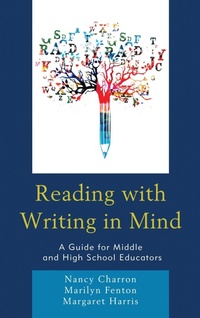
Reading with Writing in Mind
A Guide for Middle and High School Educators
1st Edition
Published on 17. November 2017
140 pages
978-1-4758-4006-3 (ISBN)
Description

Good writing begins with good reading. This book is written on the premise that students must embrace reading as a part of the full process of good writing. It may be used by classroom teachers (Grades 6-12) individually or collectively as members of a professional learning community, by pre-service teachers in a literacy course, or by other educators working to support literacy in the classroom. Interdisciplinary discussions relate to all types or genres of reading and writing.
This book offers practical lessons and ideas for teaching and motivating all learners using Universal Design for Learning principles. Formatting provides additional ideas for challenged students, including students with special needs, accelerated learners, and English Language Learners, and is aligned with Common Core State Standards for content subjects as well as for language arts. It takes ideas that were formerly reserved for the upper echelon of students in English language arts and reformulates teaching approaches to reach students across the learning spectrum and in all disciplines. All teachers need to be involved in raising the literacy bar, and this book provides activities and strategies for use in the classroom that can promote success for all learners.
This book offers practical lessons and ideas for teaching and motivating all learners using Universal Design for Learning principles. Formatting provides additional ideas for challenged students, including students with special needs, accelerated learners, and English Language Learners, and is aligned with Common Core State Standards for content subjects as well as for language arts. It takes ideas that were formerly reserved for the upper echelon of students in English language arts and reformulates teaching approaches to reach students across the learning spectrum and in all disciplines. All teachers need to be involved in raising the literacy bar, and this book provides activities and strategies for use in the classroom that can promote success for all learners.
More details
Edition
1. Auflage
Language
English
Place of publication
New York
United States
Publishing group
Bloomsbury Publishing Plc
ISBN-13
978-1-4758-4006-3 (9781475840063)
Copyright in bibliographic data and cover images is held by Nielsen Book Services Limited or by the publishers or by their respective licensors: all rights reserved.
Schweitzer Classification
Other editions
New editions
Nancy Charron | Marilyn Fenton
Reading with Writing in Mind
A Guide for All Middle and High School Educators
E-Book
08/2023
2nd Edition
Rowman & Littlefield Publishers
€29.49
Available for download
Additional editions
Nancy Charron | Marilyn Fenton | Margaret Harris
Reading with Writing in Mind
A Guide for Middle and High School Educators
Book
11/2017
Rowman & Littlefield Publishers
€100.20
Shipment within 10-20 days
Persons
Dr. Nancy Charron has worked in different capacities at the elementary, middle school, and high school levels with jobs encompassing being a general education teacher, a special education teacher, a literacy specialist, and a principal designee. She is currently working as an Associate Professor at Southern New Hampshire University.
Dr. Marilyn Fenton, an associate professor at Southern New Hampshire University, has taught writing, children's and young adult literature, and methods courses for prospective English teachers, grades 5-12. She previously taught English in high school and then served as a school district's Director of Curriculum and Instruction. She is presently involved in working with doctoral students in the Educational Leadership Program at Southern New Hampshire University.
Dr. Margaret Harris taught graduate courses in Content Literacy on Secondary Level and Social Studies Methods at Southern New Hampshire University. Prior to university teaching, she was Assistant Superintendent for Curriculum and Instruction for four years and a social studies teacher on the high school level for 27 years. Dr. Harris has recently retired from Southern New Hampshire University.
Dr. Marilyn Fenton, an associate professor at Southern New Hampshire University, has taught writing, children's and young adult literature, and methods courses for prospective English teachers, grades 5-12. She previously taught English in high school and then served as a school district's Director of Curriculum and Instruction. She is presently involved in working with doctoral students in the Educational Leadership Program at Southern New Hampshire University.
Dr. Margaret Harris taught graduate courses in Content Literacy on Secondary Level and Social Studies Methods at Southern New Hampshire University. Prior to university teaching, she was Assistant Superintendent for Curriculum and Instruction for four years and a social studies teacher on the high school level for 27 years. Dr. Harris has recently retired from Southern New Hampshire University.
Content
Preface
Introduction
Chapter 1: Reading to Improve Student Writing
Activity 1.1: Take Time to Notice-Looking and Learning
Activity 1.2: Take Time to Notice-An Artist's Choices
Activity 1.3: Take Time to Notice-Comparison of Two Works of Art
Activity 1.4: Noticing the Writer's Choices-Reading Poems
Activity 1.5: Noticing the Writer's Choices-Reading Fiction
Activity 1.6: Noticing the Writer's Choices-Reading Nonfiction
Activity 1.7: Determining Connotation vs. Denotation-Taking the Temperature of Words
Activity 1.8: Identifying Three Kinds of Questions
Activity 1.9: Using the I-Search Paper
Chapter 2: Reading and Writing in the Content Areas
Activity 2.1: Using the SOAPSTone Strategy
Activity 2.2: Role-playing
Activity 2.3: Using Primary Documents
Activity 2.4: Using Letters, Diaries, and Other Primary Sources
Activity 2.5: Applying the Concept of Essential Questions in Content Areas
Activity 2.6: Implementing Socratic Seminars
Activity 2.7: Reviewing the Textbook
Activity 2.8: Journaling
Activity 2.9: Authentic Content Area Writing
Chapter 3: Developing Focus and Logic through the Essay
Activity 3.1: How Meaning is Constructed in E.B. White's "Once More to the Lake"
Activity 3.2: Form Supports Meaning
Activity 3.3: Conversion of a Narrative to an Essay
Activity 3.4: Finding Significance in Literature
Activity 3.5: Brainstorming in Response to Essential Questions
Chapter 4: Reading for Persuasive Writing: The Argument
Activity 4.1: Checklist for Close-Reading
Activity 4.2: The Face-Off
Activity 4.3: The Scaffolded Oral Presentation
Activity 4.4: A Panel Discussion
Activity 4.5: Staging the Trial
Activity 4.6: Defending Preference
Chapter 5: Learning to Write by Reading Poetry
Activity 5.1: Less is More
Activity 5.2: "Found" Poetry
Activity 5.3: From Prose to Poetry
Activity 5.4: Playing with Meter
Activity 5.5: Learning from e.e. cummings
Activity 5.6: Poems Using Metaphor
Activity 5.7: Letter Poem
Activity 5.8: History and Poetry
Activity 5.9: Songs as Poetry
Activity 5:10: Inference
Chapter 6: Providing Literacy Access to All Students
Chapter 7: Reading and Reflecting on One's Own Writing
Chapter 8: Closing the Literacy Loop
References
About the Authors
Introduction
Chapter 1: Reading to Improve Student Writing
Activity 1.1: Take Time to Notice-Looking and Learning
Activity 1.2: Take Time to Notice-An Artist's Choices
Activity 1.3: Take Time to Notice-Comparison of Two Works of Art
Activity 1.4: Noticing the Writer's Choices-Reading Poems
Activity 1.5: Noticing the Writer's Choices-Reading Fiction
Activity 1.6: Noticing the Writer's Choices-Reading Nonfiction
Activity 1.7: Determining Connotation vs. Denotation-Taking the Temperature of Words
Activity 1.8: Identifying Three Kinds of Questions
Activity 1.9: Using the I-Search Paper
Chapter 2: Reading and Writing in the Content Areas
Activity 2.1: Using the SOAPSTone Strategy
Activity 2.2: Role-playing
Activity 2.3: Using Primary Documents
Activity 2.4: Using Letters, Diaries, and Other Primary Sources
Activity 2.5: Applying the Concept of Essential Questions in Content Areas
Activity 2.6: Implementing Socratic Seminars
Activity 2.7: Reviewing the Textbook
Activity 2.8: Journaling
Activity 2.9: Authentic Content Area Writing
Chapter 3: Developing Focus and Logic through the Essay
Activity 3.1: How Meaning is Constructed in E.B. White's "Once More to the Lake"
Activity 3.2: Form Supports Meaning
Activity 3.3: Conversion of a Narrative to an Essay
Activity 3.4: Finding Significance in Literature
Activity 3.5: Brainstorming in Response to Essential Questions
Chapter 4: Reading for Persuasive Writing: The Argument
Activity 4.1: Checklist for Close-Reading
Activity 4.2: The Face-Off
Activity 4.3: The Scaffolded Oral Presentation
Activity 4.4: A Panel Discussion
Activity 4.5: Staging the Trial
Activity 4.6: Defending Preference
Chapter 5: Learning to Write by Reading Poetry
Activity 5.1: Less is More
Activity 5.2: "Found" Poetry
Activity 5.3: From Prose to Poetry
Activity 5.4: Playing with Meter
Activity 5.5: Learning from e.e. cummings
Activity 5.6: Poems Using Metaphor
Activity 5.7: Letter Poem
Activity 5.8: History and Poetry
Activity 5.9: Songs as Poetry
Activity 5:10: Inference
Chapter 6: Providing Literacy Access to All Students
Chapter 7: Reading and Reflecting on One's Own Writing
Chapter 8: Closing the Literacy Loop
References
About the Authors
