

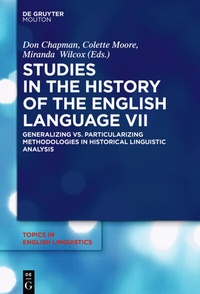
Studies in the History of the English Language VII
Description

This book looks at how historical linguists accommodate the written records used for evidence. The limitations of the written record restrict our view of the past and the conclusions that we can draw about its language. However, the same limitations force us to be aware of the particularities of language. This collection blends the philological with the linguistic, combining questions of the particular with generalizations about language change.
Reviews / Votes
"The individual papers reward careful reading and will be important resources to scholars of the history of the English language and to the students of all periods of the English language. [...] These essays could be employed in both undergraduate and graduate courses as models of argumentation using corpus linguistics, but the volume as a whole offers a model for reimagining conference proceedings. The editors tease out common threads among a diverse set of essays to demonstrate the overall coherence of their field. Other editors of proceedings would be well served to follow their example. As a result of the editors' work, this volume will make a valuable contribution to undergraduate libraries as well as to the research libraries that more typically house conference proceedings."
Felicia Jean Steele in: Diachronica 34:4 (2017), pp. 577-583
More details
Other editions
Additional editions
Persons
D. Chapman , Brigham Young University; C. Moore , University of Washington, Seattle; M. Wilcox , Brigham Young University, Provo, USA.
Content
- Intro
- Table of contents
- Introduction
- I. Particularizing and generalizing for written records
- A philological tour of HEL
- From stop-fricative clusters to contour segments in Old English
- On the regrettable dichotomy between philology and linguistics: Historical lexicography and historical linguistics as test cases
- II. Particulars of authorship
- The history of the English language and the history of English literature
- "Of harmes two, the lesse is for to chese": An integrated OT-Maxent approach to syntactic inversions in Chaucer's verse
- The effect of representativeness and size in historical corpora: An empirical study of changes in lexical frequency
- III. Particulars of communicative setting
- Seeing is believing: Evidentiality and direct visual perception verbs in Early Modern English witness depositions
- Sincerity and the moral reanalysis of politeness in Late Modern English: Semantic change and contingent polysemy
- Something to write home about: Socialnetwork maintenance in the correspondence of nineteenth-century Scottish emigrants
- IV. Particularizing from words
- Words swimming in sound change
- Plural marking in the Old and Middle English nd-stems feond and freond
- From Shakespeare to Present-Day American English: The survival of 'get + (XP) + gone' constructions
- Index
