

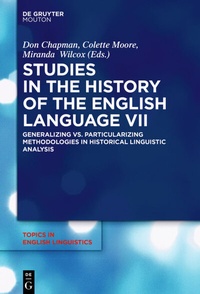
Studies in the History of the English Language VII
Description

This book looks at how historical linguists accommodate the written records used for evidence. The limitations of the written record restrict our view of the past and the conclusions that we can draw about its language. However, the same limitations force us to be aware of the particularities of language. This collection blends the philological with the linguistic, combining questions of the particular with generalizations about language change.
Reviews / Votes
"The individual papers reward careful reading and will be important resources to scholars of the history of the English language and to the students of all periods of the English language. [...] These essays could be employed in both undergraduate and graduate courses as models of argumentation using corpus linguistics, but the volume as a whole offers a model for reimagining conference proceedings. The editors tease out common threads among a diverse set of essays to demonstrate the overall coherence of their field. Other editors of proceedings would be well served to follow their example. As a result of the editors' work, this volume will make a valuable contribution to undergraduate libraries as well as to the research libraries that more typically house conference proceedings."
Felicia Jean Steele in: Diachronica 34:4 (2017), pp. 577-583
More details
Other editions
Additional editions
Persons
D. Chapman , Brigham Young University; C. Moore , University of Washington, Seattle; M. Wilcox , Brigham Young University, Provo, USA.
