

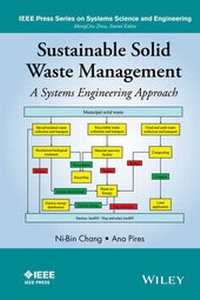
Sustainable Solid Waste Management
Description

More details
Other editions
Additional editions
Persons
Content
PREFACE xix
I FUNDAMENTAL BACKGROUND 1
1 INTRODUCTION 3
1.1 The Concept of Sustainable Development 3
1.2 Sustainability in the Context of SWM 10
1.3 The Framework for Sustainability Assessment 12
1.4 The Structure of this Book 13
References 16
2 TECHNOLOGY MATRIX FOR SOLID WASTE MANAGEMENT 19
2.1 Waste Classification and Types of Waste 19
2.2 Waste Management Through Waste Hierarchy: Reduce, Reuse, Recycle, Recover, and Disposal 28
2.3 Waste Operational Units: Real-World Cases 34
2.4 Waste Operational Units: Equipment and Facilities 42
2.5 Technology Matrix for Multiple Solid Waste Streams 72
2.6 Final Remarks 90
References 90
3 SOCIAL AND ECONOMIC CONCERNS 99
3.1 Financial Concerns 100
3.2 Economic Incentives and Socioeconomic Concerns 114
3.3 Social Concerns 123
3.4 Final Remarks 133
References 134
4 LEGAL AND INSTITUTIONAL CONCERNS 141
4.1 SWM Legislation 141
4.2 Sustainable Waste Management Principles and Policies 151
4.3 Policy Instruments 155
4.4 ISWM Plans 162
4.5 Final Remarks 163
References 163
5 RISK ASSESSMENT AND MANAGEMENT OF RISK 171
5.1 Formulate the Problem: Inherent Hazards in Solid Waste Management 171
5.2 Risk Assessment in Solid Waste Management 176
5.3 Management of Risk 183
5.4 Risk Communication 184
5.5 How to Promote a Sustainable Solid Waste Management with Risk Analysis? 186
5.6 Final Remarks 188
References 188
II PRINCIPLES OF SYSTEMS ENGINEERING 193
6 GLOBAL CHANGE, SUSTAINABILITY, AND ADAPTIVE MANAGEMENT STRATEGIES FOR SOLID WASTE MANAGEMENT 195
6.1 Global Change Impacts 195
6.2 Sustainability Considerations and Criteria 208
6.3 Adaptive Management Strategies for Solid Waste Management Systems 208
6.4 Final Remarks 210
References 210
7 SYSTEMS ENGINEERING PRINCIPLES FOR SOLID WASTE MANAGEMENT 215
7.1 Systems Engineering Principles 215
7.2 System of Systems Engineering Approaches 222
7.3 Centralized Versus Decentralized Approaches 227
7.4 Sensitivity Analysis and Uncertainty Quantification 230
7.5 Final Remarks 232
References 233
8 SYSTEMS ENGINEERING TOOLS AND METHODS FOR SOLID WASTE MANAGEMENT 235
8.1 Systems Analysis, Waste Management, and Technology Hub 236
8.2 Cost-Benefit-Risk Trade-Offs and Single-Objective Optimization 240
8.3 Multicriteria Decision-Making 248
8.4 Game Theory and Conflict Resolution 283
8.5 System Dynamics Modeling 287
8.6 Final Remarks 290
References 292
Appendix Web Site Resources of Software Packages of LINDO and LINGO 299
III INDUSTRIAL ECOLOGY AND INTEGRATED SOLID WASTE MANAGEMENT STRATEGIES 301
9 INDUSTRIAL ECOLOGY AND MUNICIPAL UTILITY PARKS 303
9.1 Industrial Symbiosis and Industrial Ecology 303
9.2 Creation of Eco-Industrial Parks and Eco-Industrial Clusters 309
9.3 Municipal Utility Parks in Urban Regions 314
9.4 Final Remarks 319
References 321
10 LIFE CYCLE ASSESSMENT AND SOLID WASTE MANAGEMENT 323
10.1 Life Cycle Assessment for Solid Waste Management 323
10.2 Phases of Life Cycle Assessment 325
10.3 LCA Waste Management Software 355
10.4 Putting LCA into Practice 361
10.5 Life Cycle Management 374
10.6 Final Remarks 376
References 376
11 STREAMLINED LIFE CYCLE ASSESSMENT FOR SOLID WASTE TREATMENT OPTIONS 387
11.1 Application of Life Cycle Assessment for Solid Waste Management 388
11.2 LCA for Screening Technologies of Solid Waste Treatment 390
11.3 LCA Assessment Methodology 391
11.4 Description of the CSLCA 397
11.5 Interpretation of CSLCA Results 400
11.6 Final Remarks 412
References 412
12 CARBON-FOOTPRINT-BASED SOLID WASTE MANAGEMENT 417
12.1 The Global-Warming Potential Impact 417
12.2 The Quantification Process 418
12.3 GWP Assessment for Solid Waste Management 426
12.4 Case Study 429
12.5 Systems Analysis 434
12.6 Final Remarks 436
References 436
IV INTEGRATED SYSTEMS PLANNING, DESIGN, AND MANAGEMENT 441
13 MULTIOBJECTIVE DECISION-MAKING FOR SOLID WASTE MANAGEMENT IN A CARBON-REGULATED ENVIRONMENT 443
13.1 Current Gaps of Cost-Benefit Analyses for Solid Waste Management 444
13.2 Background of System Planning 446
13.3 Formulation of Systems Engineering Models for Comparative Analysis 451
13.4 Interpretation of Modeling Output for Decision Analysis 459
13.5 Comparative Analysis 464
13.6 Final Remarks 470
References 470
14 PLANNING REGIONAL MATERIAL RECOVERY FACILITIES IN A FAST-GROWING URBAN REGION 475
14.1 Forecasting Municipal Solid Waste Generation and Optimal Siting of MRF in a Fast-growing Urban Region 476
14.2 Modeling Philosophy 478
14.3 Study Region and System Analysis Framework 480
14.4 Prediction of Solid Waste Generation 483
14.5 Regional Planning of Material Recovery Facilities 492
14.6 Final Remarks 506
References 508
15 OPTIMAL PLANNING FOR SOLID WASTE COLLECTION, RECYCLING, AND VEHICLE ROUTING 515
15.1 Systems Engineering Approaches for Solid Waste Collection 516
15.2 Simulation for Planning Solid Waste Recycling Drop-Off Stations 520
15.3 Multiobjective Programming for Planning Solid Waste Recycling Drop-Off Stations 533
15.4 Final Remarks 543
References 546
16 MULTIATTRIBUTE DECISION-MAKING WITH SUSTAINABILITY CONSIDERATIONS 553
16.1 Deterministic Multiple Attribute Decision-Making Process 554
16.2 MADM for Solid Waste Management 568
16.3 Final Remarks 579
References 580
17 DECISION ANALYSIS FOR OPTIMAL BALANCE BETWEEN SOLID WASTE INCINERATION AND RECYCLING PROGRAMS 585
17.1 Systems Analysis for Integrated Material Recycling and Waste-to-Energy Programs 586
17.2 Refuse-Derived Fuel Process for Solid Waste Management 587
17.3 Regional Shipping Strategies 594
17.4 Final Remarks 606
References 609
18 ENVIRONMENTAL INFORMATICS FOR INTEGRATED SOLID WASTE MANAGEMENT 611
18.1 How Does Environmental Informatics Help Solid Waste Management? 611
18.2 Sensors and Sensor Networks for Solid Waste Management 612
18.3 Database Design for Solid Waste Management 615
18.4 Spatial Analysis with GIS and GPS for Solid Waste Management 616
18.5 Expert Systems, Decision Support Systems, and Computational Intelligence Techniques 624
18.6 Integrated Environmental Information Systems 641
18.7 Final Remarks 644
References 646
V UNCERTAINTY ANALYSES AND FUTURE PERSPECTIVES 665
19 STOCHASTIC PROGRAMMING AND GAME THEORY FOR SOLID WASTE MANAGEMENT DECISION-MAKING 667
19.1 Background of Stochastic Programming 667
19.2 Model Formulations of Stochastic Programming 668
19.3 Stochastic Programming with Multiple Objective Functions 682
19.4 Stochastic Dynamic Programming 686
19.5 Game Theory 689
19.6 Final Remarks 698
References 699
20 FUZZY MULTIATTRIBUTE DECISION-MAKING FOR SOLID WASTE MANAGEMENT WITH SOCIETAL COMPLICATIONS 703
20.1 Fundamentals of Fuzzy Set Theory 703
20.2 Siting a Regional Landfill with Fuzzy Multiattribute Decision-Making and GIS Techniques 713
20.3 Fair Fund Redistribution and Environmental Justice with GIS-based Fuzzy AHP Method 731
20.4 Final Remarks 751
References 753
21 FUZZY MULTIATTRIBUTE DECISION-MAKING FOR SOLID WASTE MANAGEMENT WITH TECHNOLOGICAL COMPLICATIONS 759
21.1 Integrated Fuzzy Topsis and AHP Method for Screening Solid Waste Recycling Alternatives 759
21.2 The Algorithm of FIMADM Method 765
21.3 The Solid Waste Management System 771
21.4 Final Remarks 788
References 788
22 FUZZY MULTIOBJECTIVE DECISION-MAKING FOR SOLID WASTE MANAGEMENT 791
22.1 Fuzzy Linear Programming 791
22.2 Fuzzy Multiobjective Programming-Fuzzy Global Criterion Method 796
22.3 Fuzzy Goal Programming 800
22.4 Case Study 802
22.5 Final Remarks 823
References 826
23 GREY SYSTEMS THEORY FOR SOLID WASTE MANAGEMENT 829
23.1 Grey Systems Theory 829
23.2 Grey Linear Programming 831
23.3 The Stability Issues of Grey Programming Models 840
23.4 The Hybrid Approach for Various Cases of Uncertainty Quantification 843
23.5 Final Remarks 844
References 845
24 SYSTEMS ANALYSIS FOR THE FUTURE OF SOLID WASTE MANAGEMENT: CHALLENGES AND PERSPECTIVES 849
24.1 The Evolution of Systems Analysis for Solid Waste Management 850
24.2 Trend Analysis 862
24.3 Technical Barriers and Socioeconomic Challenges 869
24.4 Future Perspectives 872
24.5 Final Remarks 874
References 875
INDEX 895
CHAPTER 1
INTRODUCTION
Society is increasingly conscious of the importance of solid waste management (SWM) in the context of sustainable development. The need to operate our waste management activities in a way that minimizes environmental and health risks and ensures economic growth and social progress has been well received by the community. The purpose of this chapter is to emphasize the essence of sustainable development as part of the package of tools for making decisions about SWM. This chapter provides a common framework for sustainable development and relevant basic principles that support such ideas. The guidelines describe possible actions to establish a framework for a wide range of SWM activities across diverse spatial and temporal scales. Case studies that demonstrate how to apply sustainable SWM processes across a variety of activities are introduced sequentially in subsequent chapters.
1.1 THE CONCEPT OF SUSTAINABLE DEVELOPMENT
1.1.1 The Concept Formation
The book "Silent Spring" written by Rachel Carson was published in 1962 (Carson, 1962). The seemingly related connection between the insecticide applications and bird populations was considered a turning point in our basic understanding of the interconnections among the environment, the economy, and social well-being. In 1972, the United Nations Conference on the Human Environment held in Stockholm brought the industrialized and developing nations together to delineate the "rights" of the human family to a healthy and productive environment (United Nations, 2013). In the 1980s, human society was increasingly conscious of possible detrimental effects that its economic activities can have on ecosystems and the environment. Note that ecosystems in this context are systems of plants, animals, and microorganisms together with the nonliving components of their environment (UNEP/WWF/IUCCNF, 1980). This book adopts the definition used in the United Kingdom Environmental Protection Act 1990, that the environment ". consists of all, or any, of the following media, namely the air, water and land." Over generations, the loss of quality of life in human society can result from environmental degradation due to past economic activities, as seen in the numerous hazardous waste remediation sites across the United States (US). The "World Conservation Strategy," jointly published by United Nations Environment Programme (UNEP), World Wide Fund for Nature (WWF), and International Union for Conservation of Nature and Natural Resources (IUCNNR), noted that (UNEP/WWF/IUCCNF, 1980):
The combined destructive impacts of a poor majority struggling to stay alive and an affluent minority consuming most of the world's resources are undermining the very means by which all people can survive and flourish. Humanity's relationship with the biosphere (the thin covering of the planet that contains and sustains life) will continue to deteriorate until a new international economic order is achieved, a new environmental ethic adopted, human populations stabilize, and sustainable modes of development become the rule rather than the exception. Among the prerequisites for sustainable development is the conservation of living resources.
The World Conservation Strategy, which provided a precursor to the concept of sustainable development, aims to (UNEP/WWF/IUCCNF, 1980):
- maintain essential ecological processes and life-support systems (such as soil regeneration and protection, the recycling of nutrients and the cleansing of waters), on which human survival and development depend;
- preserve genetic diversity (the range of genetic material found in the world's organisms), on which depend the breeding programs necessary for the protection and improvement of cultivated plants and domesticated animals, as well as much scientific advance, technical innovation, and the security of the many industries that use living resources;
- ensure the sustainability utilization of species and ecosystems (notably fish and other wildlife, forests, and grazing lands), which supports millions of rural communities as well as major industries.
The United Nations General Assembly convened in 1983 to discuss "The World Commission on Environment and Development" to address concerns about the accelerating degradation of the human environment and natural resources and the consequences of such degradation for economic and social development. Later, the concept of "sustainable development" was formalized by the Brundtland Report published in 1987. Although sustainable development has been defined in many ways, the most frequently quoted definition is from "Our Common Future" in the Brundtland Report (WCED, 1987):
Sustainable development is development that meets the needs of the present without compromising the ability of future generations to meet their own needs.
Two key concepts are emphasized in the Brundtland Report (WCED, 1987) as excerpted below:
- "needs," in particular the essential needs of the world's poor, to which overriding priority should be given; and
- "limitations" imposed by the state of technology and social organization on the environment's ability to meet present and future needs.
In comparison, sustainable development was defined by the President's Council on Sustainable Development in the United States as (USEPA, 2013):
. an evolving process that improves the economy, the environment, and society for the benefit of current and future generations.
In June 1992, the first UN Conference on Environment and Development was held in Rio de Janeiro and adopted an agenda entitled "Agenda 21: A Programme of Action for Sustainable Development" (United Nations, 1992). Agenda 21 states the Rio Declaration on Environment and Development, which agrees to some 27 supporting principles that are abbreviated as the "Rio Principles." Agenda 21 reaffirmed that sustainable development was delimited by the integration of the economic, social, and environmental pillars. This understanding triggers the possible change in consumption and production patterns. Within these 27 supporting principles, principles 3, 4, 6, 8, 10, 11, 13, 14, 15, 16, and 17 are most relevant to waste management, as excerpted below (United Nations, 1992):
- Principle 3: The right to development must be fulfilled so as to equitably meet developmental and environmental needs of present and future generations.
- Principle 4: In order to achieve sustainable development, environmental protection shall constitute an integral part of the development process and cannot be considered in isolation from it.
- Principle 6: The special situation and needs of developing countries, particularly the least developed and those most environmentally vulnerable, shall be given special priority. International actions in the field of environment and development should also address the interests and needs of all countries.
- Principle 8: To achieve sustainable development and a higher quality of life for all people, States should reduce and eliminate unsustainable patterns of production and consumption and promote appropriate demographic policies.
- Principle 10: Environmental issues are best handled with participation of all concerned citizens, at the relevant level. At the national level, each individual shall have appropriate access to information concerning the environment that is held by public authorities, including information on hazardous materials and activities.
- Principle 11: States shall enact effective environmental legislation. Environmental standards, management objectives, and priorities should reflect the environmental and development context to which they apply. Standards applied by some countries may be inappropriate and of unwarranted economic and social cost to other countries, in particular developing countries.
- Principle 13: States shall develop national law regarding liability and compensation for the victims of pollution and other environmental damage. States shall also cooperate in an expeditious and more determined manner to develop further international law regarding liability and compensation for adverse effects of environmental damage caused by activities within their jurisdiction or control to areas beyond their jurisdiction.
- Principle 14: States should effectively cooperate to discourage or prevent the relocation and transfer to other States of any activities and substances that cause severe environmental degradation or are found to be harmful to human health.
- Principle 15: (Precautionary principle)-In order to protect the environment, the "precautionary approach" shall be widely applied by States according to their capabilities. Where there are threats of serious or irreversible damage, lack of full scientific certainty shall not be used as a reason for postponing cost-effective measures to prevent environmental degradation.
- Principle 16: (Polluter pay principle)-National authorities should endeavor to promote the internalization of environmental costs and the use of economic instruments, taking into account the approach that the polluter should, in principle, bear the cost of pollution, with due regard to the public interest and without distorting international trade and investment.
- Principle 17: Environmental impact assessment, as a national...
