

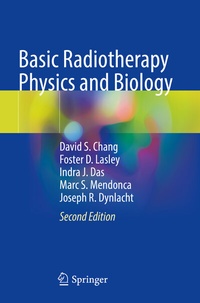
Basic Radiotherapy Physics and Biology
Description

This book is a concise and well-illustrated review of the physics and biology of radiation therapy intended for radiation therapists, dosimetrists, radiation oncology residents, and physicists. It presents topics that are included on the radiation therapy physics and biology board examinations and is designed with the intent of presenting information in an easily digestible format with maximum retention in mind. The inclusion of mnemonics, rules of thumb, and reader-friendly illustrations throughout the book help to make difficult concepts easier to grasp. This new edition is updated throughout with the latest information and applications of radiation oncology physics and biology and includes four new chapters. New topics include: MRI linac, proton beam radiotherapy, chemomodulation and immunomodulation of radiation in vitro and in vivo, and stochastic and deterministic late effects. Basic Radiotherapy Physics and Biology is a valuable reference for radiation oncologists, medical professionals in the field, residents, and all students interested in radiation oncology.
More details
Other editions
Additional editions
Previous edition
Persons
David S. Chang, MD, MS is a Radiation Oncologist at the CHRISTUS St. Patrick Regional Cancer Center in Lake Charles, LA, USA.
Foster D. Lasley, MD is a Radiation Oncologist at GenesisCare in Rogers, AK.
Indra J. Das, PhD, FACR, FASTRO is a professor and vice chair at northwestern university Feinberg School of Medicine, Chicago.
Marc S. Mendonca, PhD is a Professor of Radiation Oncology & Medical and Molecular Genetics, and Director of Radiation and Cancer Biology at Indiana University School of Medicine.
Joseph R. Dynlacht, PhD is a Professor of Radiation Oncology & BIOCHEMISTRY AND MOLECULAR BIOLOGY at Indiana University School of Medicine.
Content
Part I: Radiation Therapy Physics.- Atomic and Nuclear Structure.- Radioactive Decay.- Properties and Production of Radiation.- Interactions of Electromagnetic Radiation with Matter.- Interactions of Particulate Radiation with Matter.- Quantification and Measurement of Dose.- Characteristics of Photon Beams.- Dosimetry of Photon Beams in Water.- Dosimetry of Photon Beams in a Patient.- Dosimetry of Electron Beams.- Physics and Dosimetry of Brachytherapy.- Advanced Treatment Planning for EBRT.- Linac Quality Assurance.- Radiation Protection and Safety.- Quality Management Program.- Special Topics: Hyperthermia and Computers.- MRI linac.- Proton Beam Radiotherapy.- Part II: Radiation Therapy Biology.- Molecular Biology and Signaling.- Cancer Genetic and Molecular Characteristics.- Molecular Mechanisms of DNA Damage and Repair.- Cell Death and Survival Assays.- Fractionated Radiation Survival Models.- Oxygen Effect, Relative Biological Effectiveness and Linear Energy Transfer.- Tumor Micro-environment.- Cell and Tissue Kinetics.- Acute Effects of Total Body Irradiation (TBI).- Normal Tissue Radiation Responses.- Therapeutic Ratio.- Combined Modality Therapy.- Biology of Brachytherapy, Particle Therapy, and Alternative Radiation Modalities.- Chemomodulation and Immunomodulation of Radiation In Vitro and In Vivo.- Hyperthermia.- Stochastic and deterministic Late Effects.- Radiation Effects in the Embryo and Fetus.- Appendix A: Glossary of Terms and Physical Constants.- Appendix B: List of Radionuclides for Radiotherapy and Imaging
