

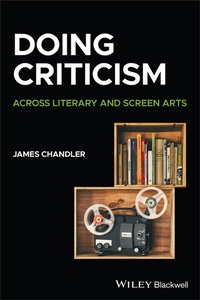
Doing Criticism
Description

Doing Criticism: Across Literary and Screen Arts is a practical guide to engaging actively and productively with a critical object, whether a film, a novel, or a play. Going beyond the study of lyric poetry and literature to include motion picture and dramatic arts, this unique text provides specific advice on how to best write criticism while offering concrete illustrations of what it looks like on the page.
Divided into two parts, the book first presents an up-to-date account of the state of criticism in both Anglo-American and Continental contexts--describing both the longstanding mission and the changing functions of criticism over the centuries and discussing critical issues that bridge the literary and screen arts in the contemporary world. The second part of the book features a variety of case studies of criticism across media, including works by canonical authors such as Jane Austen, Charles Dickens, and W. B. Yeats; films such as Coppola's The Conversation and Hitchcock's Vertigo; screen adaptations of Mary Shelley's Frankenstein and Ishiguro's The Remains of the Day; and a concluding chapter on several of Spike Lee's film "joints" that brings several of the book's central concepts to bear on work of a single film auteur.
Helping students of literature and cinema write well about what they find in their reading and viewing, Doing Criticism: Across Literary and Screen Arts:
* Discusses how the bridging of the literary arts and screen arts can help criticism flourish in the present day
* Illustrates how the doing of criticism is in practice a particular kind of writing
* Considers how to generalize the consequences of criticism beyond personal growth and gratification
* Addresses the ways the practice of criticism matters to the practice of the critical object
* Suggests that doing without criticism is not only unwise, but also perhaps impossible
* Features case studies organized under the rubrics of conversation, adaptation, genre, authorship and seriality
Doing Criticism: Across Literary and Screen Arts is an ideal text for students in introductory courses in criticism, literary studies, and film studies, as well as general readers with interest in the subject.
More details
Other editions
Additional editions
Person
James Chandler is William K. Ogden Distinguished Service Professor in the Departments of English and Cinema & Media Studies at the University of Chicago, USA. He has written widely about Romanticism, British and Irish literature since the early Enlightenment, American cinema, and the relationship of literary criticism to film criticism. He is the author of several books including England in 1819 and An Archaeology of Sympathy: The Sentimental Mode in Literature and Cinema.
Content
Preface ix
Acknowledgments xiii
Part I Critical Issues 1
Chapter 1 Doing Criticism/Doing without Criticism 3
1 Functions of Criticism 3
2 Two Thought Experiments 7
3 Limits of the Lyric Paradigm 12
4 Criticism in the Convenience Store 21
5 Criticism between Page and Screen 26
Chapter 2 Makings of the Critical Essay 36
1 Objects, Occasions, Frames of Reference 36
2 Criticism and the Essay Form 41
3 Critical Questions I 49
4 Critical Questions II 61
5 Critical Judgments 68
Part II Criticism in Practice 83
Chapter 3 Conversations 85
1 Beyond the Poem Itself 85
2 Coppola Sounds Out Hitchcock 97
3 Austen, Edgeworth, and the Moral Economy of the Novel 111
Chapter 4 Adaptations 127
1 Two-Way Street 127
2 Point of View in Fiction and Cinema: The Remains of the Day 137
3 Frankenstein and Its Adapted Progeny 154
Chapter 5 Genres 170
1 Laws of Genre 170
2 Satire across Media: Character and Impersonation 178
3 Melodrama across Media: Character and Personalization 198
Chapter 6 Conclusion: Authorship and Seriality- Spike Lee's Joints 217
1 Authorship, Seriality, and the Case of Spike Lee 217
2 Some Spike Lee Joints: Conversations and Adaptations 227
3 Crossing Genres in Bamboozled 251
Index 269
Preface
This is a book about the act of criticism, about what might be worth saying in the encounter with a poem, a novel, a play, a film, or a television series. This act of saying can assume many forms, but I attend most keenly to it when it assumes the form of a critical essay. At the same time, I also stress that there are no fixed rules for what counts as a critical essay. An essay can be a short review, an artful fragment, a course paper, or a long scholarly article. Sometimes the critical essay appears as a dialogue-as in Henry James' published Conversation about George Eliot's Daniel Deronda. Scripted critical conversations can also be embedded in a film, or a novel, or a television series episode. Think of critical discussions of contemporary poets in the Bath sitting room of a Jane Austen novel, or arguments about the relative merits of contemporary rappers on the Brooklyn streets of a Spike Lee film. Such embedded moments, indeed, can convey a sense of criticism's relation to everyday life, how it matters in and to everyday life-a recurring theme in this book.
The critical essay can assume other forms as well. In a once familiar but now unfashionable case, Alexander Pope's Essay on Criticism (1711), composed by the poet in heroic couplets at the age of twenty-three, it takes the form of a poem, one that includes the following memorable couplet:
'Tis with our judgments as our watches, none
Go just alike, but each man trusts his own.
Pope's witty conceit allows me to pose another central question of this book: what makes criticism tick? The question of course presumes that criticism is actually still ticking, which perhaps does not always go without saying these days. I address that question about criticism's possible demise, too, and also, though less explicitly, that of why it is that the analogy of critical judgment to the mechanism of an eighteenth-century timepiece, with its underlying assumption of fixed rules in both cases, is ultimately inadequate.
This book began with an invitation to write one toward a slightly different title, How to Do Criticism, for a series at Blackwell. Prior entries in the series had included David Damrosch's How to Read World Literature and Wolfgang Iser's How to Do Theory, books that proved it was possible to get a lot done in an introductory format. Blackwell's specific proposal to me offered the prospect of doing something in support of what had come to seem a beleaguered intellectual enterprise. My only condition, on accepting the charge, was that the book must embrace both literary criticism and criticism in the screen arts, especially cinema. Although it eventually evolved beyond its initial brief, the book also profited by that first conception. The ambition was to reach a range of readers, including undergraduate students and non-academics, with an accessible approach to the subject, but without confining discussion to strictly elementary matters-and yes, to include some "how to" advice for undertaking criticism in the present time.
The book that emerged-Doing Criticism: Across Literary and Screen Arts-thus keeps faith with the original objectives of How to Do Criticism, which had included advice not only about how to engage productively with a critical object-a poem, or a novel, or a film-but also how to sustain analysis in argument, how to reach judgments, and how to support them. Over time, however, it became a book not only about the hows of criticism, but also about the whys and wherefores, the whats, the whens, and even the whethers. It came to concern itself, that is, with criticism's reasons and motives, its objects, occasions, and sustaining conditions. Such questions are addressed most directly in Part 1, but they are also elaborated in the introductory sections to the four chapters in Part 2, where a range of specific categories central to my approach to criticism here are identified and explained: conversation, adaptation, genre, authorship, and seriality.
From the start, it had been part of my plan for the book not only to prescribe guidelines for effective criticism but also to perform them, to offer examples of criticism in action. Each of the four chapters of Part 2 thus also includes not only an exposition of a critical category-genre, say-but also a pair of critical essays that I have written for this book. If I have done my work well, these essays should both illustrate how the five categories of Part 2 are actualized in practice and lend a more concrete sense to some of the "how to" guidelines discussed in Part 1-especially Chapter 2's advice about the essay form itself as a vehicle for criticism. To be clear, these essays are not offered merely as illustrative exercises. In each case, I have sought to produce an original piece of critical work on a topic I take to be of genuine interest. I have, in other words, tried to strike a balance between lending a degree of autonomy to the essays and ensuring that they play their role within the larger framework of the book.
There is also another balance I have tried to strike. On the one hand, I view criticism as a recognized field of codified endeavor with an ancient pedigree extending back two and a half millennia. On the other, I acknowledge that criticism has seen many incarnations and reorientations over its long history-changing functions with the changing times. The criticism that flourished among the slaveholding male culture of the ancient Greeks and the criticism that draws energy from post-structuralism, feminism, and Critical Race Theory diverge dramatically on many scores. Although the varieties of criticism have been many over the centuries, many more than I have been able to acknowledge here, even some of the most divergent practices, as I try to suggest in the book's final pages, may be seen as part of a larger disciplinary frame of reference involving the critical relation of analysis and judgment.
Because this book has always been about the doing of criticism, it finds a special point of orientation in the work of I. A. Richards, the Cambridge polymath who is generally credited for establishing the discipline that he himself called "practical criticism." To rethink the work of practical criticism anew here, I found myself inevitably going back to Richards' bold pedagogical experiments of nearly a century ago at Cambridge, and to his democratizing efforts to challenge large groups of (almost exclusively) white male patrician students there at the level of their most fundamental intellectual formation: how they read. Richards' was a bracing project with enormous consequences for criticism. In the end, however, this book departs from his programmatic approach to doing criticism in three crucial respects.
The first has to do with the fact that Richards restricted his focus to literature, to reading-more precisely, to reading poetry on the page. I care deeply about the criticism of poetry, and it is my starting point here, but again my aim in this book has always been to broaden the scope of practical criticism to include not just literary arts but also screen arts. The stakes here are perhaps somewhat greater than they might seem, in that Richards made it clear that he saw the proper study of poetry on the page as the solution to a cultural problem for which he thought cinema partly to blame. The second departure is that where Richards insisted on taking the critical object in isolation-"the poem itself"-I stress the importance of considering critical objects in connection with one another, what I here call relational criticism. All five of the major rubrics that organize Part 2 of this book-conversation, adaptation, genre, author, and seriality-can be understood as relational in this sense. And finally, Richards did not much attend to the art of writing criticism. Instead, he gathered his students' responses to poems in the form of what he called "protocols," relatively informal reactions to the unidentified texts he distributed in his classroom experiments. This book, however, both discusses and illustrates the doing of criticism as a kind of craft-again, especially in the form of the essay, a literary genre with both a long history in its own right and a strong connection to the practice of criticism.
There are many worthy goals that this book does not pursue. It does not claim to offer a systematic method for criticism. Nor does it try to ground what principles or guidelines it offers in a general theory of criticism, though critical theory does inform the book at all points and is sometimes addressed directly. While working on this book, I have published essays in scholarly journals such as Critical Inquiry (on I. A. Richards and Raymond Williams) and New Literary History (on the question of critical sensibility) that pursue some of its key issues for readers interested in theory and the history of criticism; these are cited along the way. On another front, it must be acknowledged that there is little or no attention here to non-Western traditions, though important lines of criticism and commentary can be traced back centuries in many civilizations around the world. Many good books can be found about these traditions, and many more about how some of these traditions have overlapped and interacted with criticism in the line of the Greeks and Romans. I am not competent to undertake such...
