

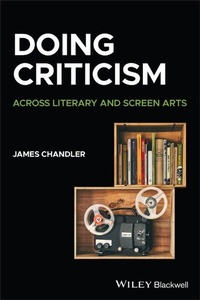
Doing Criticism
Across Literary and Screen Arts
1st Edition
Published on 28. April 2022
Book
Paperback/Softback
304 pages
978-1-4051-7779-5 (ISBN)
Description
An accessible hands-on guide to writing criticism across the literary arts, the dramatic arts, and the narrative screen arts How to Do Criticism is a practical guide to engaging actively and productively with a critical object, whether a film, a novel, or a play. Going beyond the study of lyric poetry and literature to include motion picture and dramatic arts, this unique text provides specific advice on how to best write criticism while offering concrete illustrations of what it looks like on the page
Divided into two parts, the book first presents an up-to-date account of the state of criticism in both Anglo-American and Continental contexts-describing the functions and necessity of criticism and discussing critical issues across the literary and screen arts. The second part of the book features a variety of case studies of criticism across media, including Coppola's The Conversation, Hitchcock's Vertigo, screen adaptions of Shelley's Frankenstein, Austen's Mansfield Park, and others. Helping students of literature and cinema write well about what they find in their reading and viewing, How to Do Criticism:
Discusses how the bridging of the literary arts and screen arts can help criticism flourish in the present day
Illustrates how the doing of criticism is in practice a particular kind of writing
Considers how to generalize the consequences of criticism beyond personal growth and gratification
Addresses the ways the practice of criticism matters to the practice of the critical object
Suggests that doing without criticism is not only unwise, but also perhaps impossible
Features case studies organized around contexts of conversation, adaptation, and genre
How to Do Criticism is an ideal text for students in introductory courses in criticism, literary studies, and film studies, as well as general readers with interest in the subject.
Divided into two parts, the book first presents an up-to-date account of the state of criticism in both Anglo-American and Continental contexts-describing the functions and necessity of criticism and discussing critical issues across the literary and screen arts. The second part of the book features a variety of case studies of criticism across media, including Coppola's The Conversation, Hitchcock's Vertigo, screen adaptions of Shelley's Frankenstein, Austen's Mansfield Park, and others. Helping students of literature and cinema write well about what they find in their reading and viewing, How to Do Criticism:
Discusses how the bridging of the literary arts and screen arts can help criticism flourish in the present day
Illustrates how the doing of criticism is in practice a particular kind of writing
Considers how to generalize the consequences of criticism beyond personal growth and gratification
Addresses the ways the practice of criticism matters to the practice of the critical object
Suggests that doing without criticism is not only unwise, but also perhaps impossible
Features case studies organized around contexts of conversation, adaptation, and genre
How to Do Criticism is an ideal text for students in introductory courses in criticism, literary studies, and film studies, as well as general readers with interest in the subject.
More details
Series
Language
English
Place of publication
Chicester
United Kingdom
Publishing group
John Wiley and Sons Ltd
Target group
Professional and scholarly
Dimensions
Height: 231 mm
Width: 159 mm
Thickness: 18 mm
Weight
454 gr
ISBN-13
978-1-4051-7779-5 (9781405177795)
Copyright in bibliographic data and cover images is held by Nielsen Book Services Limited or by the publishers or by their respective licensors: all rights reserved.
Schweitzer Classification
Other editions
Additional editions
E-Book
03/2022
1st Edition
Wiley-ISTE
€53.99
Available for download
E-Book
03/2022
1st Edition
Wiley-ISTE
€53.99
Available for download

Person
James Chandler is William K. Ogden Distinguished Service Professor in the Departments of English and Cinema & Media Studies at the University of Chicago, USA. He has written widely about Romanticism, British and Irish literature since the early Enlightenment, American cinema, and the relationship of literary criticism to film criticism. He is the author of several books including England in 1819 and An Archaeology of Sympathy: The Sentimental Mode in Literature and Cinema.