

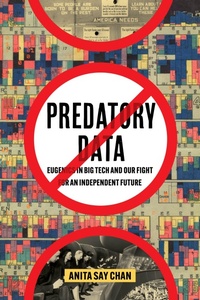
Predatory Data
Eugenics in Big Tech and Our Fight for an Independent Future
1st Edition
Published on 7. January 2025
262 pages
978-0-520-40285-0 (ISBN)
Description

A free ebook version of this title is available through Luminos, University of California Press's Open Access publishing program. Visit www.luminosoa.org to learn more.
The first book to draw a direct line between the datafication and prediction techniques of past eugenicists and today's often violent and extractive "big data" regimes. Predatory Data illuminates the throughline between the nineteenth century's anti-immigration and eugenics movements and our sprawling systems of techno-surveillance and algorithmic discrimination. With this book, Anita Say Chan offers a historical, globally multisited analysis of the relations of dispossession, misrecognition, and segregation expanded by dominant knowledge institutions in the Age of Big Data. While technological advancement has a tendency to feel inevitable, it always has a history, including efforts to chart a path for alternative futures and the important parallel story of defiant refusal and liberatory activism. Chan explores how more than a century ago, feminist, immigrant, and other minoritized actors refused dominant institutional research norms and worked to develop alternative data practices whose methods and traditions continue to reverberate through global justice-based data initiatives today. Looking to the past to shape our future, this book charts a path for an alternative historical consciousness grounded in the pursuit of global justice.More details
Other editions
Additional editions
Book
01/2025
1st Edition
University of California Press
€30.00
Available immediately
Person
Anita Say Chan is a feminist and decolonial scholar of Science and Technology Studies and Associate Professor of Information Sciences and Media Studies at the University of Illinois, Urbana-Champaign.
Content
Contents
Acknowledgments
Introduction: Predatory Data: Civic Amputations in the Global Data Economy
1 • Immigrant Excisions, "Race Suicide," and the Eugenic Information Market
2 • Streamlining's Laboratories: Monitoring Culture and Eugenic Design in the Future City
3 • Of Merit, Metrics, and Myth: Cognitive Elites and Techno-Eugenics in the Knowledge Economy
4 • Relational Infrastructures: Feminist Refusals and Immigrant Data Solidarities
5 • The Coalitional Lives of Data Pluralism: Intergenerational Feminist Resistance to Data Apartheid
6 • Community Data: Pluri-Temporalities in the Aftermath of Big Data
Conclusion: Data Pluralism and a Playbook for Defending Improbable Worlds
Notes
References
Index
Acknowledgments
Introduction: Predatory Data: Civic Amputations in the Global Data Economy
1 • Immigrant Excisions, "Race Suicide," and the Eugenic Information Market
2 • Streamlining's Laboratories: Monitoring Culture and Eugenic Design in the Future City
3 • Of Merit, Metrics, and Myth: Cognitive Elites and Techno-Eugenics in the Knowledge Economy
4 • Relational Infrastructures: Feminist Refusals and Immigrant Data Solidarities
5 • The Coalitional Lives of Data Pluralism: Intergenerational Feminist Resistance to Data Apartheid
6 • Community Data: Pluri-Temporalities in the Aftermath of Big Data
Conclusion: Data Pluralism and a Playbook for Defending Improbable Worlds
Notes
References
Index
