

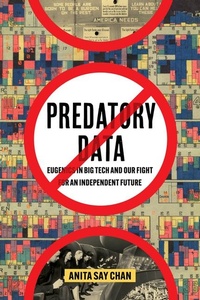
Predatory Data
Eugenics in Big Tech and Our Fight for an Independent Future
1st Edition
Published on 7. January 2025
Book
Paperback/Softback
262 pages
978-0-520-40284-3 (ISBN)
Description
The first book to draw a direct line between the datafication and prediction techniques of past eugenicists and today's often violent and extractive "big data" regimes.
Predatory Data illuminates the throughline between the nineteenth century's anti-immigration and eugenics movements and our sprawling systems of techno-surveillance and algorithmic discrimination. With this book, Anita Say Chan offers a historical, globally multisited analysis of the relations of dispossession, misrecognition, and segregation expanded by dominant knowledge institutions in the Age of Big Data.
While technological advancement has a tendency to feel inevitable, it always has a history, including efforts to chart a path for alternative futures and the important parallel story of defiant refusal and liberatory activism. Chan explores how more than a century ago, feminist, immigrant, and other minoritized actors refused dominant institutional research norms and worked to develop alternative data practices whose methods and traditions continue to reverberate through global justice-based data initiatives today. Looking to the past to shape our future, this book charts a path for an alternative historical consciousness grounded in the pursuit of global justice. A free ebook version of this title is available through Luminos, University of California Press's Open Access publishing program. Visit www.luminosoa.org to learn more.
Predatory Data illuminates the throughline between the nineteenth century's anti-immigration and eugenics movements and our sprawling systems of techno-surveillance and algorithmic discrimination. With this book, Anita Say Chan offers a historical, globally multisited analysis of the relations of dispossession, misrecognition, and segregation expanded by dominant knowledge institutions in the Age of Big Data.
While technological advancement has a tendency to feel inevitable, it always has a history, including efforts to chart a path for alternative futures and the important parallel story of defiant refusal and liberatory activism. Chan explores how more than a century ago, feminist, immigrant, and other minoritized actors refused dominant institutional research norms and worked to develop alternative data practices whose methods and traditions continue to reverberate through global justice-based data initiatives today. Looking to the past to shape our future, this book charts a path for an alternative historical consciousness grounded in the pursuit of global justice. A free ebook version of this title is available through Luminos, University of California Press's Open Access publishing program. Visit www.luminosoa.org to learn more.
Reviews / Votes
"An illuminating and unsettling depiction of Big Tech as deeply enmeshed in an ethically compromised brand of social science." * Publishers Weekly * "Anita Say Chan illuminates the throughline between the nineteenth century's anti-immigration and eugenics movements and our sprawling systems of techno-surveillance and algorithmic discrimination. . . . Looking to the past to shape our future, Predatory Data effectively charts a path for an alternative historical consciousness grounded in the pursuit of global justice. . . . Invaluable."* Midwest Book Review * "Chan's book shares lessons that society can learn from today's global justice-based data initiatives and from the data collaborations of earlier feminists, immigrants, and other minorities who refused eugenic models." * Eurasia Review * "Just as eugenicists championed their data collection practices to justify their beliefs and practices as 'evidence-based,' today's tech giants employ data and algorithms that harm minority groups under the guise of technological impartiality and the promise of an optimized future. . . . Chan urges the reader to push back, sharing a playbook for resisting datafication and prediction systems that recreate our biased past and reinforce majority voices." * Choice *
More details
Edition
First Edition
Language
English
Place of publication
Berkerley
United States
Target group
Professional and scholarly
Product notice
Paperback (trade)
Illustrations
1 b-w figure, 6 color figures
Dimensions
Height: 224 mm
Width: 149 mm
Thickness: 18 mm
Weight
400 gr
ISBN-13
978-0-520-40284-3 (9780520402843)
Copyright in bibliographic data and cover images is held by Nielsen Book Services Limited or by the publishers or by their respective licensors: all rights reserved.
Schweitzer Classification
Other editions
Additional editions
E-Book
01/2025
1st Edition
Naval Institute Press
€12.49
Available for download
Person
Anita Say Chan is a feminist and decolonial scholar of Science and Technology Studies and Associate Professor of Information Sciences and Media Studies at the University of Illinois, Urbana-Champaign.
Content
Contents
Acknowledgments
Introduction: Predatory Data: Civic Amputations in the Global Data Economy
1 * Immigrant Excisions, "Race Suicide," and the Eugenic Information Market
2 * Streamlining's Laboratories: Monitoring Culture and Eugenic Design in the Future City
3 * Of Merit, Metrics, and Myth: Cognitive Elites and Techno-Eugenics in the Knowledge Economy
4 * Relational Infrastructures: Feminist Refusals and Immigrant Data Solidarities
5 * The Coalitional Lives of Data Pluralism: Intergenerational Feminist Resistance to Data Apartheid
6 * Community Data: Pluri-Temporalities in the Aftermath of Big Data
Conclusion: Data Pluralism and a Playbook for Defending Improbable Worlds
Notes
References
Index
Acknowledgments
Introduction: Predatory Data: Civic Amputations in the Global Data Economy
1 * Immigrant Excisions, "Race Suicide," and the Eugenic Information Market
2 * Streamlining's Laboratories: Monitoring Culture and Eugenic Design in the Future City
3 * Of Merit, Metrics, and Myth: Cognitive Elites and Techno-Eugenics in the Knowledge Economy
4 * Relational Infrastructures: Feminist Refusals and Immigrant Data Solidarities
5 * The Coalitional Lives of Data Pluralism: Intergenerational Feminist Resistance to Data Apartheid
6 * Community Data: Pluri-Temporalities in the Aftermath of Big Data
Conclusion: Data Pluralism and a Playbook for Defending Improbable Worlds
Notes
References
Index