

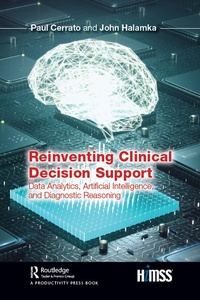
Reinventing Clinical Decision Support
Data Analytics, Artificial Intelligence, and Diagnostic Reasoning
1st Edition
Published on 6. January 2020
184 pages
978-1-000-05555-9 (ISBN)
Description

This book takes an in-depth look at the emerging technologies that are transforming the way clinicians manage patients, while at the same time emphasizing that the best practitioners use both artificial and human intelligence to make decisions.
AI and machine learning are explored at length, with plain clinical English explanations of convolutional neural networks, back propagation, and digital image analysis. Real-world examples of how these tools are being employed are also discussed, including their value in diagnosing diabetic retinopathy, melanoma, breast cancer, cancer metastasis, and colorectal cancer, as well as in managing severe sepsis.
With all the enthusiasm about AI and machine learning, it was also necessary to outline some of criticisms, obstacles, and limitations of these new tools. Among the criticisms discussed: the relative lack of hard scientific evidence supporting some of the latest algorithms and the so-called black box problem. A chapter on data analytics takes a deep dive into new ways to conduct subgroup analysis and how it's forcing healthcare executives to rethink the way they apply the results of large clinical trials to everyday medical practice. This re-evaluation is slowly affecting the way diabetes, heart disease, hypertension, and cancer are treated. The research discussed also suggests that data analytics will impact emergency medicine, medication management, and healthcare costs.
An examination of the diagnostic reasoning process itself looks at how diagnostic errors are measured, what technological and cognitive errors are to blame, and what solutions are most likely to improve the process. It explores Type 1 and Type 2 reasoning methods; cognitive mistakes like availability bias, affective bias, and anchoring; and potential solutions such as the Human Diagnosis Project. Finally, the book explores the role of systems biology and precision medicine in clinical decision support and provides several case studies of how next generation AI is transforming patient care.
AI and machine learning are explored at length, with plain clinical English explanations of convolutional neural networks, back propagation, and digital image analysis. Real-world examples of how these tools are being employed are also discussed, including their value in diagnosing diabetic retinopathy, melanoma, breast cancer, cancer metastasis, and colorectal cancer, as well as in managing severe sepsis.
With all the enthusiasm about AI and machine learning, it was also necessary to outline some of criticisms, obstacles, and limitations of these new tools. Among the criticisms discussed: the relative lack of hard scientific evidence supporting some of the latest algorithms and the so-called black box problem. A chapter on data analytics takes a deep dive into new ways to conduct subgroup analysis and how it's forcing healthcare executives to rethink the way they apply the results of large clinical trials to everyday medical practice. This re-evaluation is slowly affecting the way diabetes, heart disease, hypertension, and cancer are treated. The research discussed also suggests that data analytics will impact emergency medicine, medication management, and healthcare costs.
An examination of the diagnostic reasoning process itself looks at how diagnostic errors are measured, what technological and cognitive errors are to blame, and what solutions are most likely to improve the process. It explores Type 1 and Type 2 reasoning methods; cognitive mistakes like availability bias, affective bias, and anchoring; and potential solutions such as the Human Diagnosis Project. Finally, the book explores the role of systems biology and precision medicine in clinical decision support and provides several case studies of how next generation AI is transforming patient care.
More details
Series
Edition
1. Auflage
Language
English
Place of publication
London
United Kingdom
Publishing group
Taylor & Francis Ebooks
Target group
College/higher education
Professional and scholarly
Product notice
Reflowable
ISBN-13
978-1-000-05555-9 (9781000055559)
Copyright in bibliographic data and cover images is held by Nielsen Book Services Limited or by the publishers or by their respective licensors: all rights reserved.
Schweitzer Classification
Other editions
Additional editions
Paul Cerrato | John Halamka
Reinventing Clinical Decision Support
Data Analytics, Artificial Intelligence, and Diagnostic Reasoning
Book
08/2021
1st Edition
Taylor & Francis
€82.60
Shipment within 10-20 days
Paul Cerrato | John Halamka
Reinventing Clinical Decision Support
Data Analytics, Artificial Intelligence, and Diagnostic Reasoning
Book
12/2019
1st Edition
CRC Press
€70.61
Shipment within 15-20 days
Persons
Paul Cerrato, MA, has more than 30 years of experience working in healthcare as a medical journalist, research analyst, clinician, and educator. He has written extensively on clinical medicine, clinical decision support, electronic health records, protected health information security, and practice management. He has served as the Editor of InformationWeek Healthcare, Executive Editor of Contemporary OB/GYN, Senior Editor of RN Magazine, and contributing writer/editor for the Yale University School of Medicine, the American Academy of Pediatrics, InformationWeek, Medscape, Healthcare Finance News, IMedicalapps.com, and MedpageToday. The Health Information Management Systems Society (HIMSS) has listed Mr. Cerrato as one of the most influential columnists in healthcare IT. He has served as a guest lecturer or faculty member at the Columbia University College of Physicians and Surgeons, Harvard Medical School, and Vermont College. Among his achievements are 6 editorial awards from the American Business Media-often referred to as the Pulitzer Prize of business journalism-and the Gold Award from the American Society of Healthcare Publications Editors for best signed editorial.
John D. Halamka, MD, MS, president of the Mayo Clinic Platform, leads a portfolio of new digital platform businesses focused on transforming health by leveraging artificial intelligence, machine learning, and an ecosystem of partners for the Mayo Clinic. He is a practicing emergency medicine physician. Previously, Dr. Halamka was executive director of the Health Technology Exploration Center for Beth Israel Lahey Health in Massachusetts. Previously, he was chief information officer at Beth Israel Deaconess Medical Center for more than 20 years. In addition, he was the International Healthcare Innovation Professor at Harvard Medical School. As the leader for innovation at the $7 billion Beth Israel Lahey Health, he oversaw digital health relationships with industry, academia, and government worldwide. As a Harvard Medical School professor, he served the George W. Bush administration, the Obama administration, and governments around the world planning their health care information (IT) strategies.
John D. Halamka, MD, MS, president of the Mayo Clinic Platform, leads a portfolio of new digital platform businesses focused on transforming health by leveraging artificial intelligence, machine learning, and an ecosystem of partners for the Mayo Clinic. He is a practicing emergency medicine physician. Previously, Dr. Halamka was executive director of the Health Technology Exploration Center for Beth Israel Lahey Health in Massachusetts. Previously, he was chief information officer at Beth Israel Deaconess Medical Center for more than 20 years. In addition, he was the International Healthcare Innovation Professor at Harvard Medical School. As the leader for innovation at the $7 billion Beth Israel Lahey Health, he oversaw digital health relationships with industry, academia, and government worldwide. As a Harvard Medical School professor, he served the George W. Bush administration, the Obama administration, and governments around the world planning their health care information (IT) strategies.
Content
Dedication
Contents
Preface
About the Authors
Chapter 1: Clinical Reasoning and Diagnostic Errors
Chapter 2: The Promise of Artificial Intelligence and Machine Learning
Chapter 3: AI Criticisms, Obstacles, and Limitations
Chapter 4: CDS Systems: Past, Present, and Future
Chapter 5: Reengineering Data Analytics
Chapter 6: Will Systems Biology Transform Clinical Decision Support?
Chapter 7: Precision Medicine
Chapter 8: Reinventing Clinical Decision Support: Case Studies
Index
Contents
Preface
About the Authors
Chapter 1: Clinical Reasoning and Diagnostic Errors
Chapter 2: The Promise of Artificial Intelligence and Machine Learning
Chapter 3: AI Criticisms, Obstacles, and Limitations
Chapter 4: CDS Systems: Past, Present, and Future
Chapter 5: Reengineering Data Analytics
Chapter 6: Will Systems Biology Transform Clinical Decision Support?
Chapter 7: Precision Medicine
Chapter 8: Reinventing Clinical Decision Support: Case Studies
Index
