

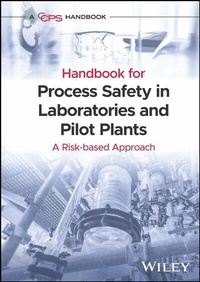
Handbook for Process Safety in Laboratories and Pilot Plants
Description

Effectively manage physical and chemical risks in your laboratory or pilot plant
In Handbook for Process Safety in Laboratories and Pilot Plants: A Risk-based Approach, the Center for Chemical Process Safety delivers a comprehensive and authoritative presentation of process safety procedures and methods for use in laboratories and pilot plants (LAPPs). Of the four broad hazard categories - chemical, physical, biological, and ionizing radiation - this book focuses on the two most common: chemical and physical hazards. It addresses the storage and handling of the hazardous materials associated with activities commonly performed in LAPPs and presents many of the physical and chemical analytical techniques used to verify and validate the efficacy of safety management systems.
This book will present tools and techniques for effectively managing the risks in any laboratory or pilot plant using engineered and administrative controls, as well as the CCPS Risk Based Process Safety (RBPS) Management Systems.
Readers will also find:
- A thorough introduction to process safety
- Comprehensive explorations of understanding hazards and risks, as well as managing risk with engineered controls, administrative controls, and RBPS Management Systems
- Practical discussions of how to learn from the experiences of your own LAPP and others
- Detailed case reports and examples, as well as practical tools, control banding strategies, and glass equipment design
Perfect for any LAPP staff member working with or managing hazardous materials, Handbook for Process Safety in Laboratories and Pilot Plants: A Risk-based Approach will also benefit LAPP engineering and scientific professionals, LAPP technical support staff, and LAPP managers.
The Center for Chemical Process Safety is a world leader in developing and distributing information on process safety management and technology. Since 1985, CCPS has published over 100 books in its process safety guidelines and concept series, 33 training modules as part of its Safety in Chemical Engineering Education series, and over 220 online offerings.
More details
Other editions
Additional editions
Person
Since 1985, the Center for Chemical Process Safety (CCPS) has been the global leader in developing and disseminating information on process safety management and technology. CCPS, an industry technology alliance of the American Institute of Chemical Engineers (AIChE), has published over 100 books in its process safety guidelines and process safety concepts series, and over 100 training modules through its Safety in Chemical Engineering Education (SACHE) series.
Content
List of Figures x
List of Tables xi
Abbreviations and Acronyms xii
Glossary xv
Acknowledgments xxii
Dedication xxiv
Online Materials Accompanying this Handbook xxv
Preface xxvii
Part 1 - Introduction and Overview 1
1 Purpose and Scope 3
1.1 Purpose 3
1.2 Scope of Book and Target Audience 4
1.3 Terms for Laboratories and Pilot Plants 5
1.4 Distinctions between Laboratories and Pilot Plants 7
1.5 Organization of This Handbook 8
2 Managing Risk to Prevent Incidents 13
2.1 Some LAPP Characteristics 13
2.2 Safety in Laboratories and Pilot Plants 24
2.3 Where to Start with a Risk-based Approach in the LAPP 25
2.4 Gain Leadership Support to Implement Risk Based Process Safety 29
2.5 Laboratory Safety Management System Considerations 29
2.6 Resources for Risk Based Process Safety Management System 31
3 Leaks and Spills in the LAPP 35
3.1 Leaks of Hazardous Materials 35
3.2 Spills of Hazardous Materials 38
Part 2 - Committing to Process Safety 39
4 LAPP Risk Management Concepts 41
4.1 Occupational Safety and Process Safety 41
4.2 Hierarchy of Controls 41
4.3 Inherently Safer Design (ISD) 42
4.4 Basic Risk Concepts 44
4.5 A Risk Management Program 47
4.6 Anatomy of an Incident 48
4.7 Preventive and Mitigative Safeguards 49
4.8 Applying a Risk-Based Approach in a LAPP 51
5 Process Safety Culture in the LAPP 55
5.1 RBPS Element 1: Process Safety Culture 55
5.2 Leaders' Responsibilities for Positive Safety Culture 58
5.3 Resources and Examples for Process Safety Culture 59
6 Standards for the LAPP 63
6.1 RBPS Element 2: Compliance with Standards 63
6.2 Risk Management Focus 65
6.3 Different Codes and Standards When Scaling Up from Laboratory to Pilot Plant 65
6.4 Jurisdictional Requirements 67
6.5 Resources for Compliance with Standards 67
7 Process Safety Competency and Training in the LAPP 69
7.1 RBPS Element 3: Process Safety Competency 69
7.2 RBPS Element 12: Training and Performance Assurance 72
8 Workforce Involvement and Stakeholder Outreach in the LAPP 79
8.1 RBPS Element 4: Workforce Involvement 79
8.2 RBPS Element 5: Stakeholder Outreach 82
Part 3 - Understanding Hazards and Risks 83
9 Process Safety Knowledge Management in the LAPP 85
9.1 RBPS Element 6: Process Knowledge Management 85
9.2 Overview of Information and Data Needs 86
9.3 Sources of Information and Data 89
9.4 Process Safety Information during Scale-up 92
10 Types of Hazards 95
10.1 Reactive Chemistry Hazards 95
10.2 Toxicity Hazards 115
10.3 Flammability and Combustibility Hazards 121
10.4 Temperature Hazards 137
10.5 Overpressure Hazards 140
10.6 Other Common LAPP Hazards 142
Table of Contents vii ix
11 Hazard Identification and Risk Analysis (HIRA) in the LAPP 153
11.1 RBPS Element 7: Hazard Identification and Risk Analysis 153
11.2 HIRA Team Members 156
11.3 HIRA Approaches Used in LAPPs 156
11.4 Qualitative versus Quantitative Analysis of Risks in LAPPs 165
11.5 ACS Hazard Analysis Tools 168
11.6 Evaluating the Effort Level for HIRAs 168
11.7 Determining the Extent of the HIRAs 169
Part 4 - Managing Risk: Engineered Controls 171
12 Spill and Leak Protection 173
12.1 Containment 173
12.2 Flexible hose and tubing 173
13 Fire and Over-Temperature Protection 175
13.1 Fire Prevention 175
13.2 Fire Mitigation 183
13.3 Over-Temperature Protection 185
14 Overpressure Prevention and Protection 191
14.1 Pressure Protection for Equipment 191
14.2 Pressure and Vacuum Relief for Atmospheric Pressure Vessels 196
14.3 Process Conditions/Situations to Consider in Pressure Relief Device Design 197
14.4 Blast Containment Cells and Pressure Relief for Building Areas 198
14.5 Venting Location and Downstream Treatment of Material Vented 201
15 Ventilation Controls 203
15.1 Ventilation Systems 203
15.2 Laboratory Chemical Fume Hoods 205
15.3 Pilot Plant Ventilation 207
15.4 Permanent Total Enclosures for Containment in the LAPP 207
16 Automated Shut-down Systems 209
16.1 Selection and Design Based on Hazard Identification and Risk Analysis 209
16.2 Basic Control Systems and Safety Shut-down Systems 209
16.3 Independent Automated Safety Shut-down Systems 210
16.4 Fail-Safe Design Considerations 212
16.5 Important Design Features for Control Systems 212
16.6 Control of Changes and Maintenance for Engineered Safeguards 214
16.7 Additional References 215
17 Engineered Controls for Common Hazards 217
17.1 Cryogenic Fluids and Compressed Gases 217
17.2 Cryogenic Fluids and Compressed Gas Cylinders 218
17.3 Glass Equipment 228
17.4 Gloveboxes 228
Part 5 - Managing Risk: Administrative Controls 235
18 Administrative Fire and Explosion Safeguards 237
18.1 Standards and Guidance for Fire Prevention 237
18.2 Ignition Source Control: Procedures 237
18.3 Manual Fire Suppression 238
19 Administrative Safeguards for Hazards in LAPPs 239
19.1 Good Practices for Compressed Gas and Cryogenic Cylinders 239
19.2 Regulations and Standards for Compressed Gases and Cryogenic Fluids 239
19.3 Procedures and Best Practices for Compressed Gases 241
19.4 Good Practices for Storage, Movement, and Use of Cryogenic Fluids 248
19.5 Good Practices For Handling Glass 251
19.6 Administrative Controls for Reactive Hazards 251
Part 6 - Managing Risk: RBPS Management Systems 253
20 Operating Procedures and Conduct of Operations in the LAPP 255
20.1 RBPS Element 8: LAPP Operating Procedures 255
20.2 RBPS Element 15: Conduct of Operations 260
21 Safe Work Practices and Contractor Management in the LAPP 263
21.1 RBPS Element 9: Safe Work Practices 263
21.2 RBPS Element 11: Contractor Management 266
22 Asset Integrity and Reliability in the LAPP 269
22.1 RBPS Element 10: Asset Integrity and Reliability 269
22.2 A Management Approach for Assuring Asset Integrity and Reliability 270
22.3 Examples of Asset Integrity and Reliability Management System Failures 271
22.4 Glass Equipment-Asset Integrity and Reliability Challenge for LAPPs 274
23 Management of Change (MOC) and Operational Readiness in the LAPP 277
23.1 RBPS Element 13: Management of Change 277
23.2 RBPS Element 14: Operational Readiness 281
Table of Contents ix xi
24 Emergency Management in the LAPP 283
24.1 RBPS Element 16: Emergency Management 283
24.2 Emergency Planning 283
24.3 Implementing an Emergency Management Plan 284
24.4 Emergency Equipment 285
24.5 Training and Drills 285
24.6 Deficiencies in Emergency Planning and Response in LAPP Cases 286
24.7 Controlling Unattended Experimental Work and Working Alone in LAPPs 288
Part 7 - Learning from Experience 291
25 Investigating Incidents 293
25.1 Incident Terminology 293
25.2 RBPS Element 17: Incident Investigation 294
25.3 Steps of an Incident Investigation 295
25.4 Ensure Lessons Are Learned and Remembered 298
25.5 Learn from Experience of Others 298
26 Metrics, Auditing, and Management Review in the LAPP 299
26.1 RBPS Element 18: Measurement and Metrics 299
26.2 RBPS Element 19: Auditing 300
26.3 RBPS Element 20: Management Review and Continuous Improvement 302
Part 8 - Conclusion 305
References 307
Appendix A Cases 323
Appendix B Examples 453
Appendix C Control Banding Strategies 501
Appendix D Glass Equipment Design 517
Index 525
Glossary
This Glossary contains Process Safety terms unique to this CCPS publication. The CCPS Process Safety terms in this publication are current at the time of issue. For other CCPS Process Safety terms and updates to these terms, please refer to the CCPS Process Safety Glossary [1].
Term Definition Acceptable Risk The average rate of loss that is considered tolerable for a given activity. Accident(See Incident) An incident that results in a significant consequence involving:
human impact,
detrimental impact on the community or environment,
property damage, material loss,
disruption of a company's ability to continue doing business or achieve its business goals Biosafety Level (BSL) A biological risk management category used to identify the protective measures needed in a laboratory setting to protect workers, the environment, and the public. Causal Factor A major unplanned, unintended contributor to an incident (a negative event or undesirable condition), that if eliminated would have either prevented the occurrence of the incident, or reduced its severity or frequency. Competent Individual having the necessary ability, knowledge, or skill to do something successfully [2]. Consequence The undesirable result of a loss event, usually measured in health and safety effects, environmental impacts, loss of property, and business interruption costs. Exothermic A physical or chemical change accompanied by the evolution of heat. Exothermic Reaction A reaction involving one or more chemicals resulting in one or more new chemical species and the evolution of heat. Explosion A release of energy that causes a pressure discontinuity or blast wave. Explosion The bursting or rupture of an enclosure or container due to the development of internal pressure from a deflagration. Finding A conclusion reached by an auditor or investigator based upon data collected and analyzed during an audit or investigation.
Note: Findings can be positive or negative. Negative Findings describe a deficiency or gap between the current state and the expected state. Fire A combustion reaction accompanied by the evolution of heat, light, and flame. Fire Triangle [A triangle diagram showing] the three basic conditions that are required for a fire to take place. These conditions are fuel, oxygen, and heat. Flash Fire A fire that spreads by means of a flame front rapidly through a diffuse fuel, such as a dust, gas, or the vapors of an ignitable liquid, without the production of damaging pressure. Hazard An inherent chemical or physical characteristic that has the potential for causing damage to people, property, or the environment. Hazard Identification Part of the Hazards Identification and Risk Analysis (HIRA) method in which the material and energy hazards of the process, along with the siting and layout of the facility, are identified so that a risk analysis can be performed on potential incident scenarios. Hazard Identification and Risk Analysis (HIRA) A collective term that encompasses all activities involved in identifying hazards and evaluating risk at facilities, throughout their life cycle, to make certain that risks to employees, the public, or the environment are consistently controlled within the organization's risk tolerance. Health Hazard Exposure Control Band (HHECB) A risk-based approach used to help manage inhalation risks when exposed to new substances that have little or no available hazards information. Hierarchy of controls A way of determining which actions will best control exposures [3]. Impact A measure of the ultimate loss and harm of a loss event.
Note: Impact may be expressed as the number of injuries and/or fatalities, the extent of the environmental damage, or the magnitude of the loss, such as property damage, material loss, production loss, market share loss, and recovery costs. Incident
(See Accident) An event, or series of events, resulting in one or more undesirable consequences, such as harm to people, damage to the environment, or asset/business losses.
Or
An unusual, unplanned, or unexpected occurrence that either resulted in, or had the potential to result in harm to people, damage to the environment, asset/business losses, or loss of public trust or stakeholder confidence in a company's reputation. Kilo-prep lab A lab used in scale-up between laboratory and pilot plant, with typical batch sizes of 2-3 kg. Often used to produce sufficient product for initial testing. Laboratory A facility where the containers used for reactions, transfers and other handling of chemicals are designed to be easily and safely manipulated by one person. A laboratory is a workplace where chemicals are used or synthesized on a nonproduction basis [4]. Laboratory And Pilot Plant (LAPP) A LAPP includes all laboratories, pilot plants, and research facilities that stand-alone or are a part of a commercial manufacturing site, government establishment, or academic institution. Loss of Containment
(or Loss of Primary Containment) An unplanned or uncontrolled release of material from [primary] containment, including non-toxic and non-flammable materials (e.g., steam, hot condensate, nitrogen, compressed CO2 or compressed air). Mitigative Safeguard A [safeguard] designed to interrupt the chain of events after a loss event, given that there has been a loss of containment of a hazardous material or energy.
Note: Specific to a hazards evaluation of an incident sequence, a mitigative [safeguard] is in between the loss of event (the loss of containment) and the scenario's impact, helping reduce the consequences of the incident scenario, and thus, helping reduce the scenario's risk. Near-miss An incident in which an adverse consequence could potentially have resulted if circumstances had been slightly different. Observation A conclusion reached by an auditor based upon data collected and analyzed during the audit. Observations can be positive or negative. Negative Observations may indicate opportunities for improvement. Pilot Plant An experimental assembly of equipment for exploring process variables or for producing semi-commercial quantities of materials [4]. Polariscope A polariscope is composed of two polarized lenses and a light source mounted behind one lens. The glass item to be examined is placed between two lenses and viewed through the lens opposite the light source lens.
Note: Polariscopes work based on the principle of stress induced birefringence, the phenomenon in which light passing through a homogenous material under stress exhibits two refractive indices. Preventive safeguard A [safeguard] designed to interrupt the chain of events leading up to a loss event, given that an initiating event has occurred.
Note: Specific to the hazards evaluation of an incident sequence, a preventive [safeguard] is in between the initiating event (the cause) and a loss event, helping reduce the frequency of the incident scenario, and thus, helping reduce the scenario's risk. Process Hazard Analysis (PHA) An organized effort to identify and evaluate hazards associated with processes and operations to enable their control.
This review normally involves the use of qualitative techniques to identify and assess the significance of hazards. Conclusions and appropriate recommendations are developed. Occasionally, quantitative methods are used to help prioritized risk reduction. Protection Layer A concept whereby a device, system, or human action is provided to reduce the likelihood and/or severity of a specific loss event. Qualitative Risk Analysis An analysis method based primarily on description and comparison using historical experience and engineering judgment, with little quantification of the hazards, consequences, likelihood, or level of risk. Quantitative Risk Analysis (QRA) The systematic development of numerical estimates of the expected frequency and severity of potential incidents associated with a facility or operation based on engineering evaluation and mathematical techniques. Recommendation A proposed action intended...
