

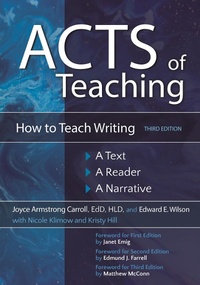
Acts of Teaching
How to Teach Writing: a Text, a Reader, a Narrative
3rd Edition
Published on 9. November 2018
272 pages
979-8-216-04213-6 (ISBN)
Description

Inclusive of the scope and authoritative references from earlier editions, this edition additionally embraces the digital world and provides practical suggestions for performing the "act of teaching."
Teachers of writing at all levels will applaud this edition for its new features designed to help teachers to understand and teach to today's new paradigms in writing. New to this edition are two chapters on cognition and technology, respectively; a chapter on early literacy, with student samples; and, for the first time, an online connection that links readers to important articles, visuals, and resources.
Essay writing is explored through discussion of the thesis and its criteria; five organizational patterns for the expository essay; and distinctions among the opinion, persuasive, and argumentative essay. Several new prewriting strategies are also provided: A Sense Notebook, Looking, Contouring, an expanded explanation of Blueprinting, and a discussion of a hierarchical approach to organization.
Teachers of writing at all levels will applaud this edition for its new features designed to help teachers to understand and teach to today's new paradigms in writing. New to this edition are two chapters on cognition and technology, respectively; a chapter on early literacy, with student samples; and, for the first time, an online connection that links readers to important articles, visuals, and resources.
Essay writing is explored through discussion of the thesis and its criteria; five organizational patterns for the expository essay; and distinctions among the opinion, persuasive, and argumentative essay. Several new prewriting strategies are also provided: A Sense Notebook, Looking, Contouring, an expanded explanation of Blueprinting, and a discussion of a hierarchical approach to organization.
More details
Edition
3rd edition
Language
English
Place of publication
New York
United States
Publishing group
Bloomsbury Publishing Plc
Illustrations
32 bw illus
File size
7,98 MB
ISBN-13
979-8-216-04213-6 (9798216042136)
Copyright in bibliographic data and cover images is held by Nielsen Book Services Limited or by the publishers or by their respective licensors: all rights reserved.
Schweitzer Classification
Other editions
Additional editions
Joyce Armstrong Carroll | Edward E. Wilson | Nicole Klimow
Acts of Teaching
How to Teach Writing: A Text, A Reader, A Narrative
Book
11/2018
3rd Edition
Libraries Unlimited Inc
€70.20
Shipment within 10-20 days
Persons
Joyce Armstrong Carroll, EdD, HLD, has taught at every level through graduate school in her sixty-year career. With her husband, Edward Wilson, she codirects Abydos Literacy Learning.
Edward E. Wilson is codirector with his wife, Joyce Armstrong Carroll, of Abydos Literacy Learning. He has taught at the elementary, secondary, and junior college levels.
Nicole Klimow, PhD, works for the Clark County, Nevada, School District as a program administrator for the English Language Learner Division.
Kristy Hill, MLS, is a library media technology specialist, educator, writing trainer, and author.
Edward E. Wilson is codirector with his wife, Joyce Armstrong Carroll, of Abydos Literacy Learning. He has taught at the elementary, secondary, and junior college levels.
Nicole Klimow, PhD, works for the Clark County, Nevada, School District as a program administrator for the English Language Learner Division.
Kristy Hill, MLS, is a library media technology specialist, educator, writing trainer, and author.
Content
- Cover
- Title
- Copyright
- Contents
- Foreword to ACTS III
- Foreword to ACTS II
- Foreword to ACTS I
- Preface: A Parable
- Let's Talk!
- Hot Links!
- Introduction: Following the Thread
- The Product and Process Paradigms
- Simultaneous Literacy
- Totus: A Third Paradigm
- Children of the Technology Age
- Let's Talk!
- Hot Links!
- Chapter 1: The Process
- The Writing Process Journey: The Beginning, Middle, and End
- Prewriting
- Prewriting Strategies
- More Thoughts on Prewriting
- Let's Talk!
- Hot Links!
- Chapter 2: Putting Writing in Order: Organization
- The Need for Organization
- Getting It All Together
- The Hierarchical Approach to Organization
- Understanding Purpose
- Understanding Audience
- Understanding the Use of Language
- Understanding the Appropriate Genre
- Understanding Focus and Coherence
- Understanding Craft
- Teaching Genre as Structure
- Inquiry and Choice of Genre
- Strategies for Teaching Genre
- Awareness of Genre
- Literary Exploration
- The Shaping Conference
- Fiction
- Implementing the Writing of Fiction
- General Characteristics of Fiction
- Problems Writing Fiction
- Three Quick Ways to Shape Fiction
- Sudden or Flash Fiction
- Fables, Myths, Legends, and Tall Tales
- Fables
- Myths
- Legends
- Tall Tales
- Drama
- Poetry
- Strategies for Writing Poetry
- Techniques to Shape Poetry
- Imagery
- Things to Remember When Writing Poetry
- Nonfiction
- Letters
- Autobiography
- Suggestions for Writing Autobiography
- Biography
- Memoir
- Interview
- Essay
- Expository and Informative Essays
- Thesis Statement
- ABCs of a Good Thesis
- Criteria of a Sound Thesis
- The Opinion/Persuasive/Argumentative Essay
- Organizing the Persuasive Essay
- Shaping the Hexagonal for an Analysis Essay
- Conclusion
- Let's Talk!
- Hot Links!
- Chapter 3: Revising: Proofreading, Editing, and Rewriting
- Proofreading
- Revising
- Editing
- Writing Groups
- Writing Conferences
- Writing Debriefings
- Rewriting
- The Grammar of Rewriting
- Skill Levels
- The Craft of Rewriting
- The Math of Rewriting
- Addition
- Subtraction
- Multiplication
- Division
- Let's Talk!
- Hot Links!
- Chapter 4: Assessment
- Diederich's Eight Qualities
- The Importance of Diederich's Work
- Developing the Carroll/Wilson Analytic Scale for Classroom Use
- The Carroll/Wilson Analytic Scale for Classroom Use
- Ways to Evaluate Writing
- Grading
- Testing
- Measuring
- Scoring
- Assessing
- Teacher-Assessment of Writing
- Portfolios
- Sticky Note Portfolios
- Authentic Assessment
- Breaking News: Data Dashboards
- Let's Talk!
- Hot Links!
- Chapter 5: Technology and Writing
- Hardware
- Chromebooks
- Laptop PCs
- Tablets
- BYOD
- Visual Organization Tools
- Collaboration Tools
- Drawing Tools
- Tools for Prewriting and Drafting
- Presentation Tools
- Conclusion
- Let's Talk!
- Hot Links!
- Chapter 6: Brain Control
- Technology and the Brain
- The Development of the Brain
- The Major Structures and Functions of the Brain
- Theories of Brain Organization and Implications for Teaching
- The R-complex
- The Limbic System
- The Cerebrum (Neocortex)
- Male and Female Brains: The Implications for Teaching
- Memory and Implications for Teaching
- Implications for Teaching
- Neural Plasticity
- Implications for Teaching
- Potentiality
- Stress
- The New Brain: Some Observations
- Winding Down
- Let's Talk!
- Hot Links!
- Chapter 7: Cognition: The Process of How We Learn
- Jean Piaget and Stage Theory
- Factors That Influence Piaget's Developmental Model
- Piaget's Stage Theory and Implications for Teaching Writing
- Nativist Theory
- Jerome Bruner and Education Process Theory
- Information-Processing Theory
- Cognitive Neuroscience Theory
- Complex Dynamic Systems Theory
- Cognitive Process Theory of Writing
- Vygotsky and Writing
- Let's Talk!
- Hot Links!
- Chapter 8: Inquiry
- Inquiry
- The I-Search Paper
- Tech Tools for Inquiry
- Implementing the Inquiry Box
- Inquiry Strategies
- Inquiry for High School Students
- Let's Talk!
- Hot Links!
- Preamble to Chapter 9
- Chapter 9: Early Literacy Revisited
- The Arenas of Writing
- Here's How It Happens
- Here's How It Looks
- Conclusion
- Let's Talk!
- Hot Links!
- Bibliography
- Index
- About the Authors
