

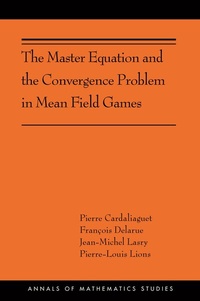
The Master Equation and the Convergence Problem in Mean Field Games
(AMS-201)
1st Edition
Published on 2. September 2019
224 pages
978-0-691-19371-7 (ISBN)
Description

This book describes the latest advances in the theory of mean field games, which are optimal control problems with a continuum of players, each of them interacting with the whole statistical distribution of a population. While it originated in economics, this theory now has applications in areas as diverse as mathematical finance, crowd phenomena, epidemiology, and cybersecurity.
Because mean field games concern the interactions of infinitely many players in an optimal control framework, one expects them to appear as the limit for Nash equilibria of differential games with finitely many players as the number of players tends to infinity. This book rigorously establishes this convergence, which has been an open problem until now. The limit of the system associated with differential games with finitely many players is described by the so-called master equation, a nonlocal transport equation in the space of measures. After defining a suitable notion of differentiability in the space of measures, the authors provide a complete self-contained analysis of the master equation. Their analysis includes the case of common noise problems in which all the players are affected by a common Brownian motion. They then go on to explain how to use the master equation to prove the mean field limit.
This groundbreaking book presents two important new results in mean field games that contribute to a unified theoretical framework for this exciting and fast-developing area of mathematics.
Because mean field games concern the interactions of infinitely many players in an optimal control framework, one expects them to appear as the limit for Nash equilibria of differential games with finitely many players as the number of players tends to infinity. This book rigorously establishes this convergence, which has been an open problem until now. The limit of the system associated with differential games with finitely many players is described by the so-called master equation, a nonlocal transport equation in the space of measures. After defining a suitable notion of differentiability in the space of measures, the authors provide a complete self-contained analysis of the master equation. Their analysis includes the case of common noise problems in which all the players are affected by a common Brownian motion. They then go on to explain how to use the master equation to prove the mean field limit.
This groundbreaking book presents two important new results in mean field games that contribute to a unified theoretical framework for this exciting and fast-developing area of mathematics.
More details
Other editions
Additional editions
Pierre Cardaliaguet | Francois Delarue | Jean-Michel Lasry
The Master Equation and the Convergence Problem in Mean Field Games
Book
08/2019
Princeton University Press
€197.50
Article not available at the moment
Pierre Cardaliaguet | Francois Delarue | Jean-Michel Lasry
The Master Equation and the Convergence Problem in Mean Field Games
Book
08/2019
Princeton University Press
€88.00
Shipment within 10-20 days
Persons
Pierre Cardaliaguet is professor of mathematics at Paris Dauphine University. François Delarue is professor of mathematics at the University of Nice Sophia Antipolis. Jean-Michel Lasry is associate researcher of mathematics at Paris Dauphine University. Pierre-Louis Lions is professor of partial differential equations and their applications at the Collège de France.
Content
- Cover
- Contents
- Preface
- 1: Introduction
- 1.1 From the Nash System to the Master Equation
- 1.2 Informal Derivation of the Master Equation
- 2: Presentation of the Main Results
- 2.1 Notations
- 2.2 Derivatives
- 2.3 Assumptions
- 2.4 Statement of the Main Results
- 3: A Starter: The First-Order Master Equation
- 3.1 Space Regularity of U
- 3.2 Lipschitz Continuity of U
- 3.3 Estimates on a Linear System
- 3.4 Differentiability of U with Respect to the Measure
- 3.5 Proof of the Solvability of the First-Order Master Equation
- 3.6 Lipschitz Continuity of dU/dM with Respect to m
- 3.7 Link with the Optimal Control of the Fokker-Planck Equation
- 4: Mean Field Game System with a Common Noise
- 4.1 Stochastic Fokker-Planck/Hamilton-Jacobi-Bellman System
- 4.2 Probabilistic Setup
- 4.3 Solvability of the Stochastic Fokker-Planck/Hamilton-Jacobi-Bellman System
- 4.4 Linearization
- 5: The Second-Order Master Equation
- 5.1 Construction of the Solution
- 5.2 First-Order Differentiability
- 5.3 Second-Order Differentiability
- 5.4 Derivation of the Master Equation
- 5.5 Well-Posedness of the Stochastic MFG System
- 6: Convergence of the Nash System
- 6.1 Finite Dimensional Projections of U
- 6.2 Convergence
- 6.3 Propagation of Chaos
- A: Appendix
- A.1 Link with the Derivative on the Space of Random Variables
- A.2 Technical Remarks on Derivatives
- A.3 Various Forms of Itô's Formula
- References
- Index
