

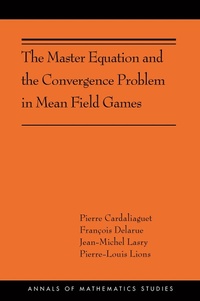
The Master Equation and the Convergence Problem in Mean Field Games
Will be published approx. on 13. August 2019
Book
Hardback
224 pages
978-0-691-19070-9 (ISBN)
Description
This book describes the latest advances in the theory of mean field games, which are optimal control problems with a continuum of players, each of them interacting with the whole statistical distribution of a population. While it originated in economics, this theory now has applications in areas as diverse as mathematical finance, crowd phenomena, epidemiology, and cybersecurity.
Because mean field games concern the interactions of infinitely many players in an optimal control framework, one expects them to appear as the limit for Nash equilibria of differential games with finitely many players as the number of players tends to infinity. This book rigorously establishes this convergence, which has been an open problem until now. The limit of the system associated with differential games with finitely many players is described by the so-called master equation, a nonlocal transport equation in the space of measures. After defining a suitable notion of differentiability in the space of measures, the authors provide a complete self-contained analysis of the master equation. Their analysis includes the case of common noise problems in which all the players are affected by a common Brownian motion. They then go on to explain how to use the master equation to prove the mean field limit.
This groundbreaking book presents two important new results in mean field games that contribute to a unified theoretical framework for this exciting and fast-developing area of mathematics.
Because mean field games concern the interactions of infinitely many players in an optimal control framework, one expects them to appear as the limit for Nash equilibria of differential games with finitely many players as the number of players tends to infinity. This book rigorously establishes this convergence, which has been an open problem until now. The limit of the system associated with differential games with finitely many players is described by the so-called master equation, a nonlocal transport equation in the space of measures. After defining a suitable notion of differentiability in the space of measures, the authors provide a complete self-contained analysis of the master equation. Their analysis includes the case of common noise problems in which all the players are affected by a common Brownian motion. They then go on to explain how to use the master equation to prove the mean field limit.
This groundbreaking book presents two important new results in mean field games that contribute to a unified theoretical framework for this exciting and fast-developing area of mathematics.
Reviews / Votes
"This book . . . . is a major contribution to the state of the art in MFGs which is a must read for researchers in the field. . . . . The authors use the book format (and not a more compact paper format) to explain all their steps carefully. Because of its structured approach, it could be used as a textbook for an advanced course on the subject."---Adhemar Bultheel, European Mathematical SocietyMore details
Series
Language
English
Place of publication
New Jersey
United States
Target group
College/higher education
Professional and scholarly
Product notice
Trade binding
Dimensions
Height: 239 mm
Width: 160 mm
Thickness: 20 mm
Weight
522 gr
ISBN-13
978-0-691-19070-9 (9780691190709)
Copyright in bibliographic data and cover images is held by Nielsen Book Services Limited or by the publishers or by their respective licensors: all rights reserved.
Schweitzer Classification
Other editions
Additional editions
Pierre Cardaliaguet | François Delarue | Jean-Michel Lasry
The Master Equation and the Convergence Problem in Mean Field Games
(AMS-201)
E-Book
09/2019
1st Edition
Princeton University Press
€85.49
Available for download
Persons
Pierre Cardaliaguet is professor of mathematics at Paris Dauphine University. Francois Delarue is professor of mathematics at the University of Nice Sophia Antipolis. Jean-Michel Lasry is associate researcher of mathematics at Paris Dauphine University. Pierre-Louis Lions is professor of partial differential equations and their applications at the College de France.