

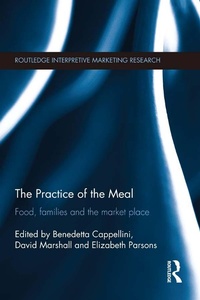
The Practice of the Meal
Food, Families and the Market Place
Published on 31. March 2016
274 pages
978-1-317-59565-6 (ISBN)
Description

Reflecting a growing interest in consumption practices, and particularly relating to food, this cross disciplinary volume brings together diverse perspectives on our (often taken for granted) domestic mealtimes.
By unpacking the meal as a set of practices - acquisition, appropriation, appreciation and disposal - it shows the role of the market in such processes by looking at how consumers make sense of marketplace discourses, whether this is how brand discourses influence shopping habits, or how consumers interact with the various spaces of the market. Revealing food consumption through both material and symbolic aspects, and the role that marketplace institutions, discourses and places play in shaping, perpetuating or transforming them, this holistic approach reveals how consumer practices of 'the meal', and the attendant meaning-making processes which surround them, are shaped.
This wide-ranging collection will be of great interest to a wide range of scholars interested in marketing, consumer behaviour and food studies, as well as the sociology of both families and food.
By unpacking the meal as a set of practices - acquisition, appropriation, appreciation and disposal - it shows the role of the market in such processes by looking at how consumers make sense of marketplace discourses, whether this is how brand discourses influence shopping habits, or how consumers interact with the various spaces of the market. Revealing food consumption through both material and symbolic aspects, and the role that marketplace institutions, discourses and places play in shaping, perpetuating or transforming them, this holistic approach reveals how consumer practices of 'the meal', and the attendant meaning-making processes which surround them, are shaped.
This wide-ranging collection will be of great interest to a wide range of scholars interested in marketing, consumer behaviour and food studies, as well as the sociology of both families and food.
Reviews / Votes
'This welcome contribution to the marketing literature builds on three decades of social scientific research to provide an invaluable demonstration of the way producing a meal lies at the heart of an intricate and overlapping set of practices that are embedded in the food provisioning cycle that runs, time after time, from shop, to kitchen, to plate, to waste bin.' - Anne Murcott, Honorary Professorial Research Associate, SOAS University of London, UK'This volume is a veritable smorgasbord of texts catering to those craving the intellectually savory, without neglecting those lusting after something sweet. Scholars with a gluttonous inclination might want to feast on the book in one setting, but I would probably recommend enjoying the chapters as tidbits from time to time, allowing plenty of time for digestion.' - Jacob OEstberg, Professor, University of stockholm, Sweden
'This is by far the most creative and innovative group of papers on food I have read in many years. The authors mount a cohesive expedition into the terra incognita of the everyday meal, discovering and exploring important rich veins of consumer culture which have been hitherto neglected. Using advanced theoretical tools, they take us far beyond the comfortable fiction of the happy family dinner.' - Richard Wilk, Provost's Professor of Anthropology, Indiana University, USA
More details
Series
Language
English
Place of publication
London
United Kingdom
Publishing group
Taylor & Francis Ltd
Target group
College/higher education
Illustrations
6 s/w Photographien bzw. Rasterbilder, 9 s/w Abbildungen, 2 s/w Tabellen, 3 s/w Zeichnungen
2 Tables, black and white; 3 Line drawings, black and white; 6 Halftones, black and white; 9 Illustrations, black and white
File size
7,25 MB
ISBN-13
978-1-317-59565-6 (9781317595656)
Copyright in bibliographic data and cover images is held by Nielsen Book Services Limited or by the publishers or by their respective licensors: all rights reserved.
Schweitzer Classification
Other editions
Additional editions

Benedetta Cappellini | David Marshall | Elizabeth Parsons
The Practice of the Meal
Food, Families and the Market Place
Book
12/2019
1st Edition
Routledge
€65.90
Shipment within 15-20 days
Benedetta Cappellini | David Marshall | Elizabeth Parsons
The Practice of the Meal
Food, Families and the Market Place
Book
04/2016
1st Edition
Routledge
€226.50
Shipment within 10-20 days
The Practice of the Meal
Food, Families and the Market Place
Book
04/2016
Taylor & Francis
Unfortunately, price unknown
Article exhausted; check different version
Persons
Benedetta Cappellini is a lecturer in Marketing at the Royal Holloway, University of London. Her research interests are in food consumption, material culture and family consumption. She has published in Journal of Business Research, The Sociological Review, Consumption, Markets and Culture, Journal of Consumer Behaviour and Advances in Consumer Research. Her teaching interests are in consumer behaviour and marketing communication.
David Marshall is Professor of Marketing and Consumer Behaviour at the University of Edinburgh Business School. His primary research interests include research on food access and availability; consumer food choice and eating rituals; and children's discretionary consumption in relation to food advertising and marketing. He edited Understanding Children as Consumers (2010) and Food Choice and the Consumer (1995) and has published in a number of academic journals including The Sociological Review, Journal of Marketing Management, Consumption, Markets and Culture, Journal of Consumer Behaviour, International Journal of Advertising and Marketing to Children (Young Consumers), Appetite, Food Quality and Preference, International Journal of Epidemiology, Journal of Human Nutrition. ?
Elizabeth Parsons is a Professor of Marketing at the University of Liverpool. Her research interests include: consumer culture, critical marketing, and gender, identity and subjectivity at work. Recent co-edited texts include: Branded Lives: The Production and Consumption of Meaning at Work (Edward Elgar) and Key Concepts in Critical Management Studies (Sage). She is also co-editor of the journal Marketing Theory.
David Marshall is Professor of Marketing and Consumer Behaviour at the University of Edinburgh Business School. His primary research interests include research on food access and availability; consumer food choice and eating rituals; and children's discretionary consumption in relation to food advertising and marketing. He edited Understanding Children as Consumers (2010) and Food Choice and the Consumer (1995) and has published in a number of academic journals including The Sociological Review, Journal of Marketing Management, Consumption, Markets and Culture, Journal of Consumer Behaviour, International Journal of Advertising and Marketing to Children (Young Consumers), Appetite, Food Quality and Preference, International Journal of Epidemiology, Journal of Human Nutrition. ?
Elizabeth Parsons is a Professor of Marketing at the University of Liverpool. Her research interests include: consumer culture, critical marketing, and gender, identity and subjectivity at work. Recent co-edited texts include: Branded Lives: The Production and Consumption of Meaning at Work (Edward Elgar) and Key Concepts in Critical Management Studies (Sage). She is also co-editor of the journal Marketing Theory.
Content
Preface 1. Introduction: The practice of the meal Part I: Acquisition 2. Authentic Food and the Double Nature of Branding 3. The Supermarket Revisited: Families shopping food 4. Working Your Way Down: Re-balancing Bourdieu's capitals in times of need 5. The Multi-Cultural Food Market: Grocery stores approaching foreign-born consumers in Sweden Part II: Appropriation 6. Appropriation 7. Appropriating Bimby on the Internet: Perspectives on technology mediated meals by a virtual brand community 8. The Digital Virtual Dimension of the Meal 9. Fraught Contexts and Mediated Culinary Practices: Ontological practices and politics Part III: Appreciation 10. Consuming the Family and the Meal: Representations of the family meal in women's magazines over 60 years 11. From Harmony to Disruption and Inability: On the embodiment of mothering and its consumption 12. The Intersection of Family Dinners and High School Schedules in Urban China 13. Meal Deviations: Children's food socialisation and the practice of snacking Part IV: Disposal 14. The Milk in the Sink: Waste, date labeling and food disposal 15. The Quest for the Empty Fridge: Examining consumers' mindful food disposition 16. "Don't Waste the Waste": Dumpster dinners among garbage gourmands 17. Shit Happens: Excrement as fear of waste, and waste of fear 18. Concluding Remarks
