

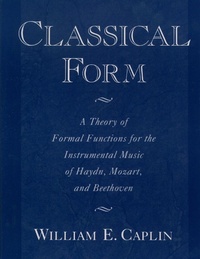
Classical Form
A Theory of Formal Functions for the Instrumental Music of Haydn, Mozart, and Beethoven
1st Edition
Published on 14. May 1998
320 pages
978-0-19-535575-8 (ISBN)
Description

Building on ideas first advanced by Arnold Schoenberg and later developed by Erwin Ratz, this book introduces a new theory of form for instrumental music in the classical style. The theory provides a broad set of principles and a comprehensive methodology for the analysis of classical form, from individual ideas, phrases, and themes to the large-scale organization of complete movements. It emphasizes the notion of formal function, that is, the specific role a given formal unit plays in the structural organization of a classical work.
More details
Other editions
Additional editions
Caplin
Classical Form
A Theory of Formal Functions for the Instrumental Music of Haydn, Mozart, and Beethoven
Book
01/2001
Oxford University Press Inc
€88.30
Shipment within 15-20 days
Content
- Intro
- Contents
- Introduction
- Part I: Preliminaries
- 1 Some Basic Formal Functions: An Overview
- Sentence
- Period
- Small Ternary
- Framing Functions
- Interthematic Functions: A Sonata Exposition
- 2 Fundamental Progressions of Harmony
- Harmonic Functions
- Harmonic Progressions
- Part II: Tight-Knit Themes
- 3 Sentence
- Presentation Phrase
- Continuation Phrase
- 4 Period
- Antecedent Phrase
- Consequent Phrase
- Deviations from the Norm
- 5 Hybrid Themes and Compound Themes
- Hybrid Themes
- Compound Themes
- 6 Small Ternary
- Exposition
- Contrasting Middle
- Recapitulation
- Tight-Knit Versus Loose Organization
- 7 Small Binary
- First Part
- Second Part
- Part III: Looser Formal Regions
- 8 Subordinate Theme
- Looser Sentential Functions
- Additional Loosening Techniques
- Multiple Subordinate Themes
- Closing Section
- Dynamic Curve of Subordinate Theme
- 9 Transition
- Modulating Versus Nonmodulating Transitions
- Beginning the Transition
- Ending the Transition
- Two-Part Transition
- 10 Development
- Tonal Organization
- Pre-Core/Core Technique
- Development Sections Without a Core
- Retransition
- 11 Recapitulation
- Main Theme
- Transition
- Fusion of Main Theme and Transition
- Subordinate Theme (Group)
- Additional Features
- Deviations from the Norm
- 12 Coda
- Start of the Coda
- Phrase-Structural Organization
- Compensatory Functions
- Part IV: Full-Movement Forms
- 13 Sonata Form
- Overall Tonal Organization
- Cadential Goals in the Exposition
- Main Theme
- Obscured Boundary Between Transition and Subordinate Theme
- Slow Introduction
- 14 Slow-Movement Forms
- Sonata Form in Slow Movements
- Large Ternary
- Sonata Without Development
- Theme and Variations
- 15 Minuet/Trio Form
- Minuet Form
- Trio
- 16 Rondo Forms
- Five-Part Rondo
- Sonata-Rondo
- 17 Concerto Form
- Opening Ritornello
- Solo Exposition
- Subordinate-Key Ritornello
- Solo Development
- Solo Recapitulation
- Closing Ritornello
- Glossary of Terms
- A
- B
- C
- D
- E
- F
- G
- H
- I
- L
- M
- N
- O
- P
- R
- S
- T
- U
- Notes
- Bibliography
- Index of Classical Compositions
- Beethoven, Ludwig van
- Haydn, Joseph
- Mozart, Wolfgang Amadeus
- General Index
- A
- B
- C
- D
- E
- F
- G
- H
- I
- J
- K
- L
- M
- N
- O
- P
- Q
- R
- S
- T
- U
- V
- W
