

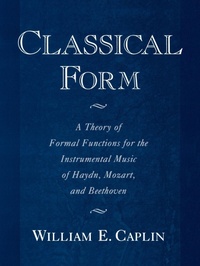
Classical Form
A Theory of Formal Functions for the Instrumental Music of Haydn, Mozart, and Beethoven
Published on 11. January 2001
Book
Paperback/Softback
320 pages
978-0-19-514399-7 (ISBN)
Description
This book introduces a new theory of form for the analysis of instrumental music of the classical style. Focusing on formal function - the role a formal unit plays in the structural organization of a work - the theory provides a broad set of principles and a comprehensive methodology for the analysis of classical form - from the individual ideas making up various phrases of themes to the large-scale organization of complete movements. The book includes a detailed discussion of standard theme types, more extensive formal regions, and full-movement forms. The theoretical concepts are illustrated by over 250 annotated musical examples by Haydn, Mozart and Beethoven.
Reviews / Votes
"This ambitious book offers nothing less than a new theory of form for the music of the Classical period....In its combination of scholarship, musicality and sheer common sense, Caplan's Classical Form is a major achievement by any standards....it should be read by anybody who teaches, studies or writes about this music."--Music and Letters "His book is an important and impressive statement that no theorist or musicologist can afford to ignore."--Music Theory Spectrum "...a compilation of intriguing examples illustrating classical design and function, an up-to-date bibliographical guide, and a source of fresh insight into the accomplishments of the classical masters. Caplin's approach, buttressed by methodological rigor and theoretical detail, makes a persuasive case for the revival of Formenlehre as a pedagogical tool and analytical discipline."--Music Theory Online "Caplin draws his Beethoven examples from all genres...the fortepiano sonatas are particularly well-represented."--The Beethoven JournalMore details
Language
English
Place of publication
New York
United States
Target group
Professional and scholarly
Illustrations
numerous music examples, tables
Dimensions
Height: 280 mm
Width: 210 mm
Thickness: 18 mm
Weight
786 gr
ISBN-13
978-0-19-514399-7 (9780195143997)
Copyright in bibliographic data and cover images is held by Nielsen Book Services Limited or by the publishers or by their respective licensors: all rights reserved.
Schweitzer Classification
Other editions
Additional editions
William E. Caplin
Classical Form
A Theory of Formal Functions for the Instrumental Music of Haydn, Mozart, and Beethoven
E-Book
12/2000
1st Edition
OUP eBook
€63.49
Available for download
William E. Caplin
Classical Form
A Theory of Formal Functions for the Instrumental Music of Haydn, Mozart, and Beethoven
E-Book
05/1998
1st Edition
OUP USA
€62.99
Available for download
Content
Introduction
Part I. Preliminaries
1: Some Basic Formal Functions: An Overview
2: Fundamental Progressions of Harmony
Part II. Tight-Knit Themes
3: Sentence
4: Period
5: Hybrid Themes and Compound Themes
6: Small Ternary
7: Small Binary
Part III. Looser Formal Regions
8: Subordinate Theme
9: Transistion
10: Development
11: Recapitulation
12: Coda
Part IV. Full-Movement Forms
13: Sonata Form
14: Slow-Movement Forms
15: Minuet/Trio Form
16: Rondo Forms
17: Concerto Form
Glossary of Terms
Notes
Bibliography
Index of Classical Compositions
General Index
Part I. Preliminaries
1: Some Basic Formal Functions: An Overview
2: Fundamental Progressions of Harmony
Part II. Tight-Knit Themes
3: Sentence
4: Period
5: Hybrid Themes and Compound Themes
6: Small Ternary
7: Small Binary
Part III. Looser Formal Regions
8: Subordinate Theme
9: Transistion
10: Development
11: Recapitulation
12: Coda
Part IV. Full-Movement Forms
13: Sonata Form
14: Slow-Movement Forms
15: Minuet/Trio Form
16: Rondo Forms
17: Concerto Form
Glossary of Terms
Notes
Bibliography
Index of Classical Compositions
General Index