

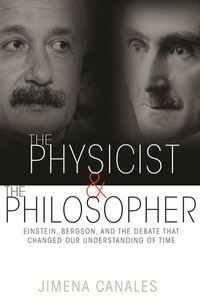
The Physicist and the Philosopher
Einstein, Bergson, and the Debate That Changed Our Understanding of Time
1st Edition
Published on 28. July 2015
488 pages
978-1-4008-6577-2 (ISBN)
Description

The explosive debate that transformed our views about time and scientific truth
On April 6, 1922, in Paris, Albert Einstein and Henri Bergson publicly debated the nature of time. Einstein considered Bergson's theory of time to be a soft, psychological notion, irreconcilable with the quantitative realities of physics. Bergson, who gained fame as a philosopher by arguing that time should not be understood exclusively through the lens of science, criticized Einstein's theory of time for being a metaphysics grafted on to science, one that ignored the intuitive aspects of time. The Physicist and the Philosopher tells the remarkable story of how this explosive debate transformed our understanding of time and drove a rift between science and the humanities that persists today.
Jimena Canales introduces readers to the revolutionary ideas of Einstein and Bergson, describes how they dramatically collided in Paris, and traces how this clash of worldviews reverberated across the twentieth century. She shows how it provoked responses from figures such as Bertrand Russell and Martin Heidegger, and carried repercussions for American pragmatism, logical positivism, phenomenology, and quantum mechanics. Canales explains how the new technologies of the period-such as wristwatches, radio, and film-helped to shape people's conceptions of time and further polarized the public debate. She also discusses how Bergson and Einstein, toward the end of their lives, each reflected on his rival's legacy-Bergson during the Nazi occupation of Paris and Einstein in the context of the first hydrogen bomb explosion.
The Physicist and the Philosopher is a magisterial and revealing account that shows how scientific truth was placed on trial in a divided century marked by a new sense of time.
On April 6, 1922, in Paris, Albert Einstein and Henri Bergson publicly debated the nature of time. Einstein considered Bergson's theory of time to be a soft, psychological notion, irreconcilable with the quantitative realities of physics. Bergson, who gained fame as a philosopher by arguing that time should not be understood exclusively through the lens of science, criticized Einstein's theory of time for being a metaphysics grafted on to science, one that ignored the intuitive aspects of time. The Physicist and the Philosopher tells the remarkable story of how this explosive debate transformed our understanding of time and drove a rift between science and the humanities that persists today.
Jimena Canales introduces readers to the revolutionary ideas of Einstein and Bergson, describes how they dramatically collided in Paris, and traces how this clash of worldviews reverberated across the twentieth century. She shows how it provoked responses from figures such as Bertrand Russell and Martin Heidegger, and carried repercussions for American pragmatism, logical positivism, phenomenology, and quantum mechanics. Canales explains how the new technologies of the period-such as wristwatches, radio, and film-helped to shape people's conceptions of time and further polarized the public debate. She also discusses how Bergson and Einstein, toward the end of their lives, each reflected on his rival's legacy-Bergson during the Nazi occupation of Paris and Einstein in the context of the first hydrogen bomb explosion.
The Physicist and the Philosopher is a magisterial and revealing account that shows how scientific truth was placed on trial in a divided century marked by a new sense of time.
More details
Other editions
Additional editions
Jimena Canales
The Physicist and the Philosopher
Einstein, Bergson, and the Debate That Changed Our Understanding of Time
Book
10/2016
Princeton University Press
€31.50
Shipment within 10-20 days
Jimena Canales
The Physicist and the Philosopher
Einstein, Bergson, and the Debate That Changed Our Understanding of Time
Book
05/2015
Princeton University Press
€39.62
Article exhausted; check different version
Person
Jimena Canales holds the Thomas M. Siebel Chair in the History of Science at the University of Illinois, Urbana-Champaign.
Content
Preface vii
PART 1. THE DEBATE
CHAPTER 1 Untimely 3
CHAPTER 2 "More Einsteinian than Einstein" 16
CHAPTER 3 Science or Philosophy? 38
PART 2. THE MEN
CHAPTER 4 The Twin Paradox 53
CHAPTER 5 Bergson's Achilles' Heel 62
CHAPTER 6 Worth Mentioning? 73
CHAPTER 7 Bergson Writes to Lorentz 87
CHAPTER 8 Bergson Meets Michelson 98
CHAPTER 9 The Debate Spreads 114
CHAPTER 10 Back from Paris 131
CHAPTER 11 Two Months Later 139
CHAPTER 12 Logical Positivism 153
CHAPTER 13 The Immediate Aftermath 162
CHAPTER 14 An Imaginary Dialogue 172
CHAPTER 15 "Full-Blooded" Time 179
CHAPTER 16 The Previous Spring 195
CHAPTER 17 The Church 203
CHAPTER 18 The End of Universal Time 218
CHAPTER 19 Quantum Mechanics 230
PART 3. THE THINGS
CHAPTER 20 Things 241
CHAPTER 21 Clocks and Wristwatches 252
CHAPTER 22 Telegraph, Telephone, and Radio 265
CHAPTER 23 Atoms and Molecules 274
CHAPTER 24 Einstein's Films: Reversible 283
CHAPTER 25 Bergson's Movies: Out of Control 292
CHAPTER 26 Microbes and Ghosts 303
CHAPTER 27 One New Point: Recording Devices 315
PART 4. THE WORDS
CHAPTER 28 Bergson's Last Comments 327
CHAPTER 29 Einstein's Last Thoughts 337
Postface 349
Acknowledgments 359
Notes 363
Bibliography 423
Index 451
PART 1. THE DEBATE
CHAPTER 1 Untimely 3
CHAPTER 2 "More Einsteinian than Einstein" 16
CHAPTER 3 Science or Philosophy? 38
PART 2. THE MEN
CHAPTER 4 The Twin Paradox 53
CHAPTER 5 Bergson's Achilles' Heel 62
CHAPTER 6 Worth Mentioning? 73
CHAPTER 7 Bergson Writes to Lorentz 87
CHAPTER 8 Bergson Meets Michelson 98
CHAPTER 9 The Debate Spreads 114
CHAPTER 10 Back from Paris 131
CHAPTER 11 Two Months Later 139
CHAPTER 12 Logical Positivism 153
CHAPTER 13 The Immediate Aftermath 162
CHAPTER 14 An Imaginary Dialogue 172
CHAPTER 15 "Full-Blooded" Time 179
CHAPTER 16 The Previous Spring 195
CHAPTER 17 The Church 203
CHAPTER 18 The End of Universal Time 218
CHAPTER 19 Quantum Mechanics 230
PART 3. THE THINGS
CHAPTER 20 Things 241
CHAPTER 21 Clocks and Wristwatches 252
CHAPTER 22 Telegraph, Telephone, and Radio 265
CHAPTER 23 Atoms and Molecules 274
CHAPTER 24 Einstein's Films: Reversible 283
CHAPTER 25 Bergson's Movies: Out of Control 292
CHAPTER 26 Microbes and Ghosts 303
CHAPTER 27 One New Point: Recording Devices 315
PART 4. THE WORDS
CHAPTER 28 Bergson's Last Comments 327
CHAPTER 29 Einstein's Last Thoughts 337
Postface 349
Acknowledgments 359
Notes 363
Bibliography 423
Index 451
