

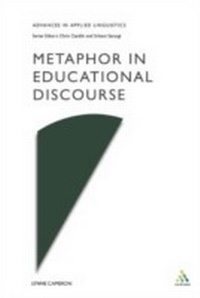
Metaphor in Educational Discourse
1st Edition
Published on 13. March 2003
306 pages
978-1-4411-7564-9 (ISBN)
Description

'Metaphor in Educational Discourse is a superb piece of applied linguistics research that integrates Vygotsky's theory of concepts with current work on metaphor into a coherent framework for investigating how teachers and learners negotiate figurative language in order to promote development in the classroom setting. In what is likely to become the standard for future studies in this area, Lynne Cameron meticulously demonstrates the central role of linguistic metaphors in classroom learning - designed to lead learners to a deeper understanding of complex mathematical and scientific concepts.'
James P. Lantolf, Professor of Applied Linguistics, The Pennsylvania State University.
This book reports research into metaphor in use with school students. The setting for the research is a UK school and the participants are around ten years old, with their first language well established but still developing concepts and understandings. Close examination of a corpus of classroom spoken discourse reveals how metaphor is employed by their teachers, not just in explaining ideas, but, in managing and mediating the activity of the classroom and the learning of the students. Particular issues discussed include: the problems of identifying metaphors in spoken discourse, the conventionalism of metaphors in the discourse of socio-cultural groups, and how a socio-cultural approach can account for systematicity in metaphor use.
James P. Lantolf, Professor of Applied Linguistics, The Pennsylvania State University.
This book reports research into metaphor in use with school students. The setting for the research is a UK school and the participants are around ten years old, with their first language well established but still developing concepts and understandings. Close examination of a corpus of classroom spoken discourse reveals how metaphor is employed by their teachers, not just in explaining ideas, but, in managing and mediating the activity of the classroom and the learning of the students. Particular issues discussed include: the problems of identifying metaphors in spoken discourse, the conventionalism of metaphors in the discourse of socio-cultural groups, and how a socio-cultural approach can account for systematicity in metaphor use.
Reviews / Votes
'Metaphor in Educational Discourse is a superb piece of applied linguistics research that integrates Vygotsky's theory of concepts with current work on metaphor into a coherent framework for investigating how teachers and learners negotiate figurative language in order to promote development in the classroom setting. In what is likely to become the standard for future studies in this area, Lynne Cameron meticulously demonstrates the central role of linguistic metaphors in classroom learning - designed to lead learners to a deeper understanding of complex mathematical and scientific concepts.' 'Lynne Cameron has started to fill a gap in research on educational discourse with this timely book. Metaphor in Educational Discourse provides an interesting attempt at linking applied linguistics with complex systems theory and sociocultural theory...cleverly constructed to guide the reader through a presentation of sociocultural theory that argues for an understanding of discourse being able to change the way we think...thought provoking and very detailed.' * Discourse and Society *More details
Series
Edition
1. Auflage
Language
English
Place of publication
New York
United States
ISBN-13
978-1-4411-7564-9 (9781441175649)
Copyright in bibliographic data and cover images is held by Nielsen Book Services Limited or by the publishers or by their respective licensors: all rights reserved.
Schweitzer Classification
Other editions
Additional editions
Lynne Cameron
Metaphor in Educational Discourse
Book
03/2003
Continuum International Publishing Group Ltd.
€104.30
Shipment within 15-20 days

Lynne Cameron
Metaphor in Educational Discourse
Book
03/2003
Continuum International Publishing Group Ltd.
€126.28
Article exhausted; check different version
Person
University of Leeds
Content
- Intro
- Contents
- Foreword
- Acknowledgements
- 1 An applied linguistic approach to metaphor in discourse
- 2 Talking, thinking and learning: theoretical background
- 3 Researching metaphor in classroom discourse
- 4 The linguistic form of metaphor in classroom discourse
- 5 Deliberate and conventionalized metaphor in classroom discourse
- 6 Metaphor in classroom activity
- 7 Researching metaphor interpretation
- 8 Metaphors in text 1: 'The Ozone Layer'
- 9 Metaphors in text 2: 'The Heart'
- 10 Systematicity, metaphor and metonymy
- 11 Metaphor in educational discourse: review and discussion
- Appendix 1 Linguistic metaphors and grammatical analysis in the geology lesson
- Appendix 2 Linguistic metaphors and teaching sequences in the geology lesson
- References
- Index
- A
- B
- C
- D
- E
- F
- G
- H
- I
- J
- K
- L
- M
- N
- O
- P
- R
- S
- T
- U
- V
- W
